ERP for Manufacturing Companies in Saudi Arabia: What Factories Actually Need
17 min read
On this page
- What is manufacturing ERP, and how is it different from a regular ERP?
- Discrete vs process vs make-to-order manufacturing
- Signs your factory has outgrown spreadsheets and basic accounting
- Core manufacturing ERP modules Saudi factories need
- Bill of materials (multi-level BOM)
- Production planning and MRP
- Work orders and shop floor control
- Inventory, warehouses and batch tracking
- Quality control and CAPA
- Plant maintenance
- HR, shifts and Saudization reporting
- ERP BOM costing: a worked example
- How ERP supports local content and the Future Factories Program
- Why local content data matters for Saudi manufacturers
- What your ERP should track for local content
- Future Factories and SIRI readiness
- Manufacturing ERP by factory type in KSA
- ERP for factories in Jubail and Dammam
- Manufacturing ERP for SMEs in Saudi Arabia: start small
- How to choose a manufacturing ERP: 10-point checklist
- Cost and timeline at a glance
- Frequently asked questions
- What is the best ERP for manufacturing companies in Saudi Arabia?
- Does a small factory in Saudi Arabia need a manufacturing ERP?
- What is the difference between MRP and ERP?
- How does ERP calculate product cost from a bill of materials?
- Can an ERP help with the local content certificate?
- How long does manufacturing ERP implementation take for a Saudi factory?
- Does manufacturing ERP support Arabic and English on the shop floor?
- Get a manufacturing ERP that fits your plant
The extrusion line in your Jubail plant stops at 2 p.m. because the resin you needed is still sitting at the port. Finance finds out what last month's big order actually cost three weeks after it shipped. Sound familiar? That is the gap a manufacturing ERP in Saudi Arabia is built to close.
This guide is for factory owners, plant managers and CFOs in the Kingdom. The sector is growing fast: Saudi Arabia went from roughly 8,000 factories to nearly 12,000, and the industrial workforce from about 500,000 to around 800,000, according to Ministry of Industry figures reported by Argaam. More factories means more competition for the same contracts, and tighter margins for anyone still costing products on a spreadsheet.
Below you will find the modules a Saudi factory actually needs, a worked BOM costing example in SAR, how ERP data supports your local content certificate, and a checklist for choosing a system.
What is manufacturing ERP, and how is it different from a regular ERP?
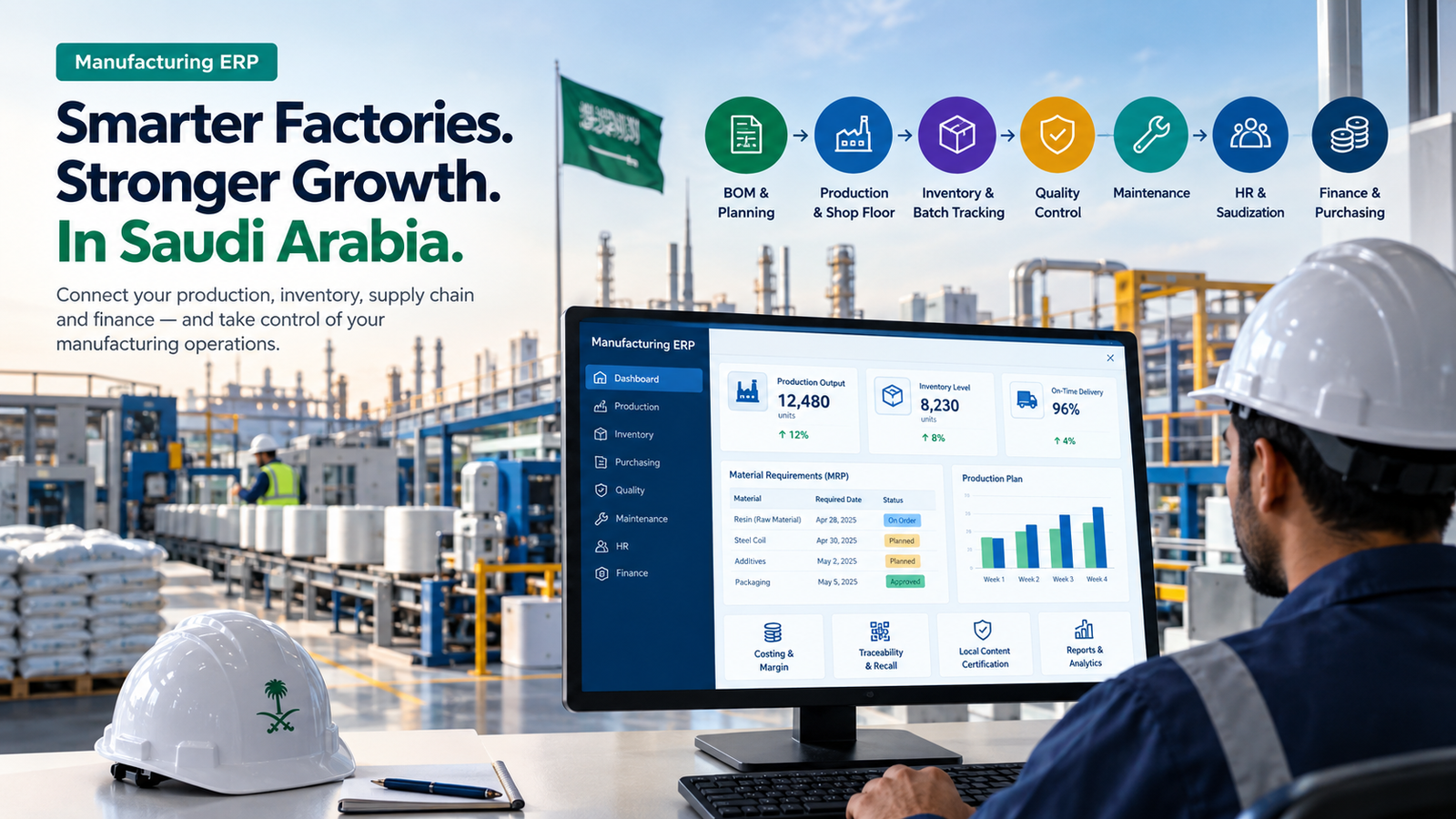
Manufacturing ERP is business software that connects production planning, bills of materials, work orders, inventory, purchasing, quality and finance in one database. A regular ERP handles buying, selling and accounting. A manufacturing ERP adds what happens between raw material and finished goods: what to make, when, with which materials, and what it really cost.
That middle layer is the difference. A trading company buys a product and sells the same product. A factory turns 40 raw materials into one finished item through several operations, with scrap, machine time and labour along the way. If your software cannot see that transformation, it cannot tell you your margin.
Discrete vs process vs make-to-order manufacturing
The type of factory you run decides which ERP features matter most.
|
Manufacturing type |
How it works |
Saudi example |
ERP features that matter most |
|---|---|---|---|
|
Discrete |
Countable units assembled from parts |
Steel cabinets, electrical panels, furniture |
Multi-level BOM, routings, serial numbers |
|
Process |
Materials blended or reacted in batches |
Plastics compounding, paints, dairy, detergents |
Recipes/formulas, batch and lot tracking, yield, expiry |
|
Make-to-order |
Built to each customer's spec |
Custom HVAC units, steel structures, signage |
Quotation-to-BOM, job costing, project-style work orders |
Many Saudi plants are mixed-mode. A building materials factory may run continuous production for standard blocks and make-to-order for custom precast. Ask any vendor to demo both.
Signs your factory has outgrown spreadsheets and basic accounting
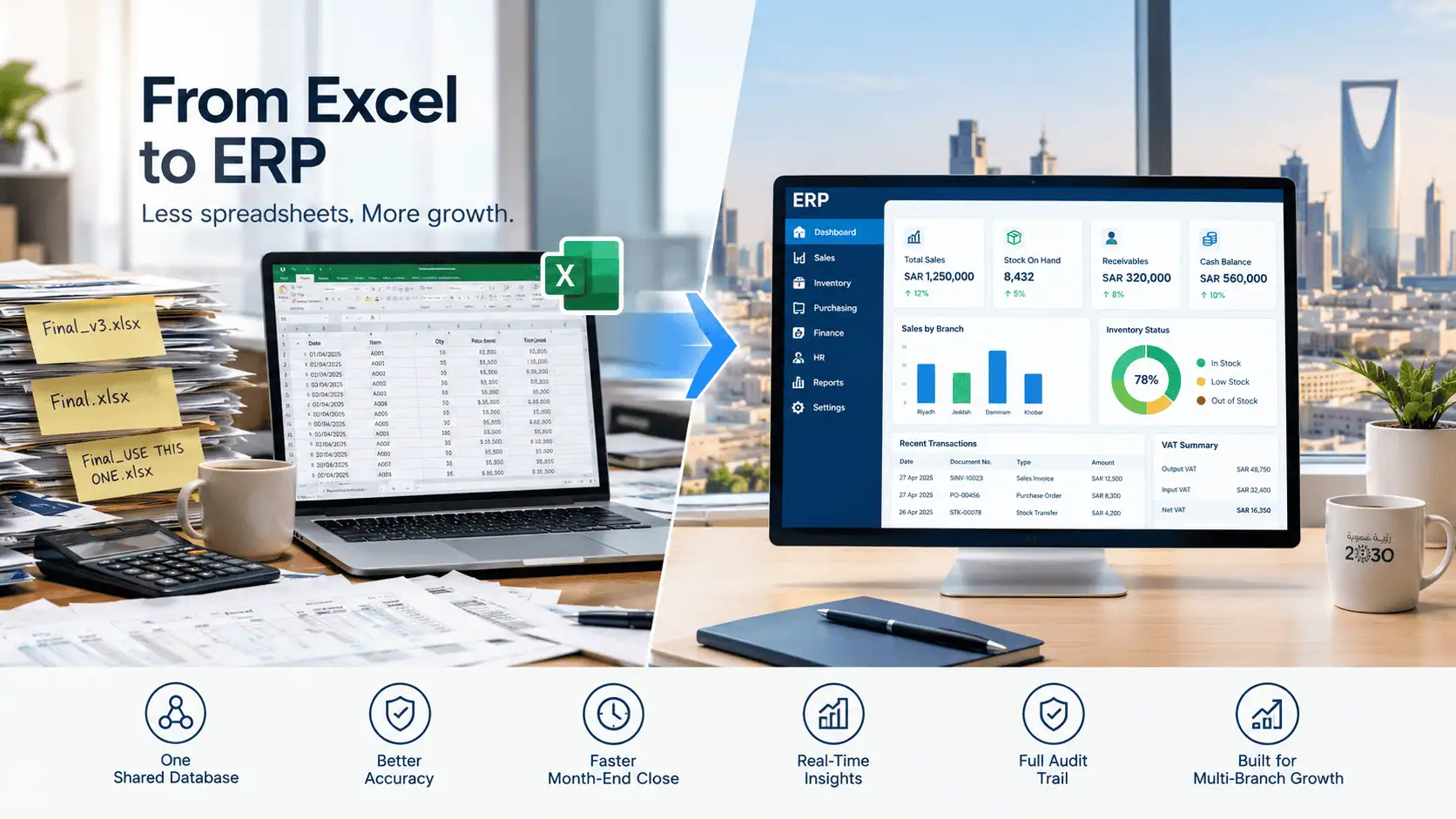
Your factory has outgrown spreadsheets when production decisions depend on one person's memory, product costs are calculated after the sale, and nobody can trace a defective batch back to its raw material in under an hour. At that point, every new order adds risk instead of profit.
Watch for these signs:
- The line stops because a raw material ran out, and purchasing did not know.
- Product cost is a "standard" number set two years ago that nobody trusts.
- A customer complaint takes days to trace to a batch, supplier and shift.
- Purchase requests arrive on WhatsApp and get lost.
- Overtime is paid, but nobody can say which job it was for.
- Finished goods stock in the system never matches the warehouse.
- Month-end closing takes more than a week because production data is rekeyed.
If three or more of these hit home, accounting software is no longer enough. Our guide on ERP vs accounting software walks through where the line sits for Saudi SMEs.
Core manufacturing ERP modules Saudi factories need
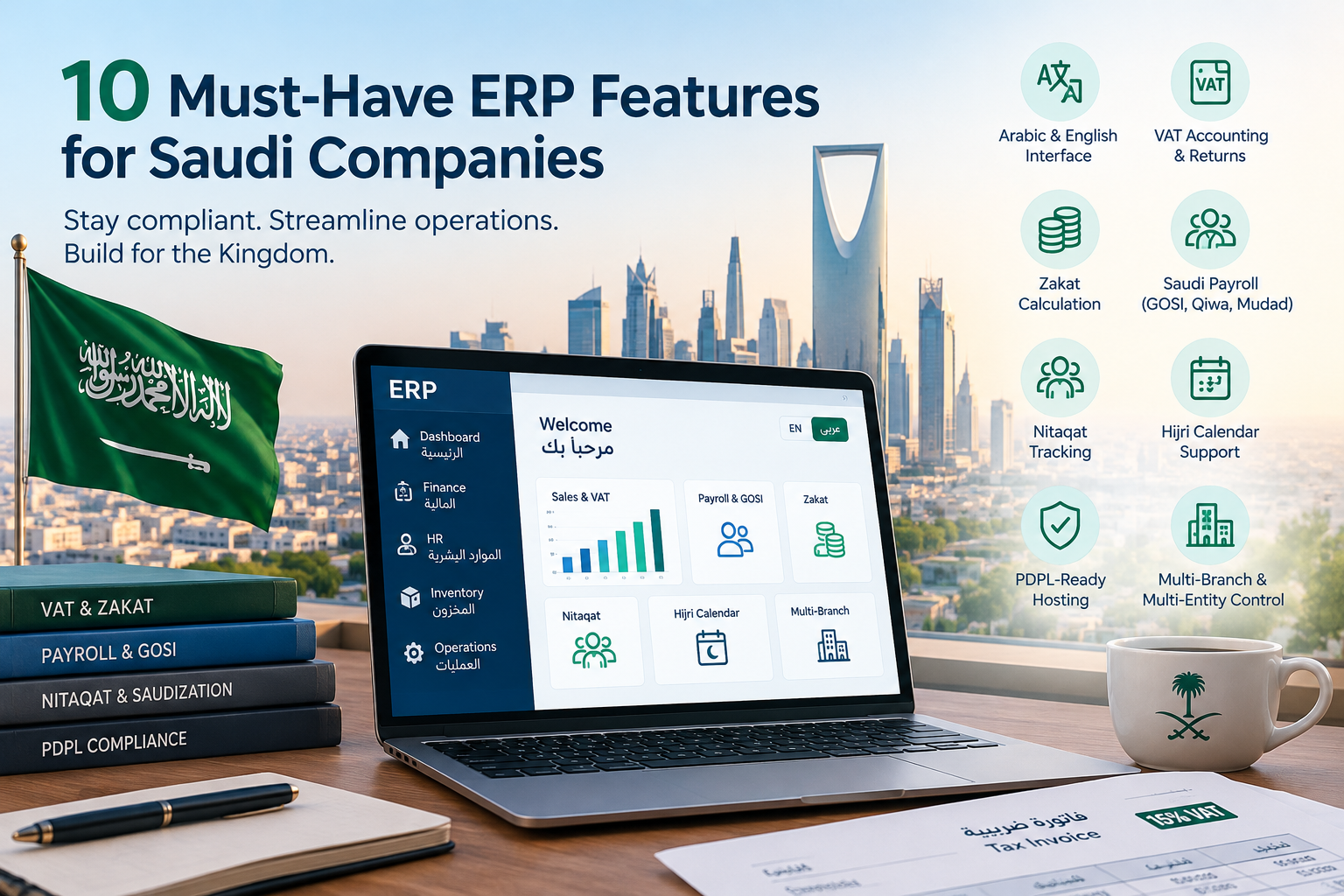
A Saudi factory needs seven modules at minimum: bill of materials, production planning with MRP, work orders and shop floor control, inventory with batch tracking, quality control, plant maintenance, and HR with shift and Saudization reporting. Finance and purchasing sit underneath all of them. The general list of must-have ERP features for Saudi companies covers the rest.
Bill of materials (multi-level BOM)
The BOM is the recipe for every product: which materials, how much, and in which sub-assemblies. A multi-level BOM lets a cabinet contain a door assembly that contains hinges and panels. Every cost and every material plan in the ERP starts here, so a sloppy BOM breaks everything downstream.
Production planning and MRP
Material requirements planning (MRP) reads your sales orders and forecast, explodes the BOMs, subtracts stock on hand and on order, and tells purchasing exactly what to buy and when. Good MRP software in KSA should handle long import lead times, because a sea shipment of imported resin or steel coil that slips by a few weeks changes your whole plan.
Work orders and shop floor control
A work order tells the floor what to make, on which machine, by when. Operators record start, stop, output and scrap on a tablet or terminal. That data feeds actual cost and machine utilisation without anyone retyping it.
Inventory, warehouses and batch tracking
Raw materials, work in progress and finished goods each need their own locations. Batch or lot tracking links every finished unit to its raw material lots, which is what lets you recall one batch instead of a whole month's production.
Quality control and CAPA
Quality inspections at receiving, in-process and final stages, with non-conformance reports and corrective and preventive actions (CAPA). For products that need SASO conformity or SFDA registration, keeping test results tied to batches makes audits far less painful.
Plant maintenance
Preventive maintenance schedules, breakdown logs and spare parts stock. When maintenance sits in the same system as production, planners can see that Line 2 is down for service next Tuesday before they schedule a rush order on it.
HR, shifts and Saudization reporting
Shift rosters, attendance and payroll, with headcount split by Saudi and non-Saudi staff per department. This matters for Nitaqat, and as you will see below, for local content too.
Intellitech configures these modules around how your plant already runs. See how our manufacturing ERP implementation works for factories in the Kingdom.
ERP BOM costing: a worked example
ERP BOM costing shows the real cost of each product by adding landed material cost, labour hours, machine hours, scrap and overhead per unit, then comparing that "actual" cost with the planned "standard" cost. Accounting software only sees the total spend for the month. BOM costing shows which product and which order lost money.
Here is an illustrative example from a metal fabrication shop in Dammam making steel storage cabinets. The steel sheet is imported, so its landed cost per kg is supplier price plus freight and clearing plus customs duty (at an assumed rate). The numbers are for illustration only.
|
Cost element (per cabinet) |
Standard (planned) |
Actual (from shop floor) |
|---|---|---|
|
Steel sheet, landed at SAR 4.24/kg |
18 kg = SAR 76.32 |
19.5 kg = SAR 82.68 |
|
Hinges, lock, fittings (local supplier) |
SAR 22.00 |
SAR 22.00 |
|
Powder coating |
SAR 9.50 |
SAR 9.50 |
|
Direct labour at SAR 28/hour |
1.5 h = SAR 42.00 |
1.8 h = SAR 50.40 |
|
Machine time (laser + press brake) at SAR 60/hour |
0.4 h = SAR 24.00 |
0.5 h = SAR 30.00 |
|
Overhead absorbed (50% of labour) |
SAR 21.00 |
SAR 25.20 |
|
Total cost per cabinet |
SAR 194.82 |
SAR 219.78 |
The variance is SAR 24.96 per cabinet, about 12.8%. On a selling price of SAR 260, the planned margin was 25.1%. The real margin was 15.5%. On a 100-unit order, that is SAR 2,496 that disappeared without anyone noticing.
The ERP also tells you why. Extra steel points to scrap on the laser nesting. Extra labour and machine time point to a setup problem or an untrained operator on that shift. Without work order data, you would only see a lower bank balance at month-end.
Three things make BOM costing accurate in a Saudi factory:
- Landed cost on every import. Freight, clearing and customs duty must be added to the raw material cost when goods are received, not booked as a general expense.
- Shop floor data at the source. Operators record actual time and scrap on the work order. Rekeyed data from paper sheets is always late and usually wrong.
- An overhead rate you review. Electricity, rent in an industrial city and supervision costs change. Review the absorption rate at least once a year.
How ERP supports local content and the Future Factories Program
A manufacturing ERP supports local content by recording, at the transaction level, which materials and suppliers are Saudi, how much payroll goes to Saudi staff, and what you spend on assets in the Kingdom. Those are the same figures the Local Content and Government Procurement Authority (LCGPA) uses to score your factory. Most Saudi ERP guides skip this entirely.
Why local content data matters for Saudi manufacturers
If you sell to government entities, Aramco-type buyers or state-owned companies, your local content score affects whether you win. The LCGPA defines local content as total spending in the Kingdom on Saudi components across labour, goods, services and assets. The workforce part is calculated from the salaries of Saudi staff plus a portion of non-Saudi salaries.
The stakes went up recently. The LCGPA introduced minimum local content thresholds for factories that want to benefit from the mandatory list of national products, and manufacturers that fall short risk losing bid preference in 2026 to 2027. The Local Content Certificate also has a fixed validity of 19 months, so you rebuild this evidence on a cycle, not once.
What your ERP should track for local content
|
Local content component |
What to set up in the ERP |
Where the data comes from |
|---|---|---|
|
Goods and services |
"Local / imported" flag on every item and supplier, origin on each BOM component |
Purchasing and BOM |
|
Workforce |
Saudi vs non-Saudi split on every employee, payroll by department |
HR and payroll |
|
Assets |
Fixed asset register with supplier origin and location |
Finance (fixed assets) |
|
Technology and R&D |
Cost centres for training, R&D and technology spend |
Finance (cost centres) |
With this set up, your finance team can pull a local content view of the year in hours instead of weeks of invoice hunting. It also shows where to improve. If 60% of your BOM value is imported resin, you know which supplier change moves your score most.
The exact calculation method and the documents the LCGPA accepts can change. Always confirm the current rules with the LCGPA or your auditor before you submit. The ERP's job is to have clean, traceable numbers ready.
Future Factories and SIRI readiness
The Ministry of Industry and Mineral Resources runs the Future Factories Program, which aims to help more than 4,000 factories adopt modern technologies. Factories are assessed against the Smart Industry Readiness Index (SIRI). From 2026, a new pull policy will link factory performance to ministry incentives.
ERP is not Industry 4.0 on its own. Sensors, automation and analytics sit on top. But they all need a single source of truth for orders, BOMs, stock and cost. A factory that still runs production on spreadsheets has nothing for smart equipment to connect to. Getting ERP right is usually step one of a SIRI improvement plan.
Manufacturing ERP by factory type in KSA
The right manufacturing ERP depends on what your plant makes. Process plants need recipes, batches and yield. Discrete and job shops need routings and job costing. Here is what to prioritise for the factory types most common in Saudi Arabia.
Plastics, chemicals and petrochemical downstream (Jubail). Many converters buy polymer feedstock and turn it into pipes, film, packaging or compounds. Prioritise formula-based BOMs, batch tracking, yield and scrap reporting, and lot-level quality results for each customer delivery.
Food and dairy. Batch and expiry control, first-expiry-first-out picking, and one-click recall traceability are non-negotiable. Keep quality test results tied to each batch for SFDA inspections.
Building materials (blocks, precast, glass, cement products). High volumes and tight margins. Focus on production planning, raw material consumption per batch, fleet and dispatch, and delivery notes tied to projects.
Metal fabrication and job shops (Dammam and Al Khobar). Make-to-order work dominates. You need quote-to-BOM, job costing like the example above, subcontracting for galvanising or coating, and progress tracking per job.
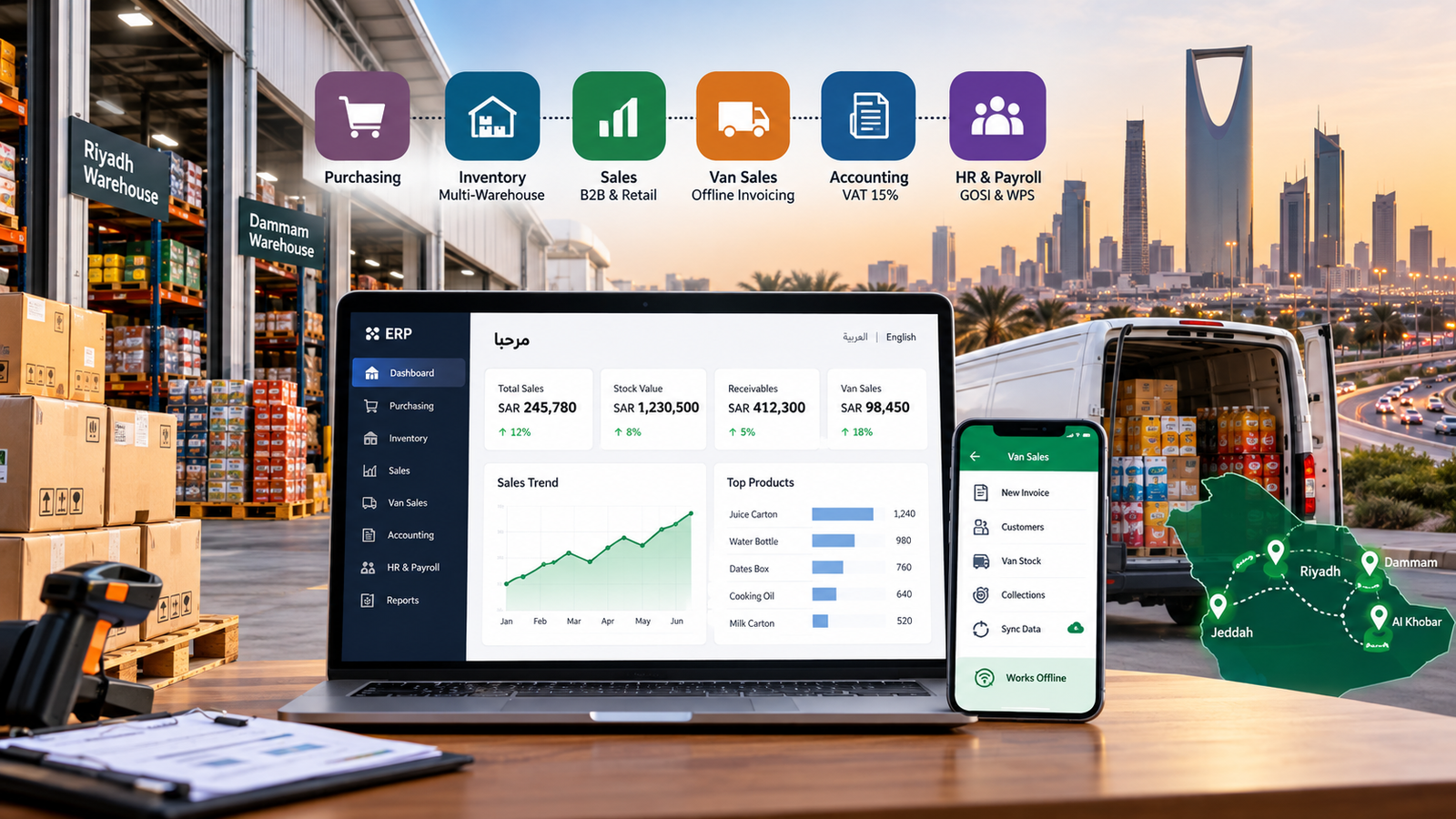
Many factories also run their own distribution network. If your plant sells through warehouses across the Kingdom, the setup overlaps with ERP for trading and distribution companies, especially multi-warehouse stock and route planning.
ERP for factories in Jubail and Dammam
Factories in Jubail and Dammam need an ERP that handles multiple sites, long import supply chains through the Eastern Province ports, bilingual users on the shop floor, and fast on-site support during go-live. A cloud system with a local implementation team usually fits better than a remote-only vendor.
A few practical points we see with Eastern Province plants:
- Multi-site setup. The plant is in Jubail Industrial City or Dammam's second industrial city, while sales and management sit in Riyadh or Al Khobar. The ERP must show one stock and one cost picture across all of them.
- Supplier and subcontractor networks. Coating, machining and testing are often subcontracted to nearby plants. Subcontract work orders keep those materials visible while they are outside your gate.
- Arabic and English on the floor. Supervisors may work in Arabic, while engineers and many operators use English. Screens, labels and work order printouts should support both.
- Shift coverage. Plants running two or three shifts need support during go-live week at night too, not just office hours.
Manufacturing ERP for SMEs in Saudi Arabia: start small
A small Saudi factory does not need every module on day one. Start with inventory, purchasing and sales, add BOMs, work orders and costing once stock data is clean, then add MRP, quality and maintenance. A phased rollout keeps the first project short and the budget under control.
|
Phase |
Modules |
Goal |
|---|---|---|
|
1 |
Inventory, purchasing, sales, finance |
One accurate stock and cash picture |
|
2 |
BOM, work orders, product costing |
Know the real cost and margin of each product |
|
3 |
MRP, quality, maintenance, shop floor terminals |
Plan ahead and reduce stoppages |
When should a small plant wait? If you make one or two simple products, have a small team and buy from a handful of local suppliers, a good inventory and accounting system may be enough for now. Revisit ERP when product variety, staff count or government tenders grow. Our breakdown of ERP cost for manufacturing companies helps you size each phase.
How to choose a manufacturing ERP: 10-point checklist
To choose a manufacturing ERP in Saudi Arabia, test it on your own products, your own BOMs and your own shop floor, not on a vendor's demo data. Check BOM depth, MRP, batch tracking, Arabic support, local content tagging and the strength of the local implementation team before you compare prices.
For the full selection process, see our guide on how to choose the right ERP system. For factories specifically, use this checklist:
- Multi-level BOM and routings. Can it model your most complex product, including sub-assemblies and alternative materials?
- MRP with real lead times. Does it plan around long import lead times and minimum order quantities?
- Batch, lot and serial tracking. Can you trace a finished unit back to raw material lots in a few clicks?
- Product costing. Does it calculate standard and actual cost per work order, with landed cost on imports?
- Arabic and English interface. Are screens, reports and printed documents bilingual?
- Local content tagging. Can you flag items, suppliers and employees for local content reporting?
- Shop floor data entry. Can operators log output and scrap on a tablet or terminal, without a desk?
- Machine and weighbridge integration. Can it take data from machines, scales or weighbridges where you need it?
- Data migration support. Who cleans and loads your item masters, BOMs and opening stock?
- Local implementation team and references. Can the partner show Saudi factories they have taken live? Our guide on evaluating an ERP implementation partner lists the questions to ask.
Cost and timeline at a glance
Manufacturing ERP cost in Saudi Arabia depends mainly on the number of users and sites, how complex your MRP and BOMs are, machine integrations, and how much data cleanup is needed. Small factories with a focused scope can go live in a few months. Multi-site plants with full MRP, quality and maintenance take longer.
For a sense of scale, a study of 70 small manufacturers by ERP vendor MRPeasy found median go-live times of 1 month for firms with 10 or fewer employees, 2 months for 11 to 25, 3 months for 26 to 50, and 6 months for 51 or more. Treat these as best-case figures for focused projects. Larger systems, heavy customisation and messy data push timelines out.
The biggest cost drivers for a Saudi factory are:
- Number of users, plants and warehouses
- Modules in scope (MRP, quality, maintenance, shop floor terminals)
- Integrations with machines, scales or existing software
- Data cleanup for item masters and BOMs
- Arabic reports, print formats and training
Our step-by-step ERP implementation process shows how each phase is planned, so you can see where time and budget go before you sign.
Frequently asked questions
What is the best ERP for manufacturing companies in Saudi Arabia?
The best manufacturing ERP in Saudi Arabia is the one that fits your manufacturing type, size and local support needs, not a single brand. Shortlist systems that handle your BOM depth, batch tracking and Arabic users, then test them on your own products. Our comparison of the best ERP software in Saudi Arabia covers the main options.
Does a small factory in Saudi Arabia need a manufacturing ERP?
A small Saudi factory needs manufacturing ERP once it makes several products, loses track of real costs or bids for government work. Below that point, inventory and accounting software can be enough. Start with inventory and purchasing, then add BOMs and costing as you grow.
What is the difference between MRP and ERP?
MRP plans the materials needed for production, while ERP runs the whole business, including finance, sales, HR and production. In a manufacturing ERP, MRP is one module inside the system. It uses BOMs, stock and orders to tell purchasing what to buy and when.
How does ERP calculate product cost from a bill of materials?
ERP calculates product cost by adding the landed cost of every BOM material to labour hours, machine hours, scrap and absorbed overhead for each work order. It compares this actual cost with the planned standard cost, so you can see the variance per product and per order.
Can an ERP help with the local content certificate?
An ERP helps with the local content certificate by tracking local versus imported items, Saudi versus non-Saudi payroll and asset spending in one place. It does not issue the certificate. It gives you clean, traceable numbers to submit, and shows which changes would raise your score.
How long does manufacturing ERP implementation take for a Saudi factory?
Manufacturing ERP implementation for a Saudi factory usually takes from a few months for a small, focused plant to longer for multi-site operations. Scope, data quality, integrations and user training decide the timeline more than the software brand does.
Does manufacturing ERP support Arabic and English on the shop floor?
Most manufacturing ERPs used in Saudi Arabia support Arabic and English, but support levels differ. Check that screens, work order printouts, labels and reports all work in both languages, and that right-to-left Arabic displays correctly on shop floor tablets.
Get a manufacturing ERP that fits your plant
If your factory is still planning production on spreadsheets and costing orders after they ship, it is time to fix the foundation. Intellitech Solutions implements ERP for factories in Saudi Arabia, from BOM setup and costing to MRP, quality and local content reporting.
Book a free factory process review with our team. We will map your current workflow, show you where cost is leaking, and tell you honestly which modules you need now and which can wait.