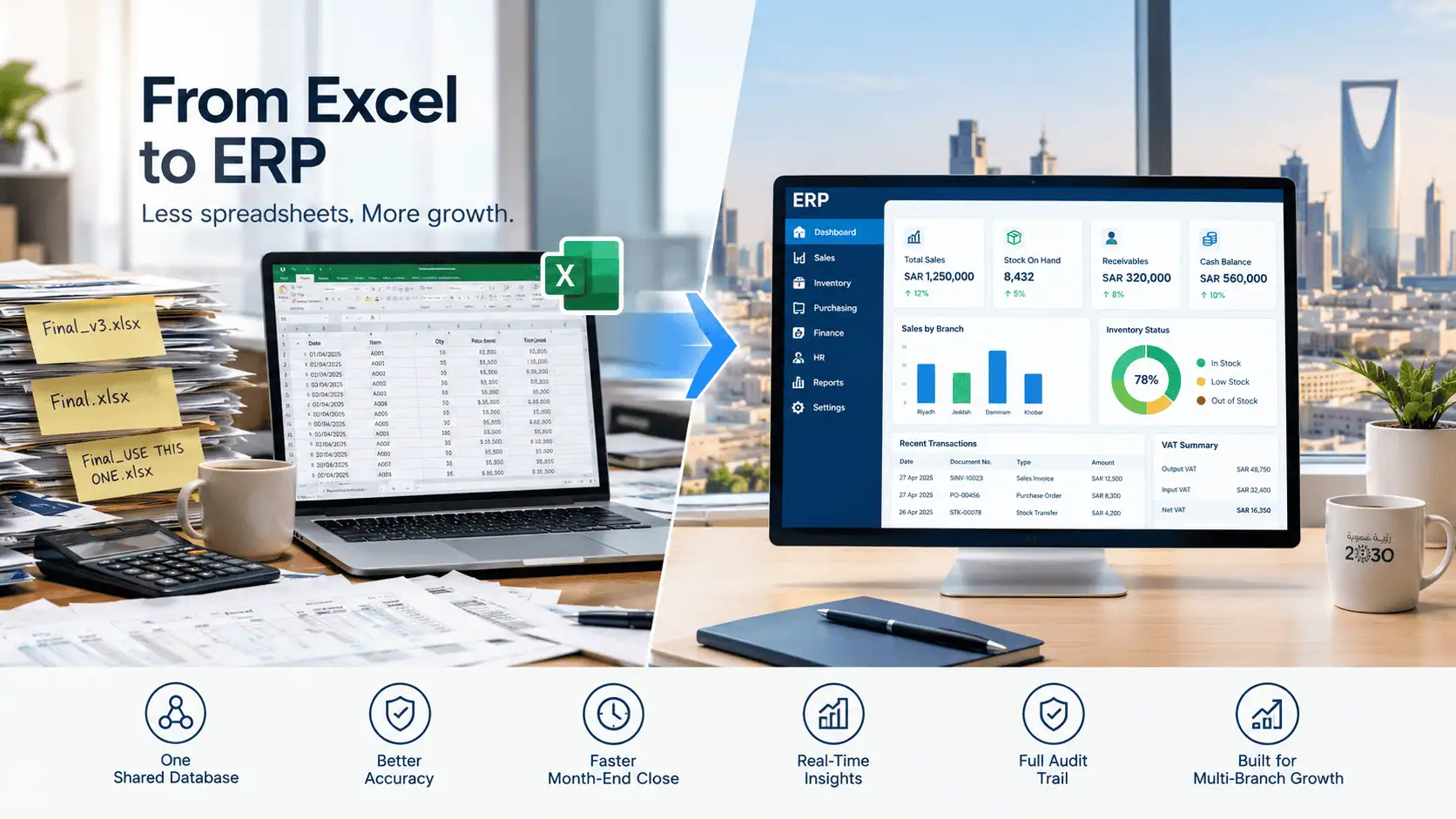
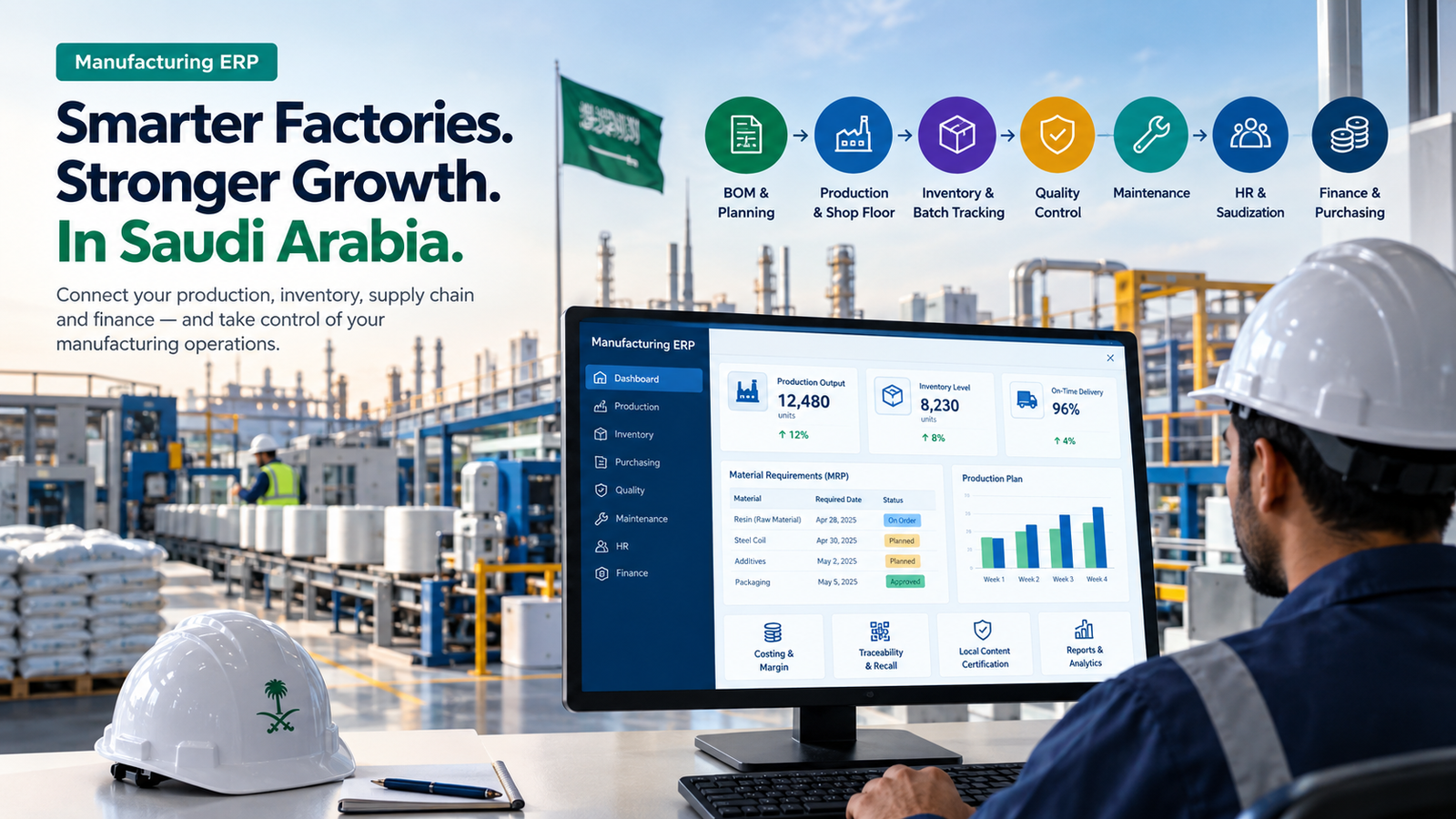
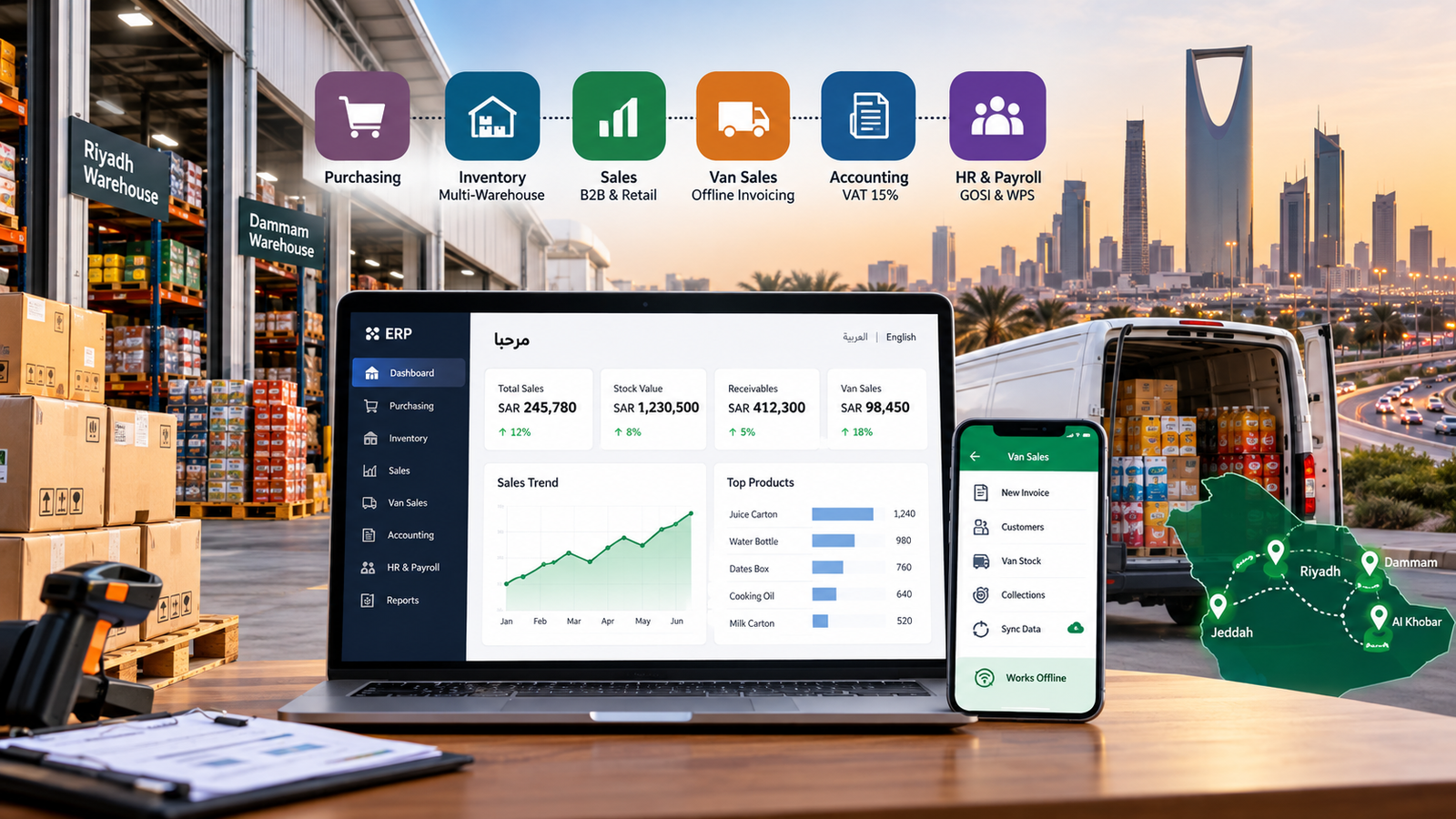
Essential ERP Features for Businesses in Saudi Arabia
9 min read
On this page
- What makes an ERP "Saudi-ready"?
- 10 Must-Have ERP Features for Saudi Companies
- Must-have vs nice-to-have ERP modules by company size
- 8 questions to ask any ERP vendor in Saudi Arabia
- Common mistakes Saudi companies make when choosing an ERP
- Need an ERP that fits Saudi rules from day one?
- FAQ (place on the page before the CTA section)
- What are the basic ERP requirements in Saudi Arabia?
- Does an ERP in Saudi Arabia need to support Arabic?
- Can a cloud ERP store data outside Saudi Arabia?
- Which ERP modules are needed for Saudi payroll compliance?
- What is the difference between VAT and Zakat features in an ERP?
- Do small businesses in Saudi Arabia need an ERP?
Most ERP demos look great in English with a US chart of accounts. Then the system goes live in Riyadh or Jubail and the problems start. Invoices print left to right. Payroll can't split Saudi and expat GOSI rules. Employee contracts sit on Hijri dates the system doesn't understand.
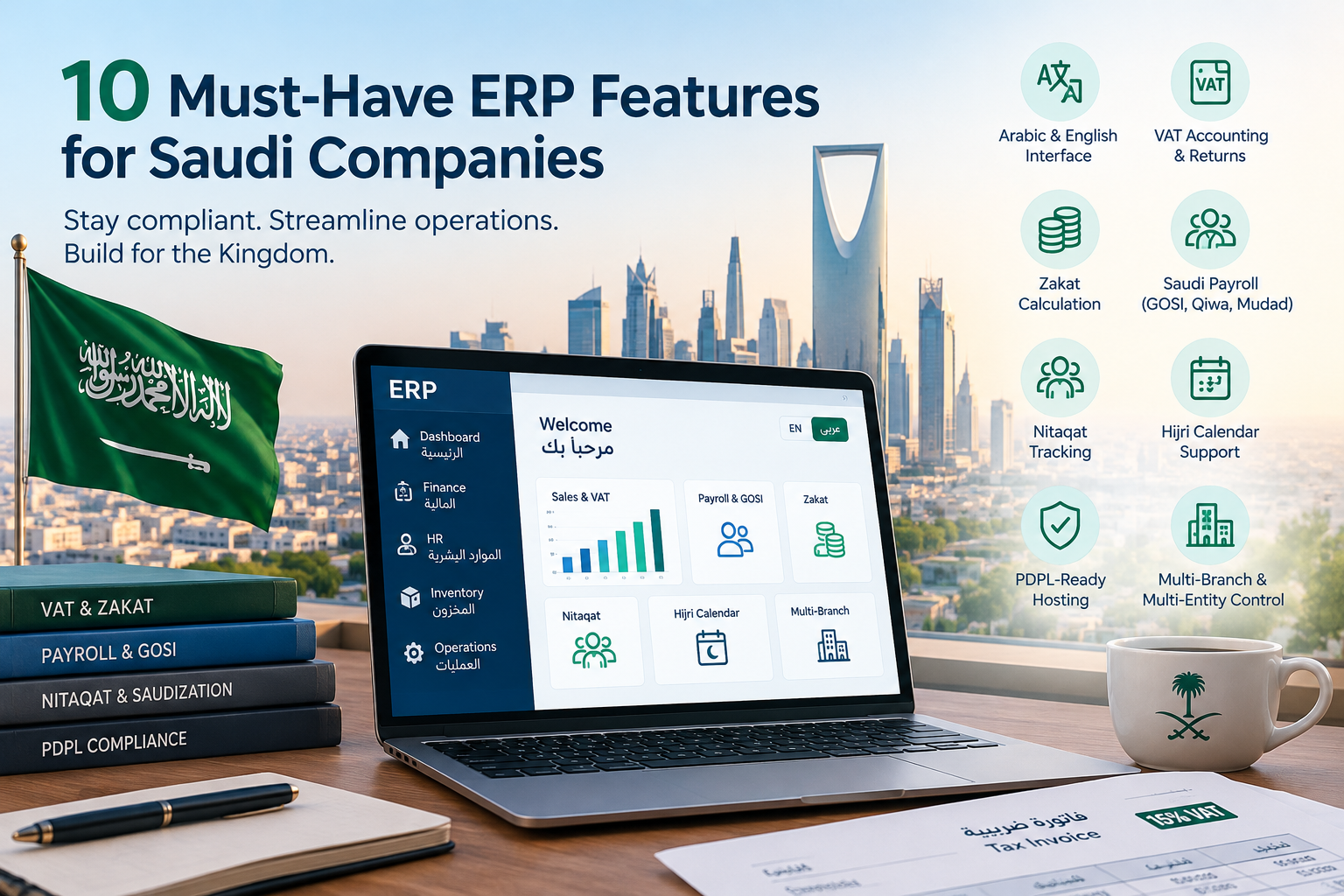
A Saudi-ready ERP needs ten features that a generic global ERP often treats as add-ons. These include a true Arabic and English interface, VAT and Zakat accounting, Saudi payroll linked to GOSI, Qiwa and Mudad, Nitaqat tracking, Hijri calendar support, and hosting that fits the Personal Data Protection Law (PDPL).
This guide lists each feature, explains why it matters in KSA, and ends with the questions to ask any ERP vendor before you sign. If you already know you want expert help, see our ERP implementation services for Saudi companies.
What makes an ERP "Saudi-ready"?
A Saudi-ready ERP is a system that runs your finance, HR, inventory and operations while following Saudi tax, labor and data rules out of the box. That means bilingual Arabic and English workflows, local payroll logic, VAT and Zakat reporting, and data hosting that meets PDPL requirements, without custom code for each rule.
The gap between "supports Arabic" on a brochure and "works for a Saudi company" is where most ERP projects lose time and budget. For the bigger picture, read our complete guide to ERP systems in Saudi Arabia.
10 Must-Have ERP Features for Saudi Companies
1. A true Arabic and English interface
An ERP with an Arabic and English interface should let every user switch language per login, with full right-to-left (RTL) layouts in Arabic. Translated menus alone are not enough.
Check for these:
- Full RTL screens, forms and reports, not just translated labels
- Bilingual print templates for invoices, quotations, payslips and contracts
- Arabic search that finds customers and items by Arabic name
- Dual-language master data (customer, item and employee names in both scripts)
In our experience, Arabic print layouts break more often than Arabic screens. Ask the vendor to print a real invoice in Arabic during the demo.
2. VAT accounting and returns
ERP features for VAT compliance in KSA should calculate the standard 15% rate, zero-rated and exempt supplies automatically on every sales and purchase line. The system should then produce VAT return figures directly from posted transactions, so your accountant isn't rebuilding them in Excel every quarter.
Look for tax codes per item and customer, input VAT tracking on purchases, credit and debit note handling, and a VAT audit report that ties every return figure back to source documents.
3. Zakat calculation
Zakat is a separate obligation from VAT, and many global ERPs ignore it. A Saudi ERP should help you build the Zakat base from your balance sheet and keep the supporting schedules ready for year-end filing. If the vendor only talks about VAT, ask directly how they handle Zakat.
4. Saudi payroll linked to GOSI, Qiwa and Mudad
Saudi payroll is a connected chain. Contracts are registered in Qiwa, salaries are paid through the Wage Protection System (WPS) on Mudad, and social insurance is reported to GOSI. If one record doesn't match, payroll gets stuck.
A must-have ERP payroll module should:
- Calculate GOSI contributions separately for Saudi nationals and expats
- Handle both GOSI rate schedules (two parallel systems have run since July 2024, one for existing subscribers and one for new entrants)
- Generate the WPS salary file in the bank format Mudad accepts
- Keep contract salaries in sync with what you actually pay
- Track Muqeem data such as iqama expiry dates for expat staff
5. End of service benefit (EOSB) calculation
Under the Saudi Labor Law, end of service pay is half a month's wage for each of the first five years and a full month's wage for each year after that, with reductions on resignation. Your ERP should calculate this automatically and keep a running EOSB provision in the accounts, so a resignation never surprises your cash flow.
6. Nitaqat and Saudization tracking
Nitaqat places every company in a color band based on its ratio of Saudi employees. Your band affects visa approvals and work permit renewals. A good ERP shows your current Saudization ratio on a dashboard and warns HR before a resignation or new expat hire pushes you into a lower band.
7. Hijri and Gregorian calendar support
Many Saudi contracts, government documents and holidays still use Hijri dates, while your books run on Gregorian. The ERP should store and display both, convert between them correctly, and let you schedule leave and holidays such as Eid on the Hijri calendar.
8. Multi-branch and multi-entity control
Saudi businesses often run branches in Riyadh, Jeddah and Dammam, or separate legal entities for different activities. Your ERP should handle separate CR numbers, branch-level stock and P&L, inter-branch transfers and consolidated group reporting, all with SAR as the base currency and other currencies for imports. Factories in the Eastern Province need extra modules on top of this, covered in our guide to ERP for manufacturing companies in Jubail.
9. PDPL-ready hosting and access controls
Saudi Arabia's Personal Data Protection Law has been fully enforced since 14 September 2024. Your ERP holds employee iqama numbers, salaries and customer data, so where it is hosted matters.
Government-related data must stay inside the Kingdom. Offshore hosting of financial institution data needs prior approval from the Saudi Central Bank. For everyone else, a cloud ERP hosted in a Saudi region (Riyadh or Jeddah) removes most of the cross-border transfer questions.
Also check for role-based access, encryption, and a clear processor agreement with the vendor.
10. Audit trail and document control
Every change to a price, salary, invoice or stock count should be logged with the user, date and old value. This protects you in tax audits and internal disputes. If your company holds ISO 9001 or plans to certify, the same audit trail, document control and approval workflows make surveillance audits much easier.
Must-have vs nice-to-have ERP modules by company size
Not every company needs every module on day one, and fewer modules also keep your ERP cost in Saudi Arabia under control. Here is how we prioritize must-have ERP modules for Saudi companies:
|
Feature |
Small business (under 20 staff) |
SME (20 to 250 staff) |
Enterprise (250+ staff) |
|---|---|---|---|
|
Arabic and English interface |
Must-have |
Must-have |
Must-have |
|
VAT accounting |
Must-have |
Must-have |
Must-have |
|
Zakat calculation |
Nice-to-have |
Must-have |
Must-have |
|
GOSI and WPS payroll |
Must-have |
Must-have |
Must-have |
|
EOSB provision |
Must-have |
Must-have |
Must-have |
|
Nitaqat dashboard |
Nice-to-have |
Must-have |
Must-have |
|
Hijri calendar |
Must-have |
Must-have |
Must-have |
|
Multi-branch and multi-entity |
Not needed |
Nice-to-have |
Must-have |
|
Saudi data hosting |
Nice-to-have |
Must-have |
Must-have |
|
Audit trail and approvals |
Nice-to-have |
Must-have |
Must-have |
8 questions to ask any ERP vendor in Saudi Arabia
Before you sign, ask every vendor these questions and get the answers in writing:
- Can you show a full Arabic RTL invoice and payslip printed from the live system?
- How does your payroll handle the two GOSI rate schedules for Saudi employees?
- Do you generate the WPS file for Mudad, and which banks have you tested?
- Where exactly is our data hosted, and is there a Saudi region option?
- How do you calculate Zakat, or do we need a separate tool?
- Do you have a Nitaqat or Saudization dashboard?
- How many Saudi clients run your system today, and can we speak to one?
- Who handles local support, and in which time zone?
A vendor that answers "we can customize that" to more than two of these is selling a project, not a product. Budget accordingly. If two vendors pass every question, our Odoo vs SAP Business One comparison for Saudi SMEs helps you pick, and our step-by-step ERP implementation plan for KSA shows what happens after you sign.
Common mistakes Saudi companies make when choosing an ERP
- Choosing on price alone. A cheaper global ERP often costs more once you pay for Arabic printing, payroll and Saudi reporting add-ons.
- Running payroll outside the ERP. Separate payroll spreadsheets break the link between contracts, WPS and accounting.
- Ignoring hosting until go-live. Moving data to a Saudi region after launch is far harder than choosing it at the start.
- Skipping user training in Arabic. Adoption drops when staff learn the system only in English.
Need an ERP that fits Saudi rules from day one?
We help Saudi companies choose, set up and localize ERP systems, from Arabic templates to GOSI and WPS payroll. See our ERP implementation in Saudi Arabia service, or book a free ERP readiness call and we will review your current setup against this checklist.
FAQ (place on the page before the CTA section)
What are the basic ERP requirements in Saudi Arabia?
A Saudi ERP needs an Arabic and English interface, VAT and Zakat accounting, GOSI and WPS payroll, Hijri calendar support, and PDPL-ready data hosting.
Does an ERP in Saudi Arabia need to support Arabic?
Yes. Most Saudi teams, customers and government documents use Arabic, so the ERP needs full right-to-left screens and bilingual invoices, payslips and contracts.
Can a cloud ERP store data outside Saudi Arabia?
It depends on the data. Government data must stay in Saudi Arabia, and financial institution data needs Saudi Central Bank approval to be hosted offshore.
Which ERP modules are needed for Saudi payroll compliance?
You need a payroll module that calculates GOSI contributions, generates WPS files for Mudad, matches Qiwa contracts, and calculates end of service benefits.
What is the difference between VAT and Zakat features in an ERP?
VAT features calculate 15% tax on each sale and purchase, while Zakat features calculate an annual charge on the company's Zakat base at year end.
Do small businesses in Saudi Arabia need an ERP?
Small businesses benefit from an ERP once they run payroll for several staff, file VAT returns, or manage stock, since manual spreadsheets get error-prone quickly.