ERP vs Accounting Software: What Saudi SMEs Actually Need in 2026
9 min read
On this page
- ERP vs accounting software: the short answer
- What accounting software covers for a Saudi business
- What an ERP adds on top
- ERP vs accounting software: side-by-side comparison
- Is accounting software enough for my business?
- 7 signs you need an ERP system
- Cost in SAR: accounting software vs ERP
- How to move from accounting software to an ERP
- Frequently asked questions
- Not sure which one you need?
Most Saudi SMEs with one location and simple stock only need accounting software. You need an ERP when you run several branches or warehouses, manage hundreds of SKUs, or spend days every month reconciling stock, sales and finance across separate tools.
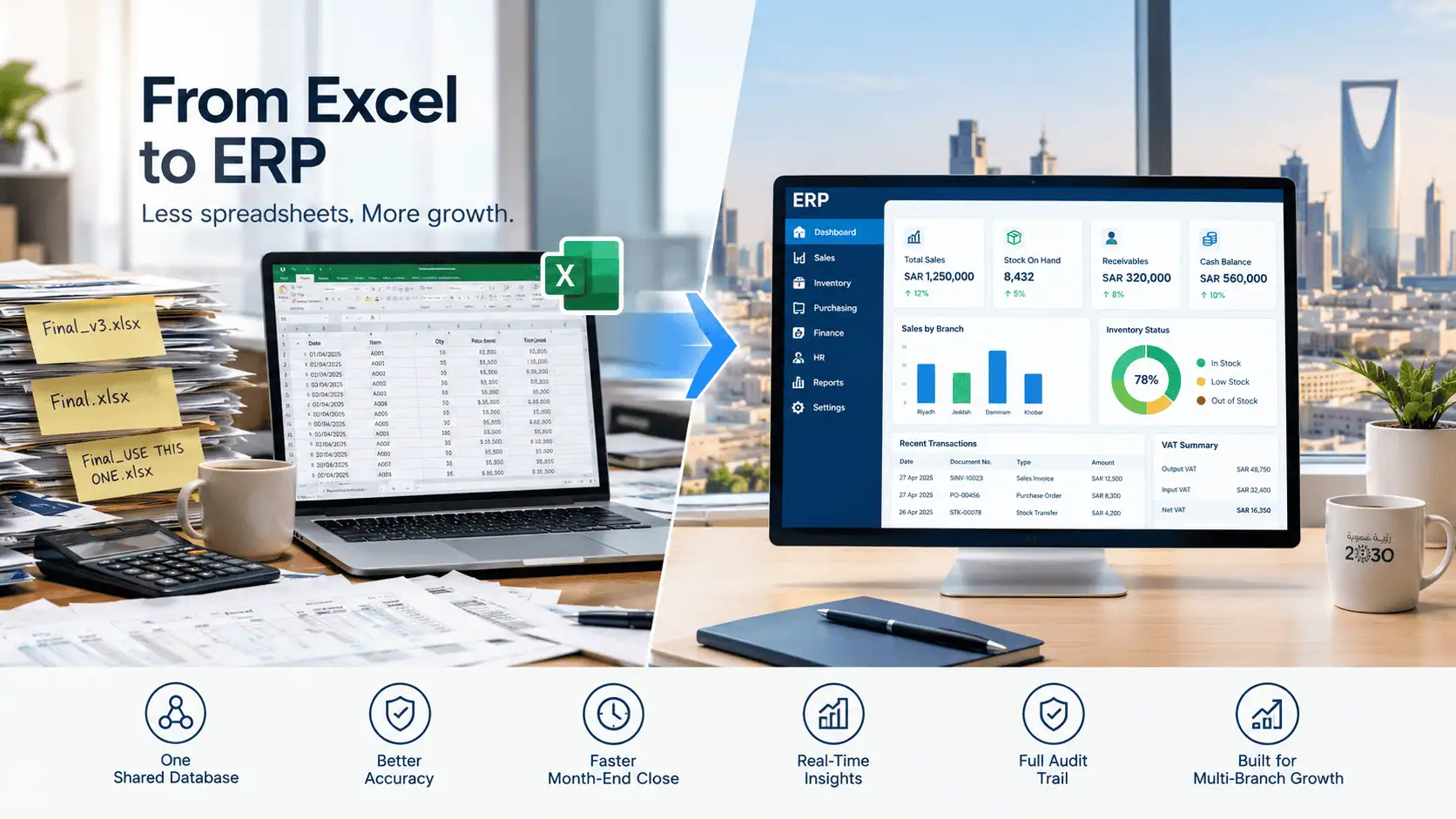
If someone on your team updates Excel every evening just so the stock numbers make sense, you're closer to ERP territory than you think.
Below, we compare both on features, cost in SAR and setup time, and list 7 signs you've outgrown accounting software. We'll also be honest about when an ERP is overkill.
ERP vs accounting software: the short answer
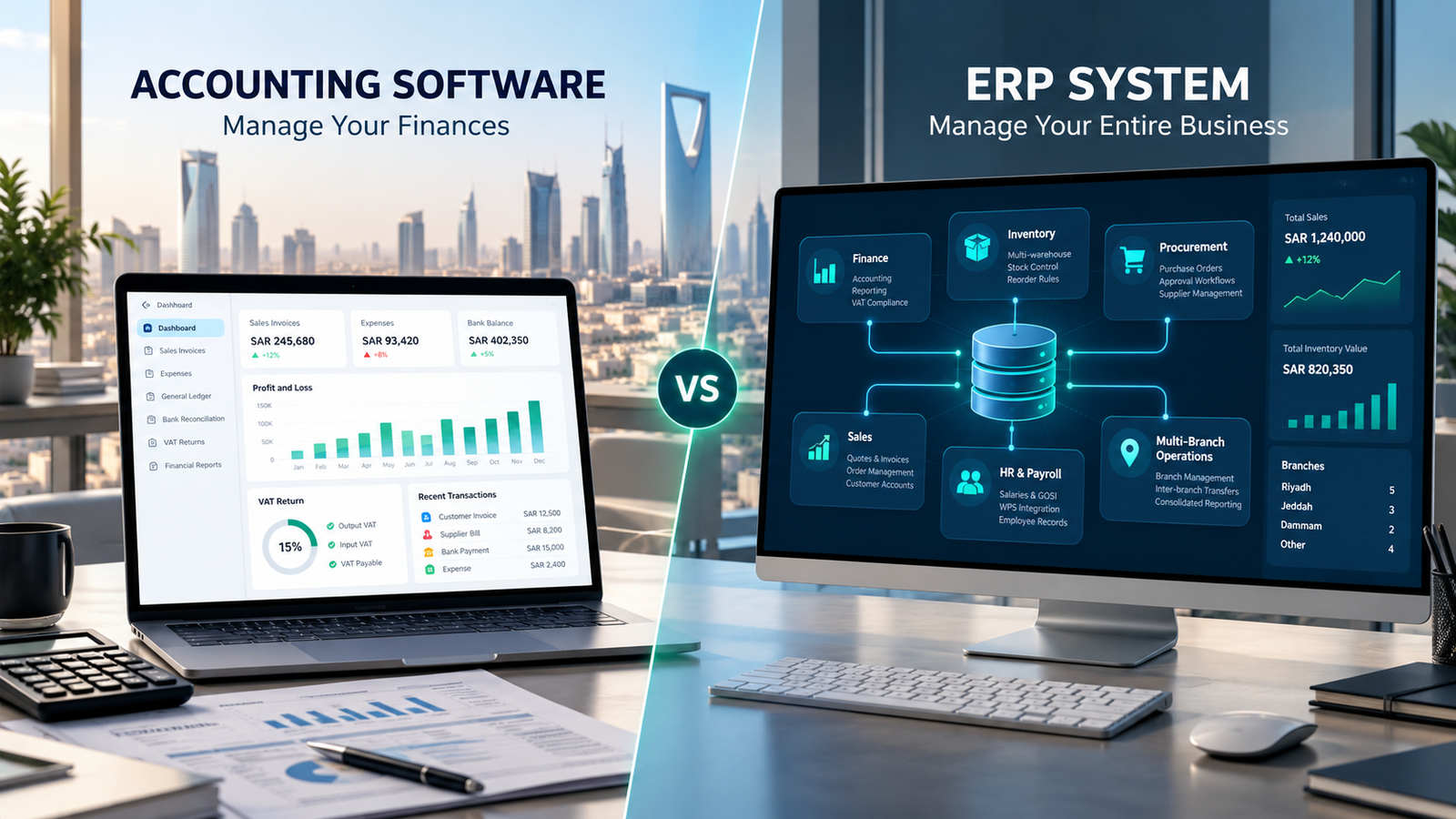
Accounting software records and reports your money: invoices, bills, VAT returns and financial statements. An ERP system runs your whole operation on one database, connecting accounting with inventory, purchasing, sales, HR and production. Saudi SMEs with one location and simple stock usually need only accounting software. Multi-branch or inventory-heavy businesses usually need an ERP.
Put simply:
- Pick accounting software if you run one location, have a small team, hold limited stock and the owner approves most spending personally.
- Pick an ERP if you run several branches or warehouses, manage hundreds of SKUs, need approval workflows, or spend days every month reconciling data between tools.
What accounting software covers for a Saudi business
Accounting software in Saudi Arabia handles the financial core of a business: the general ledger, sales invoices, supplier bills, bank reconciliation, the 15% VAT return and standard reports like profit and loss and the balance sheet. Local tools such as Qoyod, Wafeq and Zoho Books also issue invoices in Arabic and English.
For many small businesses, that's genuinely enough. A consultancy in Riyadh, a single clinic in Jeddah or a boutique in Al Khobar can run for years on good accounting software and a disciplined bookkeeper.
Modern accounting tools have also grown. Several now include basic inventory, simple purchase orders, a POS add-on and limited multi-branch support. That's why the line between "accounting software" and "ERP" feels blurry. The difference shows up in depth, not in the feature list.
What an ERP adds on top
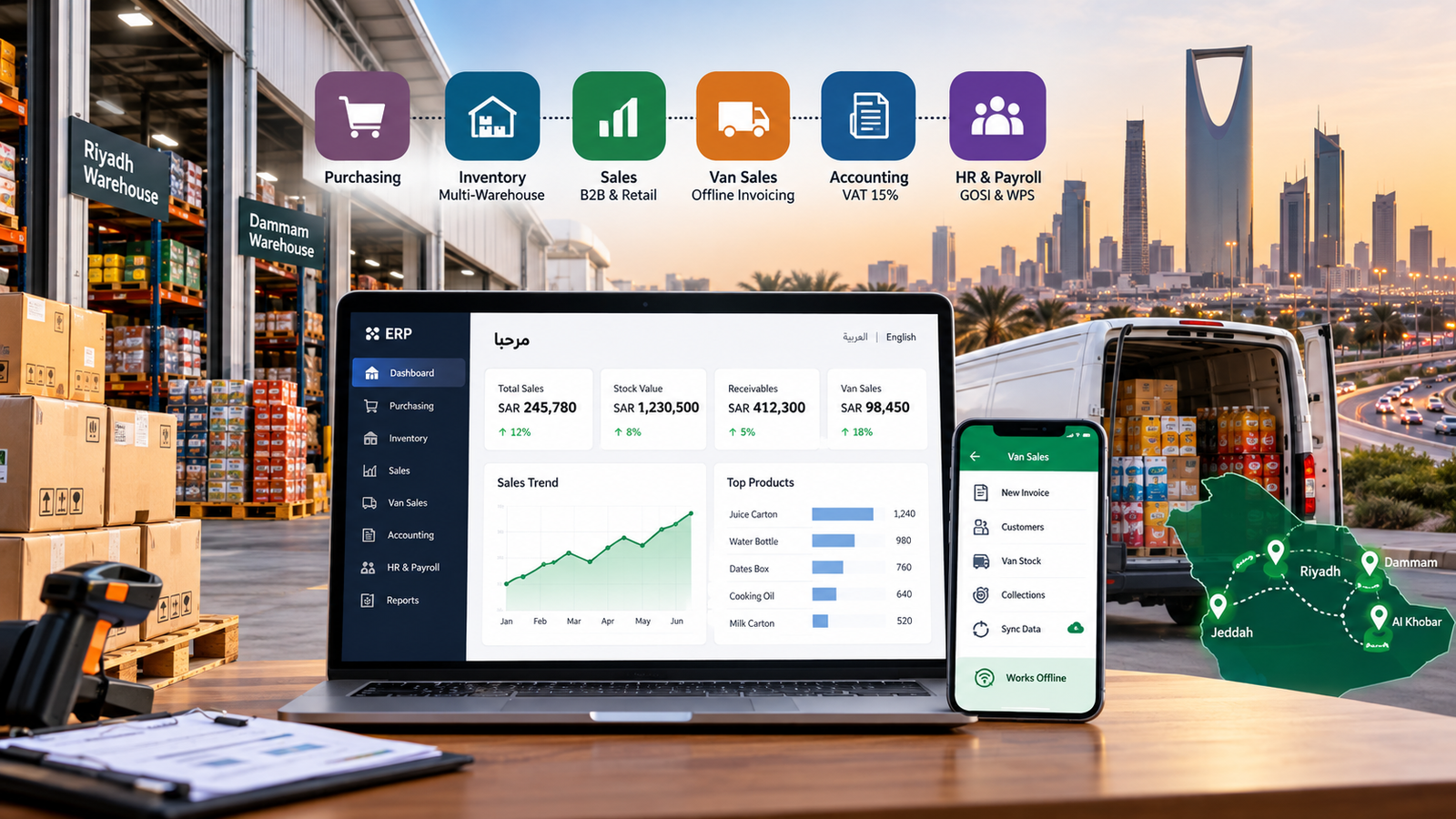
An ERP system adds the operational layer that accounting software lacks: multi-warehouse inventory, procurement with approval chains, multi-branch control, HR and payroll, and manufacturing or project costing. Every department works from one shared database, so a sale updates stock, finance and reports at the same moment without anyone re-typing data.
In practice, for a Saudi SME that means:
- Inventory: stock across several warehouses, batch and expiry tracking, reorder rules and landed costs on imports.
- Procurement: purchase requests, purchase orders, approval limits by role and supplier comparison.
- Multi-branch: branch-level profit, inter-branch transfers and one consolidated view for management.
- HR and payroll: salary runs, GOSI contributions, WPS salary files and Mudad uploads in the same system as finance (support varies by vendor).
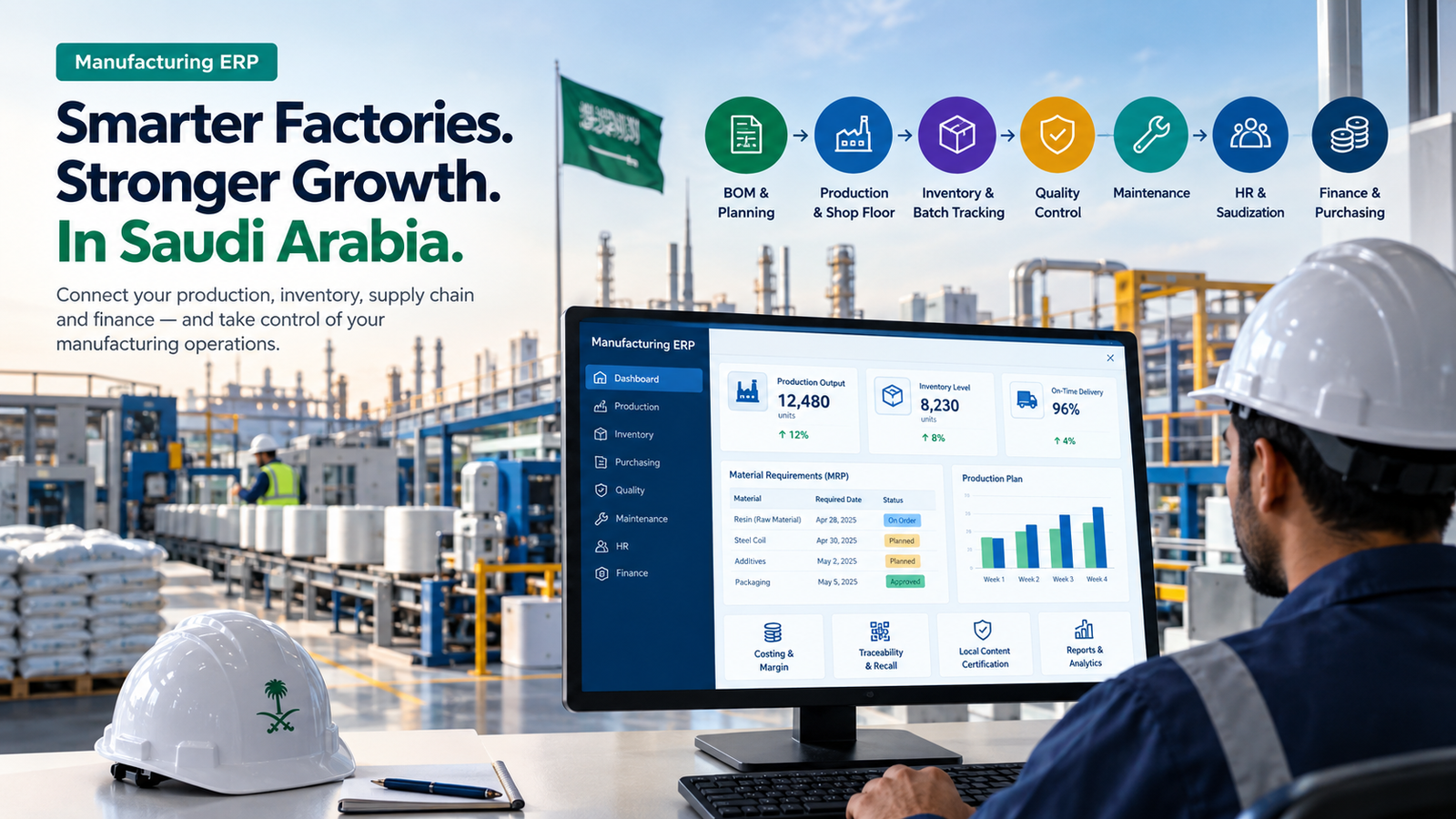
- Production or projects: bills of materials and job costing for factories in Jubail or Dammam, or project-wise costing for contractors.
- One source of truth: the CFO and the warehouse manager see the same number.
ERP vs accounting software: side-by-side comparison
|
Criteria |
Accounting software |
ERP system |
|---|---|---|
|
Core job |
Record and report money |
Run operations and finance on one database |
|
Best fit |
One location, small team, simple stock |
Multi-branch, warehouses, approvals, production or projects |
|
Inventory |
Basic, usually one location |
Multi-warehouse, batches, reorder rules, landed cost |
|
Procurement |
Supplier bills, simple POs |
Purchase requests, POs, approval chains |
|
HR and payroll |
Add-on or separate tool |
Built in, GOSI and WPS support (varies by vendor) |
|
Users and permissions |
A few users, basic roles |
Many users, role-based permissions by department |
|
Arabic and VAT |
Standard in local tools |
Depends on localisation |
|
Reporting |
P&L, balance sheet, VAT return |
Branch, product, project and real-time dashboards |
|
Setup time |
Days |
Roughly 2 to 6 months for SMEs |
|
Cost model |
Monthly subscription |
Licences + implementation + support |
For an SME, the setup time and cost rows matter most. The rest of this guide shows when the extra cost of an ERP actually pays off.
Is accounting software enough for my business?
Accounting software is enough for most Saudi businesses with one location, a small team and limited stock. If the owner approves purchases personally, month-end closes within a few days and nobody keeps side spreadsheets to fix stock or branch numbers, a good local accounting tool will serve you well and cost far less than an ERP.
A rough rule of thumb from our projects: under 20 staff, one site and a few hundred SKUs, stay on accounting software. Spend the money on a good bookkeeper and clean processes instead.
7 signs you need an ERP system
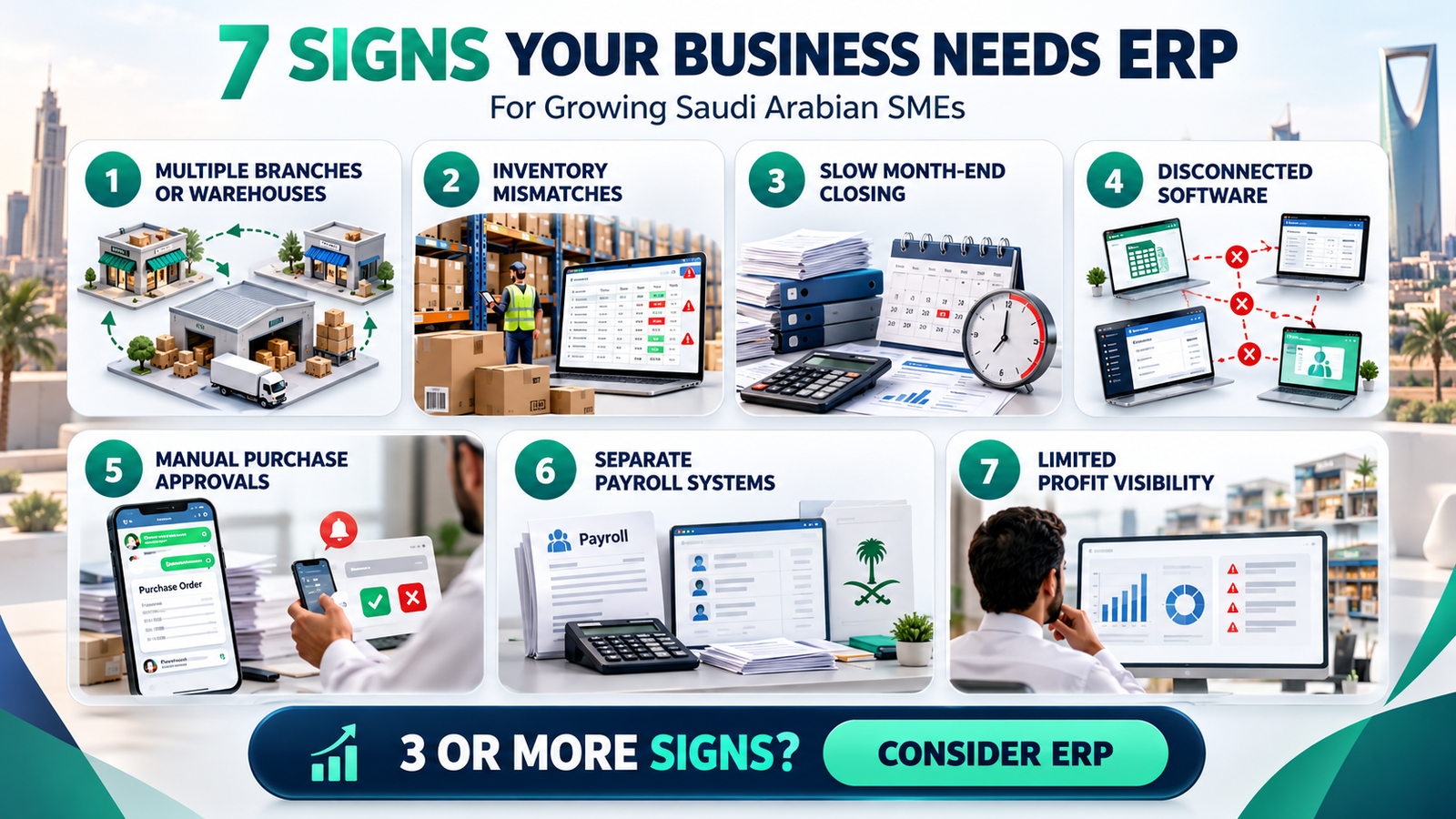
You need an ERP when your accounting software can no longer reflect how the business actually operates. The clearest signs are multiple branches or warehouses, stock that never matches the books, slow month-end closing and data scattered across disconnected tools. If three or more of these apply, an ERP will likely pay for itself.
- You run 2 or more branches or warehouses. Accounting tools treat locations as tags. An ERP treats them as real stock points with transfers between them.
- Your stock count never matches the books. If someone fixes inventory in Excel every week, the system isn't doing its job.
- Month-end close takes more than a week. Long closes usually mean manual reconciliation between sales, stock and finance.
- Your data lives in 3 or more tools. Accounting here, POS there, payroll in a third app and Excel holding it together.
- Purchase approvals happen on WhatsApp. No approval trail means no spending control once the team grows.
- Payroll and GOSI run outside your finance system. Every salary month means re-entering numbers and risking errors.
- Management can't see profit by branch or product. You know the company made money but not which part made it.
Ticked 3 or more? That's usually the point where an ERP system for growing businesses starts saving more than it costs. Talk to our ERP consultants and we'll tell you honestly if you're there yet.
ERP vs QuickBooks for Saudi SMEs
QuickBooks works well as simple accounting software for a single office with simple stock. Its limits show once you add warehouses, branches or approval workflows: you end up stacking third-party apps on a tool built for small teams. Many Saudi SMEs also prefer locally built tools with Arabic-first interfaces. When the add-ons start piling up, an ERP is usually cleaner and cheaper to run than the patchwork.
Cost in SAR: accounting software vs ERP
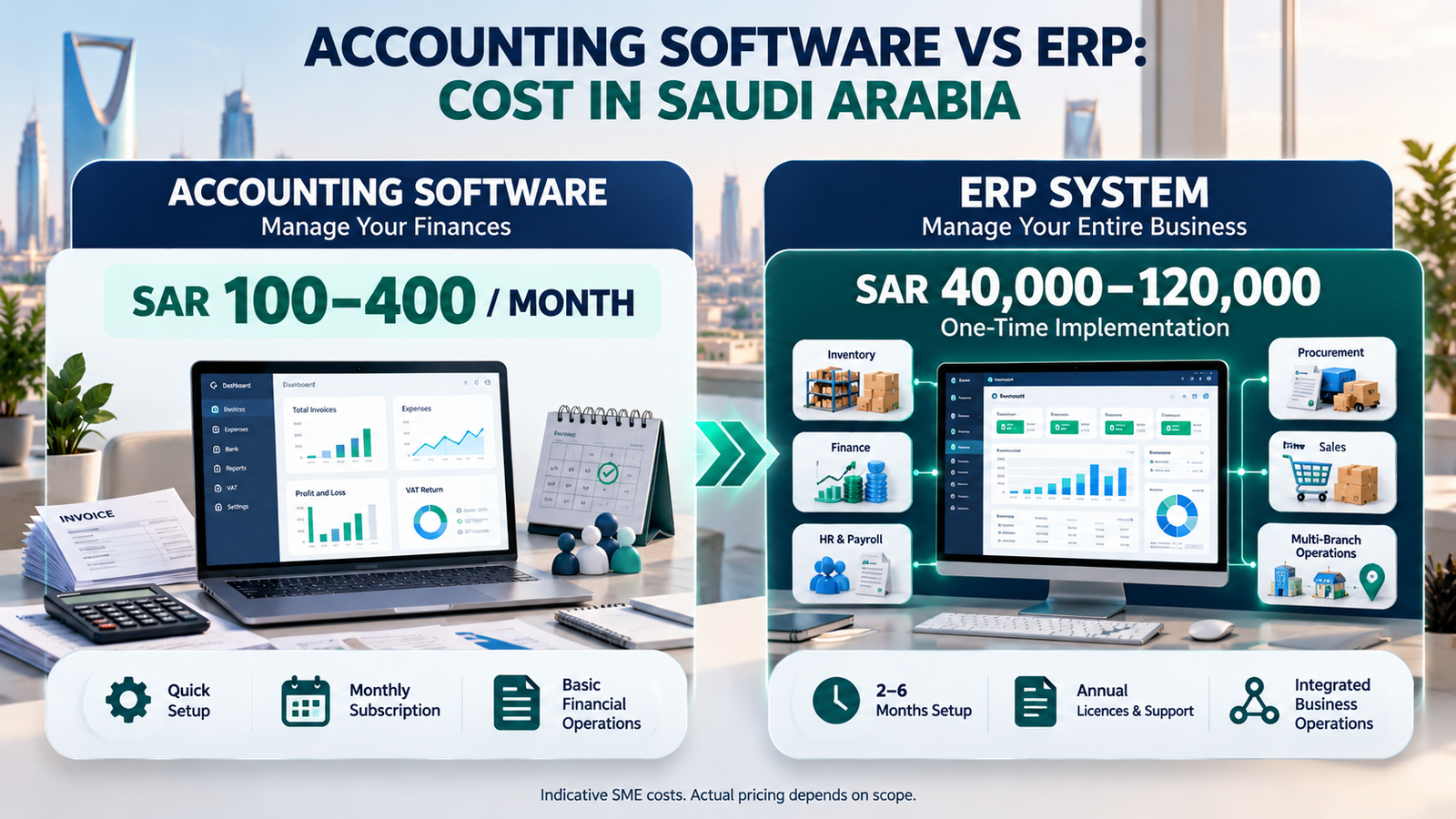
Accounting software in Saudi Arabia typically costs SAR 100 to 400 per month on a subscription. An ERP for an SME usually needs a one-off implementation of roughly SAR 40,000 to 120,000, plus yearly licences and support. The gap is large, which is why switching only makes sense when the operational pain is real.
|
Cost item |
Accounting software |
ERP (SME, 10 to 15 users) |
|---|---|---|
|
Subscription or licences |
About SAR 99 to 380 per month on published local plans |
Per user, per month, depends on platform |
|
Implementation |
Usually none, self-setup |
About SAR 40,000 to 120,000 one-off |
|
Timeline |
Days |
Roughly 2 to 6 months |
|
Ongoing support |
Included in subscription |
Annual support contract |
These are indicative ranges from published 2025 to 2026 pricing, converted at the fixed rate of SAR 3.75 to the US dollar. Odoo implementations for about 15 users are commonly quoted at $10,700 to $21,300, and Microsoft Dynamics 365 Business Central for 10 users at $16,000 to $32,000. Your real number depends on users, branches, data migration and customisation. Our ERP selection guide covers what drives the price up.
How to move from accounting software to an ERP
Moving from accounting software to an ERP works best in five steps: map your current processes, clean your master data, choose the ERP and partner, migrate opening balances at a period end, then run both systems in parallel for one month. Most failed projects skip the data cleanup or the parallel run.
- Map your processes. Write down how a sale, a purchase and a stock transfer actually flow today, including the WhatsApp and Excel steps.
- Clean master data. Fix duplicate customers, dead SKUs and the chart of accounts before migrating anything.
- Choose the system and the partner. Compare platforms in our roundup of the best ERP software in Saudi Arabia, then vet who implements it with this ERP implementation partner checklist.
- Migrate at a period end. Move opening balances at a month or quarter close so the numbers tie out.
- Run in parallel for one month. Keep the old tool read-only, compare reports, then switch off.
Frequently asked questions
What is the difference between ERP and accounting software?
Accounting software records financial transactions, while an ERP connects finance with inventory, purchasing, sales, HR and production in one database. Accounting software tells you what happened to your money. An ERP also controls the operations that moved it.
Is accounting software enough for a small business in Saudi Arabia?
Yes, for most small Saudi businesses with one location and simple stock. A local tool like Qoyod, Wafeq or Zoho Books covers invoicing, VAT returns and reporting. Consider an ERP once you add branches, warehouses or approval workflows.
How much does an ERP cost compared to accounting software in Saudi Arabia?
Accounting software in Saudi Arabia usually costs SAR 100 to 400 per month. An ERP for an SME typically needs a one-off implementation of roughly SAR 40,000 to 120,000, plus yearly licences and support. The final figure depends on users, branches and data migration.
How long does it take to move from accounting software to an ERP?
Most Saudi SMEs need roughly 2 to 6 months to move from accounting software to an ERP. That covers process mapping, data cleanup, setup, migration at a period end and a one-month parallel run. Larger multi-branch setups take longer.
When should a Saudi SME switch from accounting software to ERP?
A Saudi SME should switch when it runs multiple branches or warehouses, struggles to match stock with the books, or spends over a week on month-end close. Three or more of these signs together usually justify the cost of an ERP.
Can I keep my accounting software and add an ERP later?
Yes, many businesses start on accounting software and move to an ERP as they grow. Plan the switch at a period end and migrate opening balances cleanly. Run both systems side by side for one month before switching off the old one.
Not sure which one you need?
Intellitech Solutions helps Saudi SMEs pick the right system, whether that's staying on accounting software or moving to an ERP. Book a free 30-minute readiness call. We'll review your current setup, map where the gaps are and tell you honestly if an ERP is worth it yet.