ERP for Trading and Distribution Companies in Saudi Arabia
14 min read
On this page
- What is an ERP for trading and distribution companies?
- Why Saudi trading and distribution companies need an ERP now
- Thin margins leave no room for stock leakage
- Multi-branch growth across the Kingdom
- Customers expect faster, more accurate service
- Vision 2030 is raising the bar for business systems
- Must-have features in a distribution ERP for Saudi Arabia
- Best ERP options for Saudi trading companies, by company size
- How much does an ERP cost in Saudi Arabia?
- A real-world example
- Cloud vs on-premise ERP for Saudi distributors
- How ERP implementation works for a trading company
- 5 red flags when choosing an ERP vendor in Saudi Arabia
- Frequently asked questions
- Which ERP is best for a trading company in Saudi Arabia?
- How much does an ERP cost in Saudi Arabia?
- Does an ERP support van sales and offline invoicing?
- Can an ERP work in both Arabic and English?
- Is cloud or on-premise ERP better for a Saudi distributor?
- How long does ERP implementation take for a distributor?
- Find the right ERP for your trading business
The best ERP for a trading or distribution company in Saudi Arabia is one system that connects purchasing, multi-warehouse inventory, sales, van sales and accounting, works in Arabic and English, and fits your user count and budget. For most small traders that means Odoo, ERPNext or a Saudi-built ERP. Mid-size distributors usually shortlist SAP Business One or Microsoft Dynamics 365 Business Central, and multi-entity groups look at NetSuite.
The brand matters less than the fit. Picture a food distributor in Dammam with six vans, two warehouses and 400 retail customers. Orders arrive on WhatsApp, stock lives in Excel, and nobody knows the real margin on a carton of juice until the next month is half over. Any of the systems above can fix that, but only if it's set up around how that company actually buys, stores, sells and collects.
This guide covers the features to insist on, which ERP suits which company size, what it really costs in SAR, and the red flags to spot before you sign. It's written by the team at Intellitech Solutions in Al Khobar, who configure, extend and build ERP systems in Saudi Arabia for businesses across the Kingdom.
What is an ERP for trading and distribution companies?
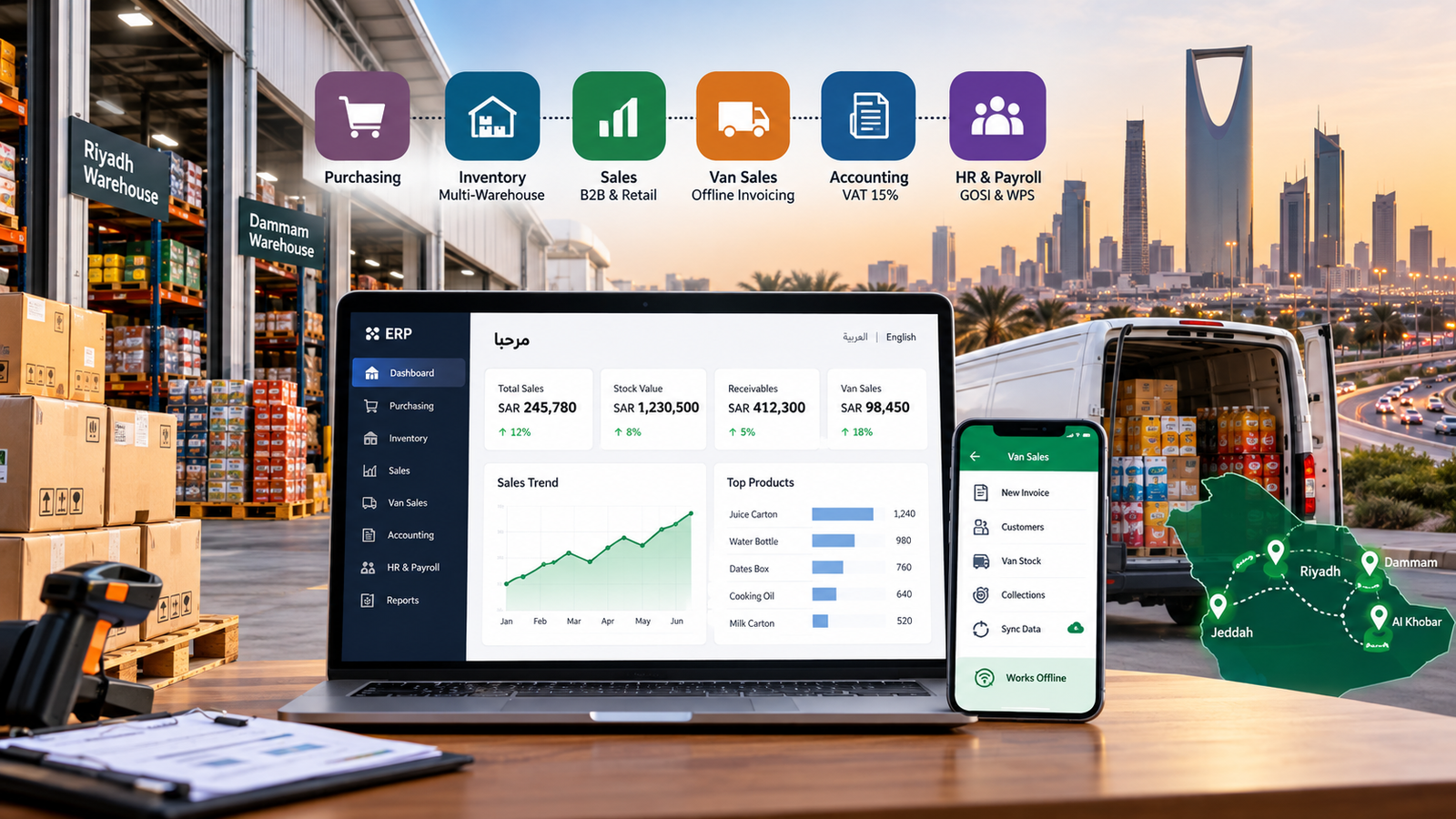
An ERP for trading and distribution companies is one system that runs the full buy, store, sell and collect cycle. It replaces separate tools for purchasing, inventory, sales, delivery and accounting with a single shared database, so every branch, warehouse and van works from the same live numbers.
For a trader, the value isn't the software itself. It's that a sales order in Jeddah instantly reserves stock in your Riyadh warehouse, updates the customer's credit balance and posts the revenue to your books.
Here's how a typical trading workflow maps to ERP modules:
|
Business step |
ERP module |
What it handles |
|---|---|---|
|
Buying from suppliers and importing |
Purchasing |
Purchase orders, supplier price lists, goods receipt |
|
Calculating true product cost |
Landed cost |
Freight, customs and clearance charges spread across items |
|
Storing stock across sites |
Inventory and warehouse |
Multi-warehouse stock, batch and expiry, transfers, FIFO valuation |
|
Selling to B2B customers |
Sales and CRM |
Quotations, sales orders, customer price tiers, credit limits |
|
Selling from the road |
Van sales |
Route plans, van stock, on-the-spot invoices, cash collection |
|
Getting paid |
Receivables and collections |
Customer statements, ageing, payment matching |
|
Closing the books |
Accounting |
General ledger, VAT 15%, branch and company consolidation |
|
Paying your team |
HR and payroll |
GOSI, WPS salary files, end-of-service calculations |
Why Saudi trading and distribution companies need an ERP now
Saudi traders need an ERP because growth exposes the gaps that spreadsheets hide. Once you run more than one warehouse, a few vans or several branches, stock errors, late collections and slow month-end closes start eating a margin that was thin to begin with.
Thin margins leave no room for stock leakage
Distribution often runs on single-digit margins. A few expired cartons, an unrecorded van return or a wrong price on a large order can wipe out a week of profit. An ERP tracks every unit from goods receipt to customer delivery, with batch and expiry dates attached.
Multi-branch growth across the Kingdom
Many traders start in one city and expand to Riyadh, Jeddah, Dammam or Al Khobar within a few years. Each new branch with its own spreadsheet adds another version of the truth. An ERP gives head office one consolidated view of stock, sales and cash across every location.
Customers expect faster, more accurate service
Retail chains and wholesale buyers now expect quick quotes, correct invoices and on-time delivery. When your sales team can see live stock and customer credit on a phone, they stop promising what the warehouse can't ship.
Vision 2030 is raising the bar for business systems
As Vision 2030 pushes the economy toward digital operations, larger buyers, banks and investors increasingly expect clean, auditable numbers from their suppliers. A proper ERP makes that reporting routine instead of a scramble.
Must-have features in a distribution ERP for Saudi Arabia
A distribution ERP for Saudi Arabia must handle multi-warehouse inventory, landed cost, customer pricing and credit, van sales, bilingual documents and Saudi payroll. Missing any one of these usually means a workaround in Excel, which is exactly what you're paying to get rid of.
Use this list as your demo checklist:
- Multi-warehouse inventory with batch and expiry. Essential for FMCG, food and pharma traders. Ask the vendor to show FIFO or FEFO picking live, not in slides. If you also sell online or on marketplaces, inventory sync across sales channels keeps those stock numbers in line with the warehouse.
- Landed cost for imports. Your real product cost includes freight, customs duty and clearance fees. Without landed cost, every margin report is a guess.
- Customer price lists and credit limits. Wholesale customers rarely pay list price. The ERP should apply tiered pricing automatically and block orders when a customer crosses their credit limit.
- Van and field sales. Vans lose signal on highways and in rural areas, so reps need invoicing that works offline and syncs stock, sales and cash once they reconnect. For Lumen Energy Solutions, we built a native Android app for field salesmen on the same ERP that runs their stock and accounts.
- Load-in and load-out reconciliation. Every van should start and end the day with a stock count that matches the system, so returns and shortages show up the same day.
- Reorder planning. Suggested purchase quantities based on sales history stop cash from sitting in slow-moving stock. On the Lumen Energy ERP, AI-driven reorder planning helped avoid about USD 20,000 of excess stock.
- Arabic and English documents. Invoices and statements in Arabic with right-to-left layout, plus Hijri dates where your customers expect them.
- Saudi HR and payroll. GOSI contributions, WPS salary files and end-of-service benefits calculated inside the system.
- Role-based access and local data hosting. Sales reps see their own customers only. Check where data is hosted and how the vendor aligns with Saudi Arabia's Personal Data Protection Law (PDPL).
- Mobile dashboards for owners. Daily sales, stock value, overdue receivables and van performance on one screen.
Best ERP options for Saudi trading companies, by company size
The best ERP for a trading company in Saudi Arabia depends mostly on size and complexity. Small traders usually get the best value from Odoo, ERPNext or a Saudi-built system. Mid-size distributors often choose SAP Business One or Microsoft Dynamics 365 Business Central. Multi-entity groups tend to look at NetSuite or larger SAP products.
There's no single winner, and any guide that ranks one product first for everyone is probably selling it. Use the table to shortlist two or three, then compare them on your own workflows.
|
ERP |
Best fit |
Strengths for traders |
Watch out for |
Starting licence price |
|---|---|---|---|---|
|
Odoo |
Small to mid-size traders |
Modular apps for sales, inventory, purchase and accounting; strong Arabic localization through Saudi partners |
Quality depends heavily on the implementation partner |
From about SAR 93 per user per month (USD 24.90, annual billing) |
|
ERPNext |
Budget-focused small traders |
Open source, Arabic interface, van sales add-ons available |
Needs a capable partner for hosting and support |
No licence fee; you pay for hosting and implementation |
|
SAP Business One |
Mid-size distributors with structured processes |
Mature inventory and finance, large Saudi partner network |
Higher per-user cost; partner required |
About SAR 202 per user per month, or about SAR 12,000 per user one-time |
|
Microsoft Dynamics 365 Business Central |
Companies already on Microsoft 365 |
Familiar interface, Excel and Teams integration |
Saudi-specific features rely on partner add-ons |
About SAR 262 to 375 per user per month |
|
Oracle NetSuite |
Fast-growing or multi-entity groups |
Cloud-native, strong multi-company consolidation |
Base fee plus per-user fees add up quickly |
Base about SAR 3,746 per month plus SAR 371 to 469 per user per month |
|
Saudi-built ERPs |
Small distributors wanting Arabic-first software |
Built-in van sales apps, local support teams |
Smaller ecosystems; check long-term roadmap |
Quote-based |
Prices are vendor list prices converted at USD 1 = SAR 3.75 (October 2026). Partner pricing in Saudi Arabia varies.
None of these a good fit? Some traders run a process no packaged ERP handles well, such as unusual pricing rules or their own field sales model. That's when custom ERP and business software built around your workflow can be the better answer than bending a product to fit.
How much does an ERP cost in Saudi Arabia?
ERP cost in Saudi Arabia has four parts: licences, implementation, hosting and support. Licences start under SAR 100 per user per month for entry-level systems, but implementation is usually the biggest single cost. Industry estimates put implementation at 100% to 200% of the software cost.
That's the number most vendor pricing pages leave out. Here's what each part typically looks like:
|
Cost part |
What it covers |
Typical range |
|---|---|---|
|
Licences |
Per-user subscription or one-time licence |
SAR 93 to 469 per user per month, depending on the system (see the table above) |
|
Implementation |
Setup, configuration, data migration, training |
Small Odoo projects: about SAR 18,750 to 56,250. NetSuite: about SAR 93,750 to 375,000+ |
|
Hosting |
Cloud server or vendor cloud |
Included in SaaS plans; separate for self-hosted Odoo or ERPNext |
|
Support |
Bug fixes, updates, user help |
Annual contract, usually a share of the implementation fee |
A real-world example
One Riyadh-based partner's public cost estimator gives this 3-year scenario for an Odoo rollout:
- Implementation and advisory: SAR 147,000 (one-time)
- User licences: SAR 36,000 per year
- Cloud hosting in KSA: SAR 8,000 per year
- Support: SAR 22,050 per year
- 3-year total: SAR 345,150
Treat this as one example, not a market average. A 5-user trader with one warehouse will spend far less; a 100-user group with custom integrations will spend more.
Licence fees are only the starting point. Ask every vendor for a written scope covering implementation, data migration, training and support. At Intellitech, scope and price are fixed after discovery, before you commit to anything.
Our view: [Name], [role] at Intellitech Solutions: "[insert a real quote on where Saudi traders overspend, for example customizations they never use]"
Cloud vs on-premise ERP for Saudi distributors
Most Saudi trading and distribution companies are better served by cloud ERP. It costs less upfront, works for vans and branches anywhere with a connection, and moves server maintenance to the vendor. On-premise still makes sense for companies with strict data-control rules or an in-house IT team.
|
Factor |
Cloud ERP |
On-premise ERP |
|---|---|---|
|
Upfront cost |
Low; monthly subscription |
High; servers plus licences |
|
Access for vans and branches |
Anywhere with internet |
Needs VPN or remote setup |
|
Maintenance and updates |
Handled by vendor |
Your IT team |
|
Data control |
Check hosting location and PDPL terms |
Full control on your servers |
|
Best for |
Most small and mid-size traders |
Large groups with strict data policies |
A hybrid setup, cloud ERP plus a mobile sales app, is common for distributors covering long routes outside the main cities. If the system has to run on your own servers, plan backups, monitoring and updates from day one, which is what self-hosted ERP deployment and DevOps covers.
How ERP implementation works for a trading company
ERP implementation for a trading company follows seven steps: fit assessment, data cleanup, configuration, integrations, testing, training and go-live. The timeline depends on users, warehouses, data quality and how many custom workflows you need, so treat any quote of "two weeks" with care.
- Fit assessment. Map your real workflows: how you buy, store, price, deliver and collect. Note where each branch does things differently.
- Data cleanup. Clean your item master, customer list, opening stock and open balances. This step is usually the slowest, and the one that decides go-live quality.
- Configuration. Set up warehouses, price lists, credit rules, chart of accounts, Arabic invoice templates, user roles and approval chains. Where sign-off runs deeper than two steps, automated approval workflows keep requests from stalling in someone's inbox.
- Integrations. Connect van sales devices, barcode scanners, your bank and any e-commerce or B2B portal. Connecting the systems you already run is often cheaper than replacing them.
- User acceptance testing. Run a full week of real transactions in a test copy: a purchase, an import with landed cost, a van route, a customer return, a month-end close.
- Training. Train by role. Warehouse staff, van reps and accountants need different sessions, ideally in Arabic and English.
- Go-live and support. Go live at the start of a month, keep the old system read-only for reference, and plan daily check-ins for the first two weeks.
Before you sign, ask any partner to walk you through these seven steps with their own timeline and a named owner for each.
5 red flags when choosing an ERP vendor in Saudi Arabia
The biggest red flags are a demo that avoids your real workflows, no offline van sales, weak Arabic documents, a price with no implementation breakdown and no local references. Any one of these is a reason to slow down before you sign.
- The demo uses their data, not yours. Send three real scenarios before the demo, such as a landed-cost import, a van route with returns and a customer over their credit limit. Watch whether they can run them.
- Van sales only works online. If reps can't invoice without a signal, you'll be back to paper on the highway between cities.
- Arabic is an afterthought. Ask for a sample Arabic invoice and customer statement. Broken right-to-left layouts or English-only reports are common.
- A licence quote with no implementation estimate. Since implementation can cost one to two times the software, a quote without it isn't a real quote.
- No references. Ask to speak with clients running the same system at a similar size. A good partner will arrange it and point you to published ERP case studies.
Frequently asked questions
Which ERP is best for a trading company in Saudi Arabia?
The best ERP depends on company size: Odoo or ERPNext for small traders, SAP Business One or Business Central for mid-size distributors, and NetSuite for multi-entity groups. Shortlist two or three and test them on your own workflows.
How much does an ERP cost in Saudi Arabia?
ERP licences in Saudi Arabia range from about SAR 93 to SAR 469 per user per month, and implementation often costs one to two times the annual software fee. Hosting and support add a yearly cost on top.
Does an ERP support van sales and offline invoicing?
Many ERPs support van sales through a mobile app, but not all of them work offline. Choose a system where reps can invoice without a signal and sync stock, sales and cash once they reconnect.
Can an ERP work in both Arabic and English?
Yes, most ERPs used in Saudi Arabia offer Arabic and English, but quality varies. Ask for a sample Arabic invoice and statement to check right-to-left layout and Hijri date support before you buy.
Is cloud or on-premise ERP better for a Saudi distributor?
Cloud ERP suits most Saudi distributors because it costs less upfront and works across branches and vans. On-premise fits large groups that need full control of their servers and data.
How long does ERP implementation take for a distributor?
ERP implementation time for a distributor depends on users, warehouses, data quality and customizations. Small single-warehouse projects move much faster than multi-branch rollouts, and data cleanup is usually the step that sets the pace.
Find the right ERP for your trading business
You don't need the most expensive ERP. You need one that matches how your company buys, stores, sells and collects, and a partner who will get your team using it properly.
Intellitech Solutions works with trading and distribution companies across Saudi Arabia from our office in Al Khobar. Tell us how your business buys, stores, sells and collects today, and we'll recommend whether to configure a proven ERP, extend one or build custom. You get scope, approach and price in writing before committing, and we'll tell you if your current setup is fine.
Book a consultation or email info@intellitech.com.