Best ERP Software in Saudi Arabia: A 2026 Buyer's Guide
12 min read
On this page
- The best ERP software in Saudi Arabia at a glance
- How we chose these systems
- Best ERP software for small businesses in Saudi Arabia
- Odoo
- Microsoft Dynamics 365 Business Central
- When accounting software like Qoyod is enough
- Best ERP software for mid-size and growing companies
- SAP Business One
- Oracle NetSuite
- Best ERP software for large enterprises
- SAP S/4HANA and Oracle Fusion Cloud ERP
- How each ERP handles ZATCA Phase 2
- Odoo vs SAP Business One vs Business Central: quick verdict
- The partner matters as much as the software
- Frequently asked questions
- What is the best ERP software in Saudi Arabia?
- Which ERP is most used in Saudi Arabia?
- Is Odoo or SAP Business One better for a Saudi SME?
- Does Business Central support ZATCA Phase 2?
- Do small businesses in Saudi Arabia need an ERP?
- How much does ERP software cost in Saudi Arabia?
- Get an ERP shortlist for your business
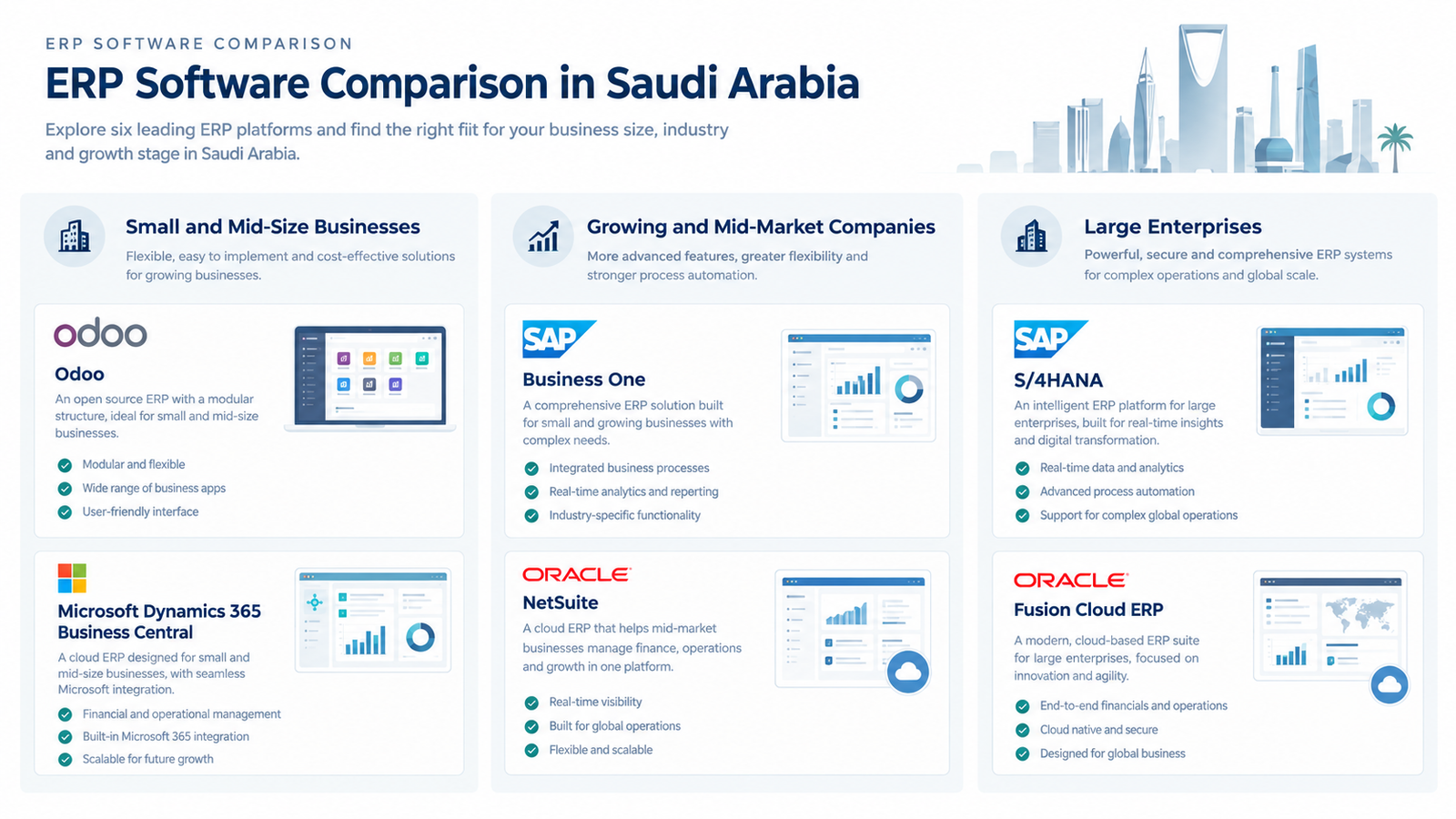
There is no single best ERP software in Saudi Arabia. For most small and mid-size businesses, the realistic shortlist is Odoo, Microsoft Dynamics 365 Business Central and SAP Business One. Larger groups usually look at Oracle NetSuite, SAP S/4HANA or Oracle Fusion Cloud ERP. The right pick depends on your size, how the system handles ZATCA Phase 2 e-invoicing, and the local partner who implements it.
Most "best ERP" lists you will find are written by a partner selling one of these products, and they end with that product winning. This guide does it differently. It groups the options by business size, explains how each one actually delivers ZATCA compliance, and tells you who each system is not for.
A note on where we stand: Intellitech Solutions implements [CONFIRM: product names] for Saudi businesses. We have kept the comparison factual and linked the sources, so you can check every claim yourself.
The best ERP software in Saudi Arabia at a glance
The table below compares the six options Saudi buyers shortlist most often. The column that matters most for 2026 is how each system reaches ZATCA Phase 2, because it decides who you depend on for compliance updates.
|
ERP software |
Best for |
ZATCA Phase 2 route |
Arabic support |
Pricing model |
|---|---|---|---|---|
|
Odoo |
SMEs and mid-market trading, retail and distribution |
Native module in the official Saudi localization |
Native Arabic and right-to-left |
Per user per month, plus implementation |
|
Microsoft Dynamics 365 Business Central |
Growing SMEs on Microsoft 365, finance-led teams |
Third-party extensions on Microsoft AppSource |
Through localization extensions |
Per user per month |
|
SAP Business One |
Mid-size distributors and manufacturers |
Partner add-ons |
Available, layouts usually customized |
Licence or subscription through a partner |
|
Oracle NetSuite |
Multi-entity, fast-growing cloud-first companies |
Confirm with Oracle or the partner |
Confirm in demo |
Annual subscription |
|
SAP S/4HANA / Oracle Fusion Cloud ERP |
Large enterprises and groups |
Delivered within the enterprise implementation |
Available |
Enterprise contract |
|
Qoyod (accounting-first) |
Small businesses that mainly need invoicing and accounts |
Vendor states Phase 2 approval |
Native Arabic |
Monthly subscription |
If you already know you want help narrowing this list, our ERP implementation and consulting team can map your requirements to two or three options before you book any demos.
How we chose these systems
We picked these systems because they are the ones Saudi businesses actually use and shortlist, then judged them on six criteria that matter in the Kingdom. Popularity alone was not enough; a product needed a clear route to ZATCA compliance and local partners who can implement it.
- Saudi adoption. A scan of 3,894 Saudi websites by WMTips found Microsoft Dynamics 365 on 62.4% of sites where an ERP was detected, Odoo on 30.6% and Oracle Fusion Cloud ERP on 3.5%. This measures traces on public websites, not every installation, but it shows where the market is.
- ZATCA Phase 2 route. Native module, partner extension or add-on.
- Arabic and right-to-left support on screens and printed documents.
- Local partner network across Riyadh, Jeddah and the Eastern Province.
- Total cost over three to five years, not the first-year licence.
- Room to grow in users, branches and modules.
To score your own shortlist against these criteria, use our ERP selection scorecard.
Best ERP software for small businesses in Saudi Arabia
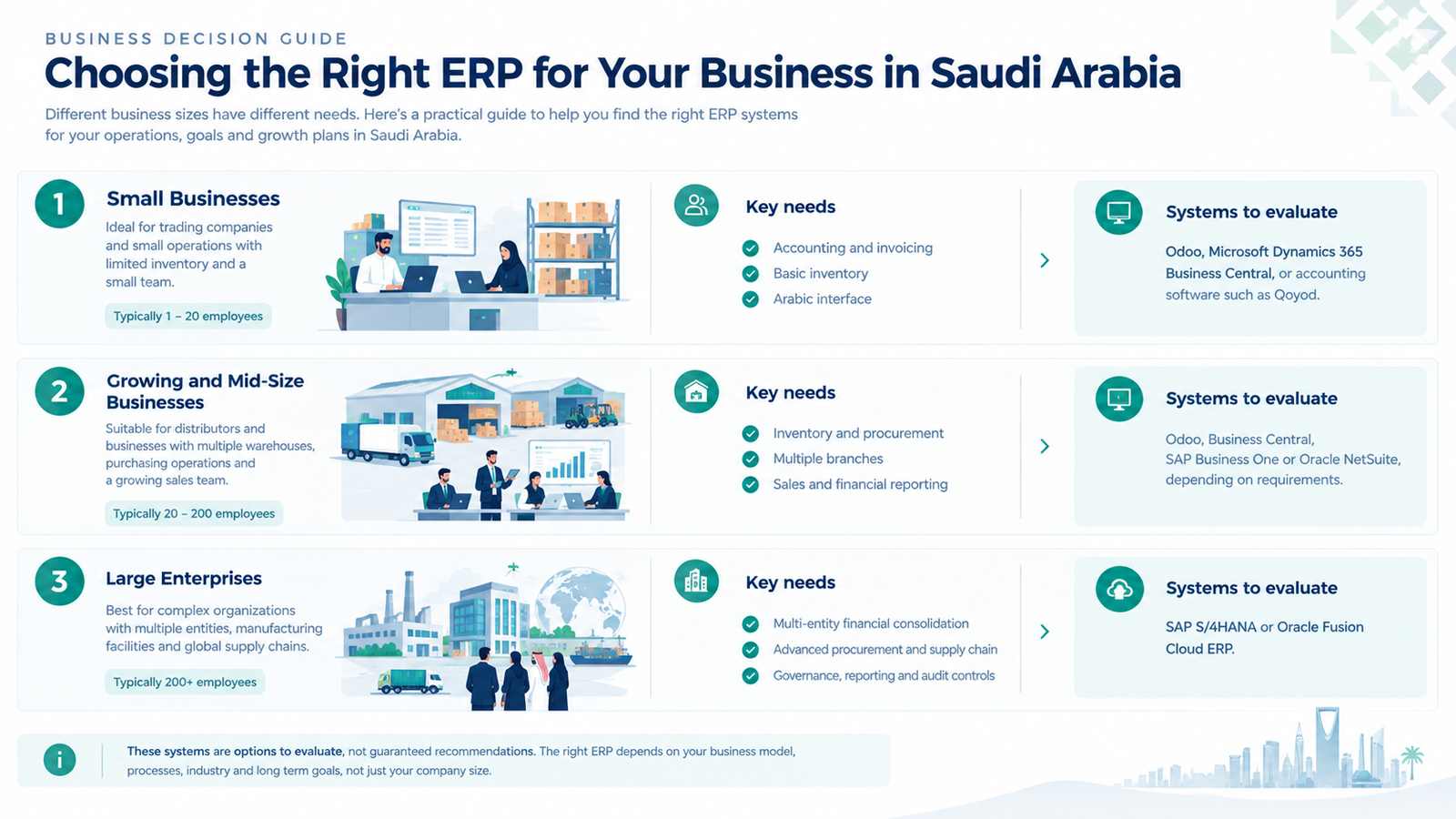
For small Saudi businesses, Odoo and Microsoft Dynamics 365 Business Central are the two ERP systems most worth shortlisting. Odoo wins on built-in Saudi localization and Arabic, while Business Central suits teams already working in Microsoft 365. If you only need invoicing and accounts, a local accounting tool may be enough.
Odoo
Who it suits: small and mid-size trading, retail, distribution and service companies that want to start with a few modules and add more later.
Saudi localization: Odoo's official Saudi Arabia localization includes a Saudi chart of accounts, VAT and withholding taxes, accounting reports, a point of sale package and a module for ZATCA Phase 2 API integration. It also supports sandbox and simulation modes, so you can test e-invoicing before going live.
Strengths: native Arabic interface, modular pricing, inventory and point of sale in the same system, a large partner network in Saudi Arabia.
Not for you if: you run complex process manufacturing or need heavy multi-company consolidation from day one. Heavy customization can also make upgrades harder, so keep changes in check.
Microsoft Dynamics 365 Business Central
Who it suits: growing SMEs that already use Outlook, Teams and Excel, and finance-led businesses that want strong accounting with operations attached.
Saudi localization: Business Central gets ZATCA compliance through certified third-party extensions on Microsoft AppSource, not through a built-in Saudi module. Arabic layouts, Hijri dates and Saudi VAT setup usually come from a partner's localization pack as well.
Strengths: familiar Microsoft environment, strong finance, good reporting with Power BI, wide adoption on Saudi company websites.
Not for you if: you want compliance updates to come from the core vendor itself. With Business Central, ask who maintains the ZATCA extension and what happens when ZATCA changes its specifications.
When accounting software like Qoyod is enough
Not every small business needs an ERP yet. Local tools such as Qoyod focus on invoicing and accounting, and Qoyod says it is approved for Phase 2 e-invoicing with a native Arabic interface. If you have one location, simple stock and a small team, start there.
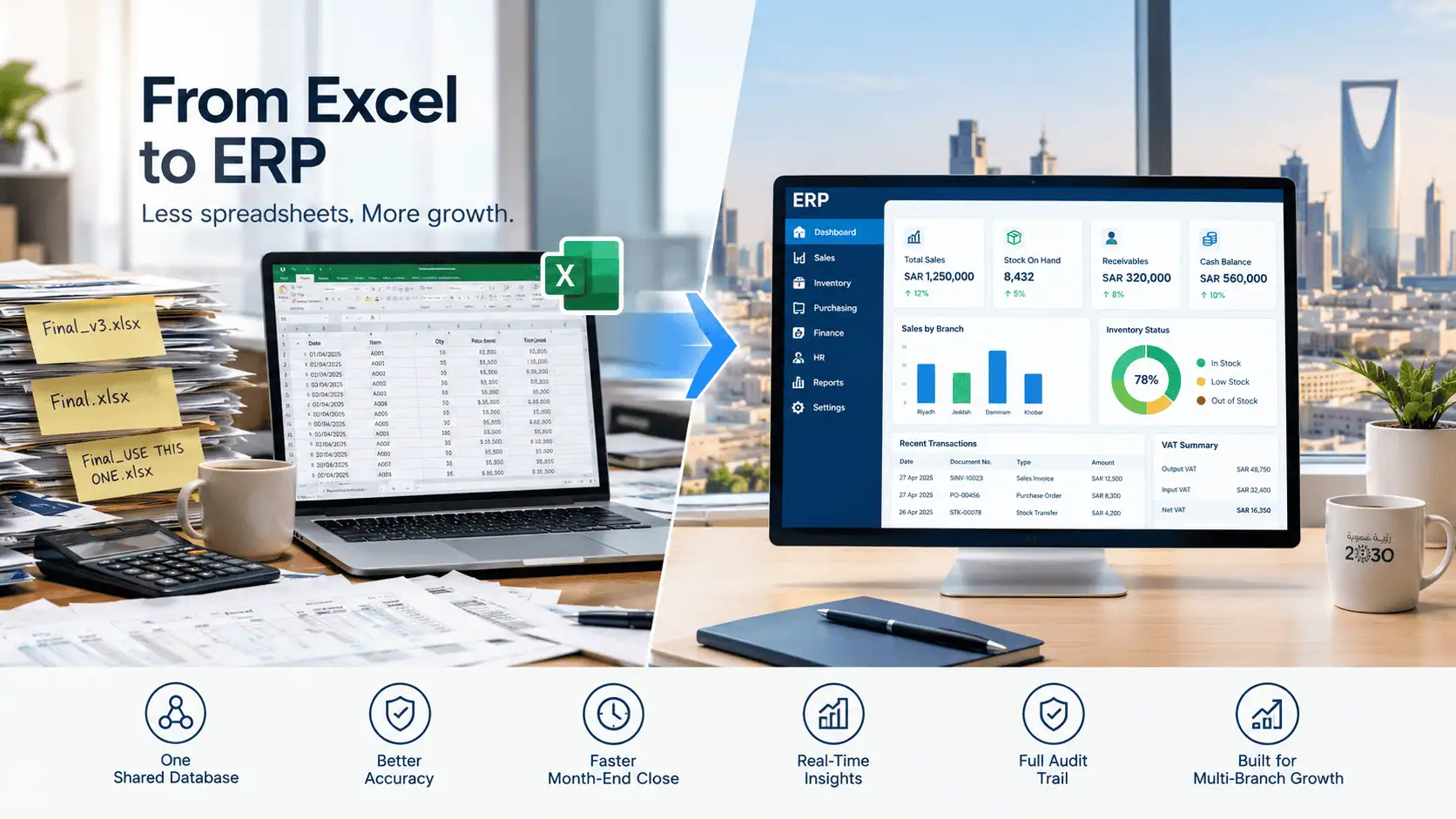
Move to an ERP when you add warehouses, branches, purchasing approvals or manufacturing. Our guide on ERP vs accounting software shows the signs that you have outgrown an accounting tool.
Best ERP software for mid-size and growing companies
Mid-size Saudi companies with several branches, warehouses or entities usually compare SAP Business One and Oracle NetSuite, alongside Odoo and Business Central. SAP Business One suits structured distribution and manufacturing, while NetSuite suits cloud-first companies adding entities quickly.
SAP Business One
Who it suits: mid-size distributors, importers and manufacturers that want a structured SAP system without the cost of SAP's enterprise products.
Saudi localization: e-invoicing for ZATCA Phase 2 is delivered through partner add-ons, such as SEIDOR's solution for SAP Business One, which generates the XML invoices and connects to ZATCA's systems. Your partner's add-on is part of what you are buying, so evaluate it as carefully as the core product.
Strengths: mature inventory, purchasing and production features, a well-known brand for auditors and investors, a clear upgrade path to larger SAP products.
Not for you if: you are a small team on a tight budget, or you want a fully Arabic experience without extra layout work.
Oracle NetSuite
Who it suits: fast-growing companies that want a pure cloud ERP and expect to add subsidiaries or countries.
Saudi localization: ask Oracle or your NetSuite partner to show, in a sandbox, how invoices reach ZATCA's Fatoora platform, who provides that connection, and how Arabic invoices print. Treat any answer you cannot see working as unconfirmed.
Strengths: strong multi-entity and consolidated reporting, a single cloud platform, no servers to run.
Not for you if: you need on-premise hosting, or your budget cannot absorb an annual subscription that rises with users and modules.
If you trade or distribute goods, our guide to ERP for trading and distribution companies covers the modules to test in detail.
Best ERP software for large enterprises
Large Saudi enterprises and holding groups typically choose between SAP S/4HANA and Oracle Fusion Cloud ERP. Both handle complex finance, procurement and supply chains across many entities, but they come with enterprise budgets, long timelines and a large implementation partner.
SAP S/4HANA and Oracle Fusion Cloud ERP
Who they suit: groups with several companies, large manufacturing or industrial operations, and organizations that need deep audit trails and controls.
Saudi localization: at this scale, ZATCA e-invoicing, Arabic documents and Saudi payroll are designed as part of the implementation project. Ask the integrator to name who owns each compliance piece after go-live.
Strengths: depth across finance, procurement, supply chain and HR, plus the controls large organizations and regulators expect.
Not for you if: you are an SME. The licence, partner fees and project length are out of proportion for most businesses below enterprise size, and a mid-market product will serve you better.
How each ERP handles ZATCA Phase 2
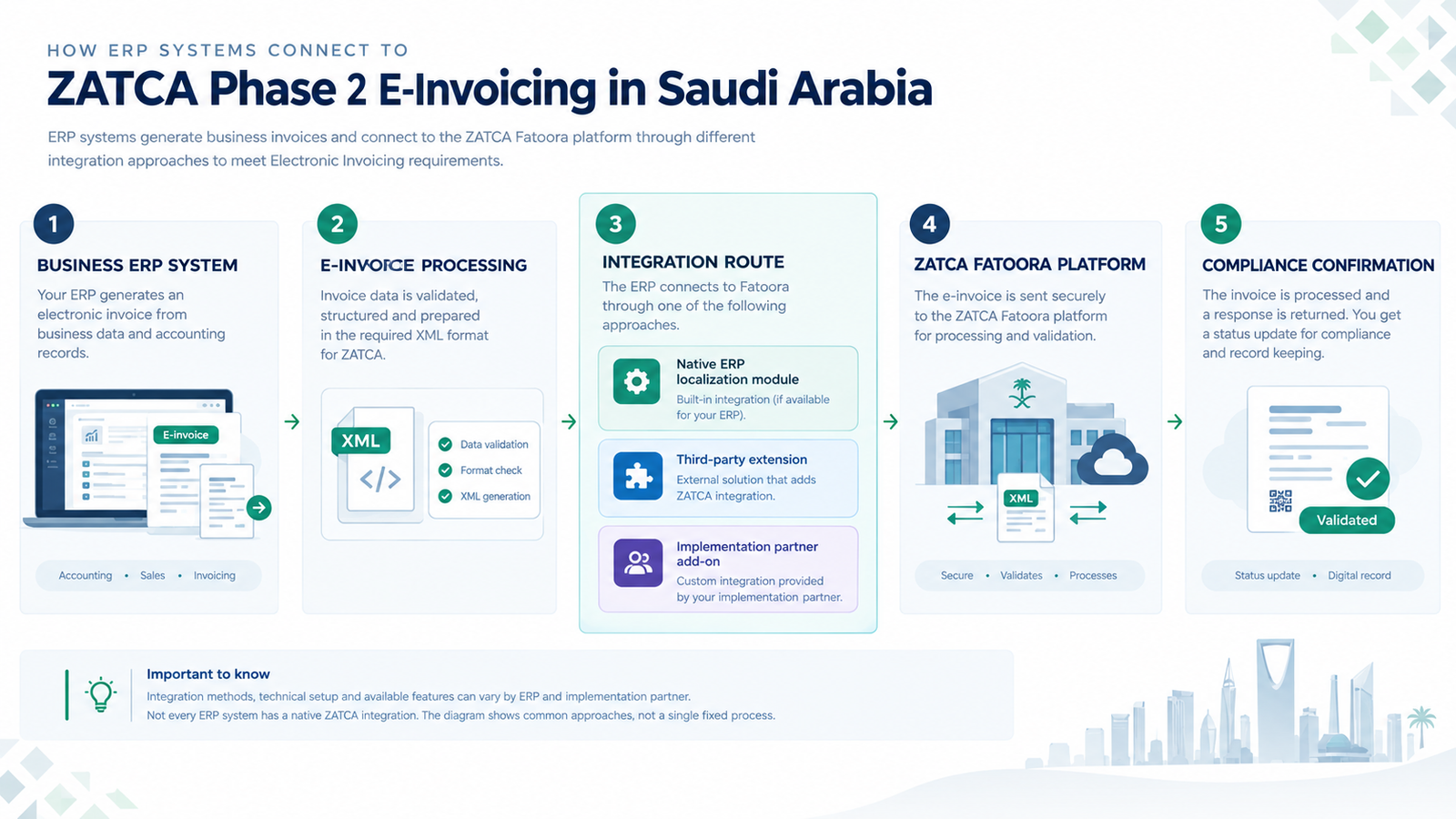
Every serious ERP can produce ZATCA-compliant e-invoices, but they get there in three different ways: a native module from the vendor, a third-party extension, or a partner add-on. The route decides who updates your compliance when ZATCA changes its rules, and that matters more than any feature list.
The pressure is real. ZATCA's wave 25 covers businesses whose VAT-subject revenue exceeded SAR 187,500 in any year from 2022 to 2025, and they must integrate with the Fatoora platform by 1 February 2027 (VATupdate). That threshold brings many small businesses into scope for the first time.
|
Route |
Example |
Who maintains it |
What to ask |
|---|---|---|---|
|
Native vendor module |
Odoo's Saudi localization |
The ERP vendor, through normal updates |
Which edition includes it, and is it in our version? |
|
Third-party extension |
Business Central via AppSource |
The extension publisher |
Who publishes it, how fast do they update, what does it cost per year? |
|
Partner add-on |
SAP Business One |
Your implementation partner |
What happens to our compliance if we change partners? |
|
Built into the project |
S/4HANA, Oracle Fusion |
The integrator and your IT team |
Who owns compliance changes after go-live? |
Whichever route you choose, ask to see an invoice generated and submitted in ZATCA's sandbox during the demo. A vendor's claim is not proof. Our ZATCA Phase 2 integration guide explains the technical steps in detail.
Odoo vs SAP Business One vs Business Central: quick verdict
For most Saudi SMEs, the real decision is between these three. Odoo leads on built-in Saudi localization, Business Central on Microsoft integration, and SAP Business One on structured operations for mid-size firms.
|
Factor |
Odoo |
Business Central |
SAP Business One |
|---|---|---|---|
|
Typical company size |
Small to mid-size |
Small to mid-size |
Mid-size |
|
ZATCA Phase 2 |
Native module |
Third-party extension |
Partner add-on |
|
Arabic interface |
Native |
Via localization |
Available, layouts need work |
|
Strongest area |
Inventory, sales, point of sale |
Finance and Microsoft 365 |
Distribution and production |
|
Main watch-out |
Over-customization |
Extension dependency |
Cost for small teams |
|
Saudi web adoption (WMTips) |
30.6% |
Part of Dynamics 365 at 62.4% |
Not in top three |
Choose Odoo if you want Saudi compliance from the vendor and a native Arabic system you can grow module by module.
Choose Business Central if your team lives in Microsoft 365 and finance drives most decisions.
Choose SAP Business One if you are a mid-size distributor or manufacturer that wants SAP's structure without enterprise cost.
Budget is the other half of the decision. See what ERP implementation costs in KSA before you compare quotes.
The partner matters as much as the software
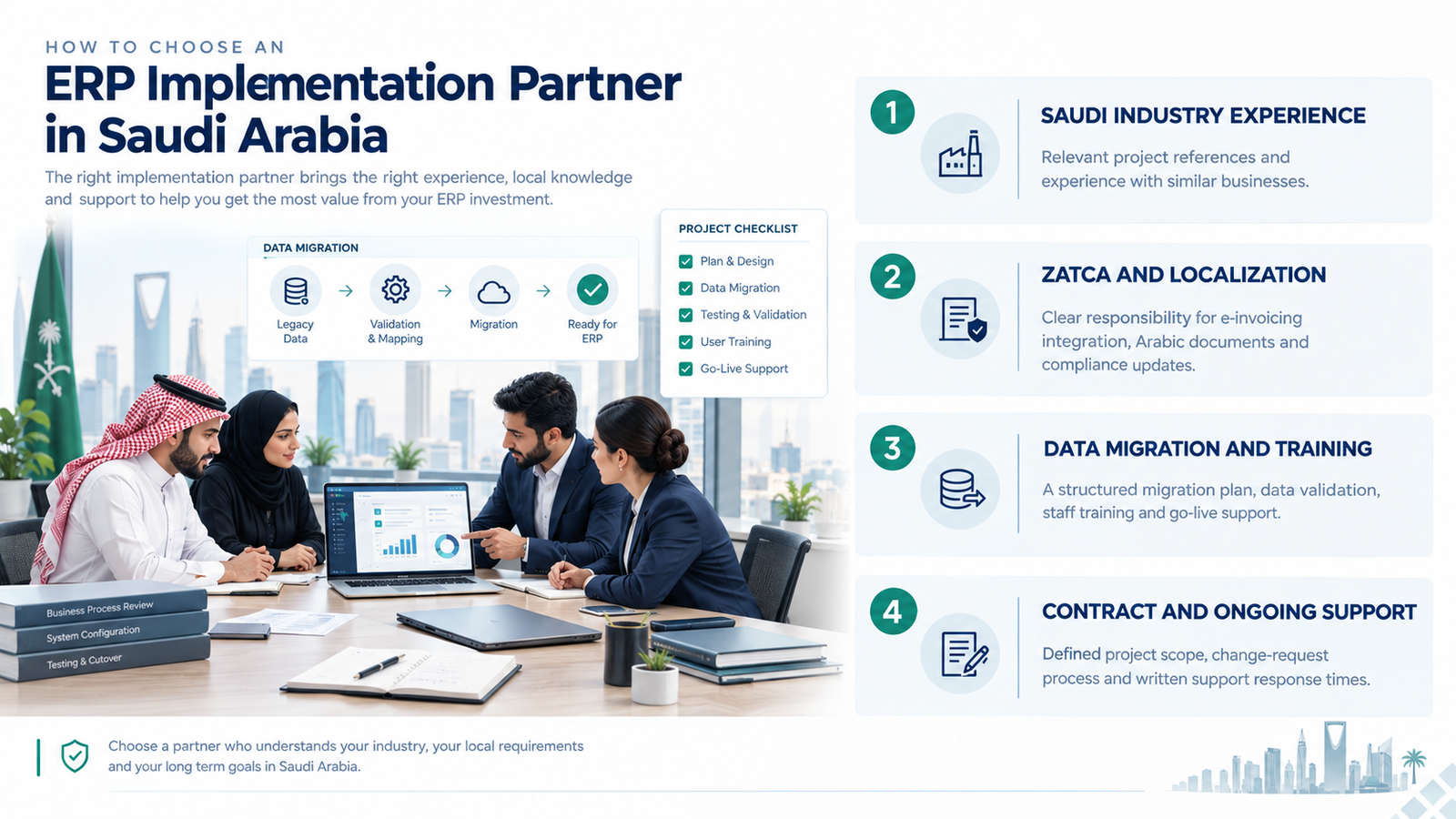
The same ERP can succeed at one Saudi company and fail at the next, and the difference is usually the implementation partner. A good partner gets your data, Arabic documents and ZATCA setup right; a weak one leaves you with a system nobody uses.
Before you sign, check four things:
- References in your industry, ideally in Saudi Arabia, that you can call yourself.
- The named team who will work on your project, not only the sales consultant.
- Local presence in your region, whether that is Riyadh, Jeddah or the Eastern Province, for training and post-launch support.
- A written contract that separates scope, change requests and support response times.
We saw this on our own work for EUTC Global, a certification company in Al Khobar. Its certifications, exams, sales and finances ran in separate, mostly manual tools. Intellitech replaced them with one platform and migrated more than 30,000 historic certificate records in staged batches, with a person checking every ambiguous record instead of letting a script guess. With everything in one place, the team built SAR 600,000 of sales pipeline in a single month. Read the EUTC Global case study.
For the full list of questions and red flags, read our guide on choosing an implementation partner.
Frequently asked questions
What is the best ERP software in Saudi Arabia?
There is no single best ERP; Odoo and Business Central suit most SMEs, SAP Business One suits mid-size firms, and S/4HANA or NetSuite suit large groups. Pick by size, ZATCA route and partner.
Which ERP is most used in Saudi Arabia?
Website scans show Microsoft Dynamics 365 and Odoo as the most detected ERP platforms on Saudi company websites, well ahead of Oracle and SAP. These figures track public websites, not every installation.
Is Odoo or SAP Business One better for a Saudi SME?
Odoo usually suits SMEs wanting native Arabic and built-in ZATCA Phase 2, while SAP Business One suits mid-size firms that want a structured SAP system. Test both on your own data before deciding.
Does Business Central support ZATCA Phase 2?
Business Central supports ZATCA Phase 2 through certified third-party extensions on Microsoft AppSource, not through a built-in Saudi localization module. Ask who maintains the extension and how quickly it is updated.
Do small businesses in Saudi Arabia need an ERP?
Small businesses that mainly invoice and keep accounts can often use local accounting software; ERP becomes worth it once inventory, branches or departments multiply. Moving early to ERP adds cost without much benefit.
How much does ERP software cost in Saudi Arabia?
ERP cost in Saudi Arabia depends on users, modules, integrations and data migration, so compare written quotes over three to five years, not first-year licence prices. Implementation often costs more than the licence.
Get an ERP shortlist for your business
The best ERP for your business is the one that fits your size, passes ZATCA in a live demo and comes with a partner you trust. Write down your requirements, narrow the list to two or three systems, and make each one prove itself on your own data.
If you want a second opinion, Intellitech Solutions can review your requirements and get an ERP shortlist for your business before you spend time on demos. Sometimes the honest answer is that an accounting tool is enough for now, and we will say so.