ERP Implementation Cost in Saudi Arabia
15 min read
On this page
- ERP implementation cost in Saudi Arabia at a glance
- Why two ERP quotes for the same business can differ by 5x
- The 8 factors that decide your ERP price
- 1. Licence model
- 2. Number of modules and users
- 3. Customization vs standard configuration
- 4. Data migration volume and data quality
- 5. Integrations
- 6. Saudi localization
- 7. Branches and legal entities
- 8. Hosting and who delivers the work
- ERP implementation cost breakdown: where the money goes
- Sample estimate: a 25-user trading company in Al Khobar
- Hidden costs of ERP implementation
- First-year price vs 3-year total cost of ownership
- How to compare ERP quotes: a checklist
- How to lower ERP implementation cost without risking the project
- How Intellitech scopes and quotes ERP projects
- Frequently asked questions
- How much does ERP cost for a small business in Saudi Arabia?
- What is included in an ERP implementation cost?
- Why is ERP implementation more expensive than the software licence?
- What are the hidden costs of ERP implementation?
- Do ERP prices in Saudi Arabia include VAT?
- Is a fixed-price ERP quote better than time-and-materials?
- How much does ERP support and maintenance cost per year?
- Conclusion
You asked three partners to quote the same ERP project. One came back at SAR 35,000, another at SAR 90,000, and the third at SAR 180,000. All three said their price was "complete". If that sounds familiar, this guide is for you.
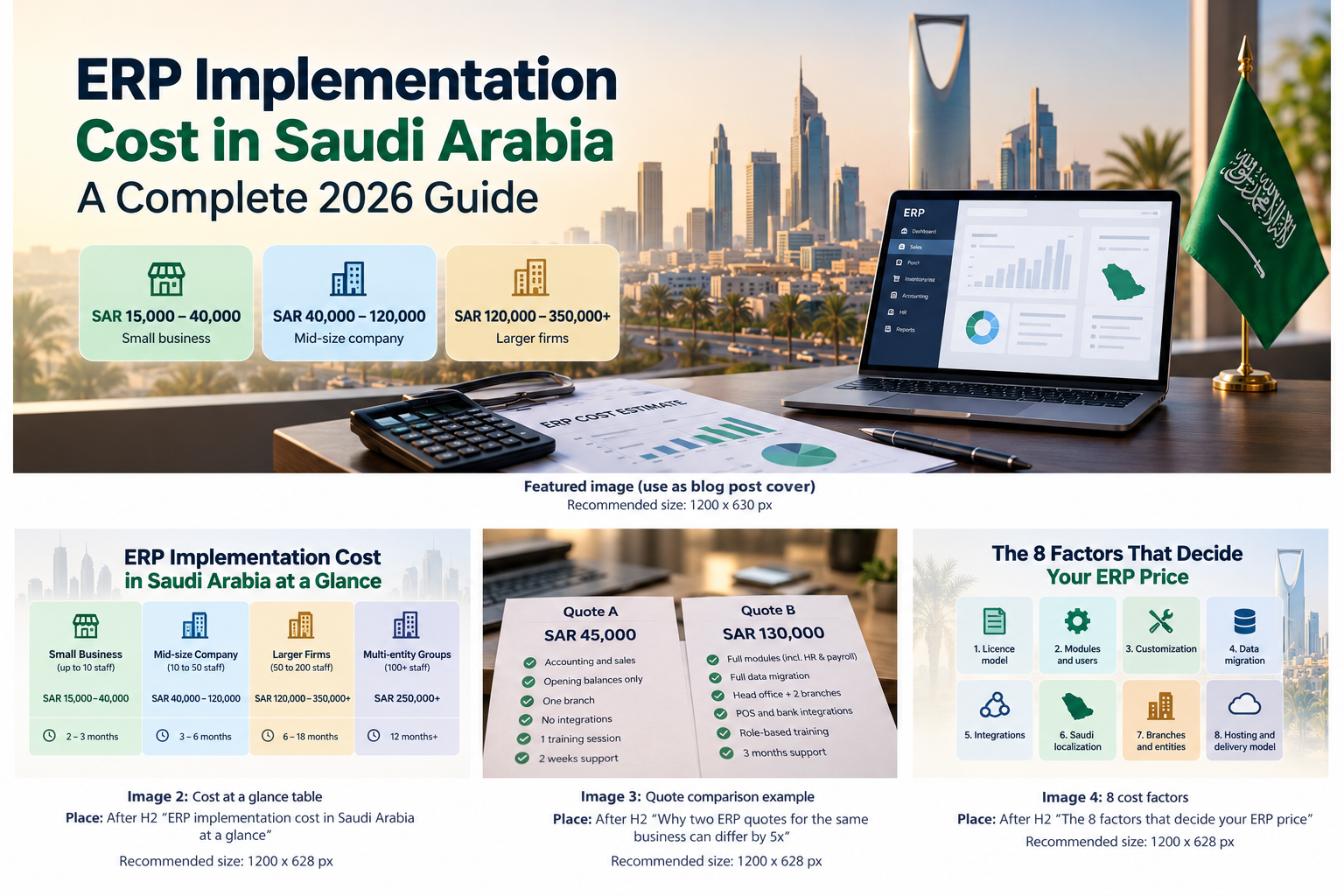
Here is the short answer. ERP implementation cost in Saudi Arabia usually runs from about SAR 15,000 to SAR 40,000 in the first year for a small business, SAR 40,000 to SAR 120,000 for a mid-size company, and SAR 120,000 to SAR 350,000 or more for larger firms. These are the ranges most Saudi ERP partners publish in 2026, and they are normally quoted before 15% VAT. Implementation work, not the software licence, is usually the biggest line: industry benchmarks put it at 40 to 60% of first-year ERP spend.
Below, we break down what sits inside those numbers, why quotes differ so much, and how to read a quote before you sign. If you already know your scope and want a fixed number for it, our ERP implementation services page explains how we scope and deliver projects across the Eastern Province, Riyadh and Jeddah.
ERP implementation cost in Saudi Arabia at a glance
First-year ERP cost in Saudi Arabia depends mainly on company size, user count and how many modules go live. The table below shows ranges commonly quoted in the Saudi market for software, implementation, training and first-year hosting combined. Use it to sanity-check a quote, not as a final price.
|
Company size |
Users |
Typical scope |
First-year cost (SAR, excl. VAT) |
Typical timeline |
|---|---|---|---|---|
|
Small (up to 10 staff) |
3 to 8 |
Accounting, sales, basic inventory |
15,000 to 40,000 |
2 to 3 months |
|
Mid-size (10 to 50 staff) |
8 to 25 |
Multi-module, some customization |
40,000 to 120,000 |
3 to 6 months |
|
Larger (50 to 200 staff) |
25 to 100 |
Full modules, integrations, branches |
120,000 to 350,000+ |
6 to 18 months |
|
Multi-entity groups |
100+ |
Several companies, consolidation |
250,000+ |
12 months or more |
Product choice moves these numbers too. Open-source ERPs such as ERPNext carry no licence fee, so you pay for hosting and implementation. SAP Business One projects in Saudi Arabia are commonly quoted from about SAR 56,000 to over SAR 560,000 for implementation alone. If you are still shortlisting software, compare ERP options available in Saudi Arabia first.
Why two ERP quotes for the same business can differ by 5x
Two ERP quotes for the same Saudi business can differ by five times because each partner prices a different scope, not a different ERP. One quote may cover configuration only, while another includes data migration, integrations, training and a support period. Compare what is inside each number before comparing the numbers.
Here is a typical example for a mid-size company in the Eastern Province. Same company, same 20 users, two quotes:
|
What the quote assumes |
Quote A: SAR 45,000 |
Quote B: SAR 130,000 |
|---|---|---|
|
Modules |
Accounting and sales |
Accounting, sales, inventory, purchasing, HR and payroll |
|
Data migration |
Opening balances only, imported by your team |
Customers, suppliers, items and 3 years of history, cleaned by the partner |
|
Branches |
One company, one warehouse |
Head office plus two branches with separate stock |
|
Integrations |
None |
POS and bank statement import |
|
Training |
1 online session |
Role-based training for each department |
|
Support after go-live |
2 weeks |
3 months on-site and remote |
|
Change requests |
Billed hourly, rate not stated |
20 hours included |
Quote A looks cheaper, but it is a smaller project. Once you add the missing pieces as change requests, the final bill often lands close to Quote B, and the go-live date moves too. That is why research from KFUPM on ERP projects in Saudi Arabia found that most organisations faced time or cost overruns: the scope that mattered was never in the first quote.
Three questions settle most of the gap:
- What exactly goes live on day one? Modules, branches, users and reports.
- Who does the data work? Cleaning and importing data is often the line that gets left out.
- What happens after go-live? Support length, response time and the hourly rate for changes.
The 8 factors that decide your ERP price
Eight factors decide almost every ERP implementation cost in Saudi Arabia: the licence model, modules and users, customization, data migration, integrations, Saudi localization, branches and entities, and hosting plus who delivers the work. Each one either adds days to the project plan or removes them, and days are what you pay for.
1. Licence model
The licence model sets your recurring cost, not your implementation cost. ERP software is sold per user, per app, as a flat subscription, or as open source with no licence fee. Many cloud ERPs bill in US dollars, so your SAR cost follows the riyal's peg of about 3.75 to the dollar. Open source looks free, but you still pay for hosting and more setup work. Our guide to choosing the right ERP for your business covers this trade-off in detail.
- Adds cost when: you license every staff member, including people who only view reports.
- Keeps cost down when: you separate full users from light or read-only users.
2. Number of modules and users
Every module that goes live needs its own setup, testing and training, so module count drives implementation days more than user count does. Accounting alone is a short project. Accounting plus inventory, purchasing, HR and manufacturing is a much bigger one.
- Adds cost when: everything goes live on the same day.
- Keeps cost down when: core finance and sales go live first, and other modules follow in phase two.
3. Customization vs standard configuration
Customization is the factor most likely to double a budget. Configuring standard features is fast. Building new screens, workflows or reports is development work, and a genuine custom module is often quoted at SAR 15,000 to SAR 55,000 each in Saudi Arabia. Custom code also has to be retested at every version upgrade.
- Adds cost when: the ERP must copy your current Excel process exactly.
- Keeps cost down when: you adapt the process to the ERP's standard workflow where it makes sense.
4. Data migration volume and data quality
Data migration costs depend less on how much data you have and more on how clean it is. Duplicate customers, items with three different names, and unreconciled balances all need fixing before import. Saudi market estimates put a light migration (under 2 years of data) at around SAR 18,000 to SAR 45,000, and a moderate one (3 to 7 years) at around SAR 45,000 to SAR 112,000.
Scale matters too. On a recent platform project for a certification company in Al Khobar, our team migrated more than 30,000 historic certificate records in staged batches so daily work never stopped. Staging like that takes planning time, and it belongs in the quote.
5. Integrations
Each system your ERP has to talk to adds design, build and testing time. Common integrations in Saudi projects include POS terminals, e-commerce stores, bank statement imports, shipping tools and e-invoicing integration with your ERP. Middleware subscriptions for these connections can also become a new recurring cost.
6. Saudi localization
Localization covers the Saudi-specific setup a global template does not include out of the box. Typical lines are payroll that handles GOSI contributions and produces Mudad and WPS salary files, Arabic print formats for invoices and statements, bilingual Arabic and English reports, and Hijri dates where your team needs them. Ask whether each item is included as standard or quoted as an extra.
7. Branches and legal entities
Every extra branch or company adds its own stock locations, cost centres, approval rules and reports. A trading company with a head office in Al Khobar and branches in Riyadh and Jeddah needs inter-branch transfers and branch-wise profit reports from day one. Several legal entities also need intercompany entries and consolidation.
8. Hosting and who delivers the work
Hosting choice changes both setup and running cost. Cloud ERP moves cost into a monthly fee, on-premise needs servers and IT support up front, and some companies choose hosting inside the Kingdom because the Personal Data Protection Law overseen by SDAIA restricts transfers of personal data abroad. Who delivers also matters: a local team that can sit with your staff costs more per day than an offshore team, but usually needs fewer days and fewer rework cycles. Read how to evaluate an ERP implementation partner before you compare day rates.
Once you know which of these eight apply to you, the price stops being a guess. Share your module list, users, branches and data situation, and we can get you an ERP implementation quote built on that scope.
ERP implementation cost breakdown: where the money goes
An ERP budget in Saudi Arabia splits into one-time project costs and recurring running costs. One-time costs (implementation, migration, integrations, training) usually take the larger share in year one. Recurring costs (licences or hosting, support) are smaller each year but continue for as long as you use the system.
|
Cost item |
One-time or recurring |
What drives the amount |
|---|---|---|
|
Licences or subscription |
Recurring, monthly or yearly |
Users, apps and plan; USD billing for many cloud ERPs |
|
Hosting |
Recurring |
Cloud plan, server size, in-Kingdom hosting needs |
|
Implementation and configuration |
One-time |
Modules, branches, approval workflows, reports |
|
Customization |
One-time, plus upkeep at upgrades |
Custom screens, modules and print formats |
|
Data migration |
One-time |
Years of history, data quality, number of source systems |
|
Integrations |
One-time build, sometimes recurring middleware |
POS, e-commerce, banks, e-invoicing |
|
Training |
One-time, plus new-joiner training |
Departments, user count, train-the-trainer or full training |
|
Support and maintenance (AMC) |
Recurring, usually yearly |
Response time, included hours, version upgrades |
Sample estimate: a 25-user trading company in Al Khobar
A 25-user trading company in Al Khobar with two branches would typically spend about SAR 94,000 to SAR 150,000 on ERP in the first year, before VAT. The example below is illustrative and built from the market ranges in this guide. Your own number depends on the eight factors above.
The company: head office and main warehouse in Al Khobar, branches in Dammam and Riyadh, 25 ERP users, around 4,000 stock items, and 3 years of history kept in an older accounting system and Excel.
Scope: accounting, sales, purchasing, inventory across 3 locations, POS at both branches, bank statement import, and role-based training.
|
Line item |
Estimated first-year cost (SAR, excl. VAT) |
|---|---|
|
Licences or subscription for 25 users |
25,000 to 40,000 |
|
Implementation and configuration |
30,000 to 50,000 |
|
Data migration (3 years, cleaning included) |
18,000 to 25,000 |
|
Integrations (POS and bank import) |
8,000 to 15,000 |
|
Training |
5,000 to 8,000 |
|
Go-live support for the first 3 months |
8,000 to 12,000 |
|
Total year one |
94,000 to 150,000 |
About two thirds of that total is project work, not software. That is normal for a company with branches, POS and messy legacy data. If your business looks like this one, our guide to ERP for trading and distribution companies covers the inventory and branch setup in more depth.
Hidden costs of ERP implementation
The hidden costs of ERP implementation are the ones that never appear on the partner's quote: your own staff time, data cleanup, change requests, and the dip in productivity right after go-live. They are real money, and planning for them is the difference between a project that lands on budget and one that runs over.
- Your team's time. Finance, sales and warehouse leads spend hours in workshops, testing and data checks. Someone may need to cover their normal work.
- Data cleanup before migration. Merging duplicate customers and fixing item codes is often done by your staff, not the partner.
- Change requests. Anything outside the signed scope is billed separately. Ask for the hourly rate in writing before you sign.
- Productivity dip after go-live. Plan for the first few weeks to be slower while people learn new screens.
- Upgrade work on custom code. Every customization has to be retested when the ERP vendor releases a new version.
- Licence growth. New hires, new branches and new modules all raise the yearly bill.
Panorama Consulting's breakdown of hidden ERP costs points to data cleansing and change management as the items companies underestimate most. The risk is highest for Saudi companies moving off years of Excel files.
First-year price vs 3-year total cost of ownership
Total cost of ownership (TCO) is what an ERP costs you over three years, not just at go-live. For the sample Al Khobar company above, the 3-year TCO comes to roughly SAR 174,000 to SAR 300,000 before VAT, because licences and support continue after the project ends.
|
Year |
What you pay for |
Estimated cost (SAR, excl. VAT) |
|---|---|---|
|
Year 1 |
Licences, implementation, migration, integrations, training, go-live support |
94,000 to 150,000 |
|
Year 2 |
Licences, annual support (AMC), small changes |
40,000 to 75,000 |
|
Year 3 |
Licences, AMC, small changes, possible new users |
40,000 to 75,000 |
|
3-year total |
174,000 to 300,000 |
When you compare two systems, compare this three-year number. A cheap first year with expensive licences can cost more by year three than a higher project fee with lower running costs.
How to compare ERP quotes: a checklist
To compare ERP quotes fairly, line them up against the same scope and check what each one leaves out. A lower number is only cheaper if it covers the same modules, data, integrations, training and support. Use this checklist before you sign.
- Pricing model: fixed price for a defined scope, or time-and-materials billed by the hour?
- Modules and branches: listed by name, with the number of users and locations.
- Data migration: which records, how many years, and who cleans the data.
- Integrations: each one named, with any middleware fees shown separately.
- Training: hours or sessions per department, plus training material.
- Go-live support: how long the support period lasts and how fast issues get a response.
- Change requests: the hourly or daily rate, and any hours already included.
- Annual support (AMC): yearly fee, what it covers, and whether upgrades are included.
- Licences: billed by whom, in which currency, and the price for each extra user.
- VAT: whether the 15% VAT is included or added on top.
Fixed price suits most small and mid-size Saudi companies because the budget is locked once scope is agreed. Time-and-materials suits projects where requirements are still unclear, but it needs tight tracking. If you want a second opinion on quotes you already have, book an ERP pricing consultation with our team.
How to lower ERP implementation cost without risking the project
You can lower ERP implementation cost in Saudi Arabia by going live in phases, using standard features before custom ones, and cleaning your data before migration starts. These steps cut project days without cutting the parts that keep the system usable.
- Go live in phases. Start with finance, sales and inventory. Add HR, payroll or manufacturing once the core is stable.
- Use standard workflows first. Customize only where a standard process would hurt your business.
- Clean data early. Fix customer, supplier and item lists while the partner is still configuring.
- Name one internal project owner. Fast decisions save more days than any discount.
- Train the trainers. Train key users deeply, then let them train their departments.
- Migrate only what you need. Opening balances plus 1 to 2 years of history is often enough; archive the rest.
Timeline and cost move together, so it helps to understand the step-by-step ERP implementation process before you plan your budget.
How Intellitech scopes and quotes ERP projects
Intellitech Solutions quotes ERP projects only after a scoping session, so the price is tied to your modules, users, branches and data, not to a generic package. We are based in Al Khobar and work with companies across the Eastern Province, Riyadh and Jeddah.
A typical quote from us spells out what goes live, who handles the data, which integrations are included, how much training each department gets, and how long go-live support lasts. Anything outside that list is shown as optional, with its price, so nothing turns up later as a surprise. For the Al Khobar certification company mentioned above, that planning helped their team build SAR 600,000 in sales pipeline within a month of moving to the new platform.
To see the full scope of what we deliver, visit our ERP system implementation page for Saudi businesses.
Frequently asked questions
How much does ERP cost for a small business in Saudi Arabia?
A small business in Saudi Arabia typically spends SAR 15,000 to SAR 40,000 on ERP in the first year, before VAT. That usually covers 3 to 8 users on accounting, sales and basic inventory, including setup, training and hosting or licences.
What is included in an ERP implementation cost?
ERP implementation cost covers configuration, data migration, integrations, training and go-live support. Software licences and annual support are usually priced separately. Always ask for a line-by-line quote so you can see which of these items are included and which are extra.
Why is ERP implementation more expensive than the software licence?
ERP implementation costs more than the licence because most of the work is people's time: mapping your processes, configuring the system, cleaning and moving data, and training staff. Industry benchmarks put implementation at roughly 40 to 60% of first-year ERP spend.
What are the hidden costs of ERP implementation?
The main hidden costs of ERP implementation are internal staff time, data cleanup, change requests, slower work in the first weeks after go-live, and retesting custom code at upgrades. None of these appear on a partner's quote, so budget for them separately.
Do ERP prices in Saudi Arabia include VAT?
Most ERP quotes in Saudi Arabia are shown before the 15% VAT, which is added to the invoice. Licences billed in US dollars also move with the exchange rate, so check the currency and VAT treatment of every line before you compare quotes.
Is a fixed-price ERP quote better than time-and-materials?
A fixed-price ERP quote is usually better for small and mid-size companies because the budget is locked once scope is agreed. Time-and-materials suits projects with unclear requirements, but you need to track hours closely to avoid overruns.
How much does ERP support and maintenance cost per year?
ERP support and maintenance in Saudi Arabia is usually a yearly contract, often called an AMC, priced on response time, included hours and upgrades. Add it to licence renewals when you calculate yearly running costs, since both continue after the project ends.
Conclusion
ERP implementation cost in Saudi Arabia is not one number. It is the sum of eight decisions about licences, modules, customization, data, integrations, localization, branches and hosting. Get those clear first, compare quotes on the same scope, and budget for three years, not just go-live.
Ready for a number built on your scope? Request your ERP quote or talk to our team.