ERP for Construction Companies in Saudi Arabia: What Contractors Should Look For
14 min read
On this page
- What is a construction ERP?
- Why accounting software breaks for contractors
- How money moves through one project in a construction ERP
- Project-wise financial reporting: budget vs committed vs actual
- Must-have modules for contractors in Saudi Arabia
- Progress billing and retention tracking
- Subcontractor management and variation orders
- ERP for construction procurement: from request to site receipt
- Site stores, materials and equipment
- Saudi-specific requirements for a contractor ERP
- Construction-specific ERP vs configurable generic ERP
- How to evaluate a construction ERP: scorecard and 10 questions
- How Intellitech helps contractors in Saudi Arabia
- Frequently asked questions
- What is the best ERP for construction companies in Saudi Arabia?
- How is a construction ERP different from accounting software?
- Can an ERP track retention and progress claims for Saudi projects?
- How does project costing work in a construction ERP?
- Does a construction ERP in Saudi Arabia need Arabic support?
Saudi Arabia awarded more than SR30 billion in contracts in May 2026 alone, the highest month of the year so far, according to Saudi Contractors Authority figures reported by Arab News. More projects means more work for contractors. It also means more places for margin to quietly disappear.
If you run a contracting company in Riyadh, Dammam, Jubail or Jeddah, you probably know the pattern. The site engineer orders material on WhatsApp. The purchaser tracks POs in Excel. The accountant sees the cost a month later. By the time anyone compares budget to actual, the project is already over.
A construction ERP in Saudi Arabia fixes this by putting every project's budget, purchases, subcontractors, progress claims and retention in one system. This guide explains what a construction ERP should actually do, which modules matter most for Saudi contractors, and how to judge your options before you sign anything.
What is a construction ERP?
A construction ERP is business software built around the project, not just the company ledger. Estimating, procurement, site stores, subcontractors, progress billing and finance all read and write the same project record. So a contractor can see each project's budget, committed cost, actual cost and billed amount in one place, at any time.
Generic ERP and accounting tools are built around departments: sales, purchasing, inventory, accounts. Contractors work differently. Every job has its own contract value, BOQ, budget, suppliers, subcontractors and payment cycle. A construction ERP treats cost codes, variation orders, progress claims and retention as standard features, not custom add-ons.
Why accounting software breaks for contractors
Accounting software records what already happened. Contractors need to see what is about to happen. Here is where it usually falls short:
- It shows company-level profit, not profit per project or per cost code.
- It records a purchase only when the invoice arrives, so committed costs stay invisible for weeks.
- It has no idea what a progress claim, retention or variation order is.
- Site stores and material transfers between projects live outside the system.
If you are still deciding whether you need a full ERP at all, our guide on ERP vs accounting software walks through the warning signs.
How money moves through one project in a construction ERP
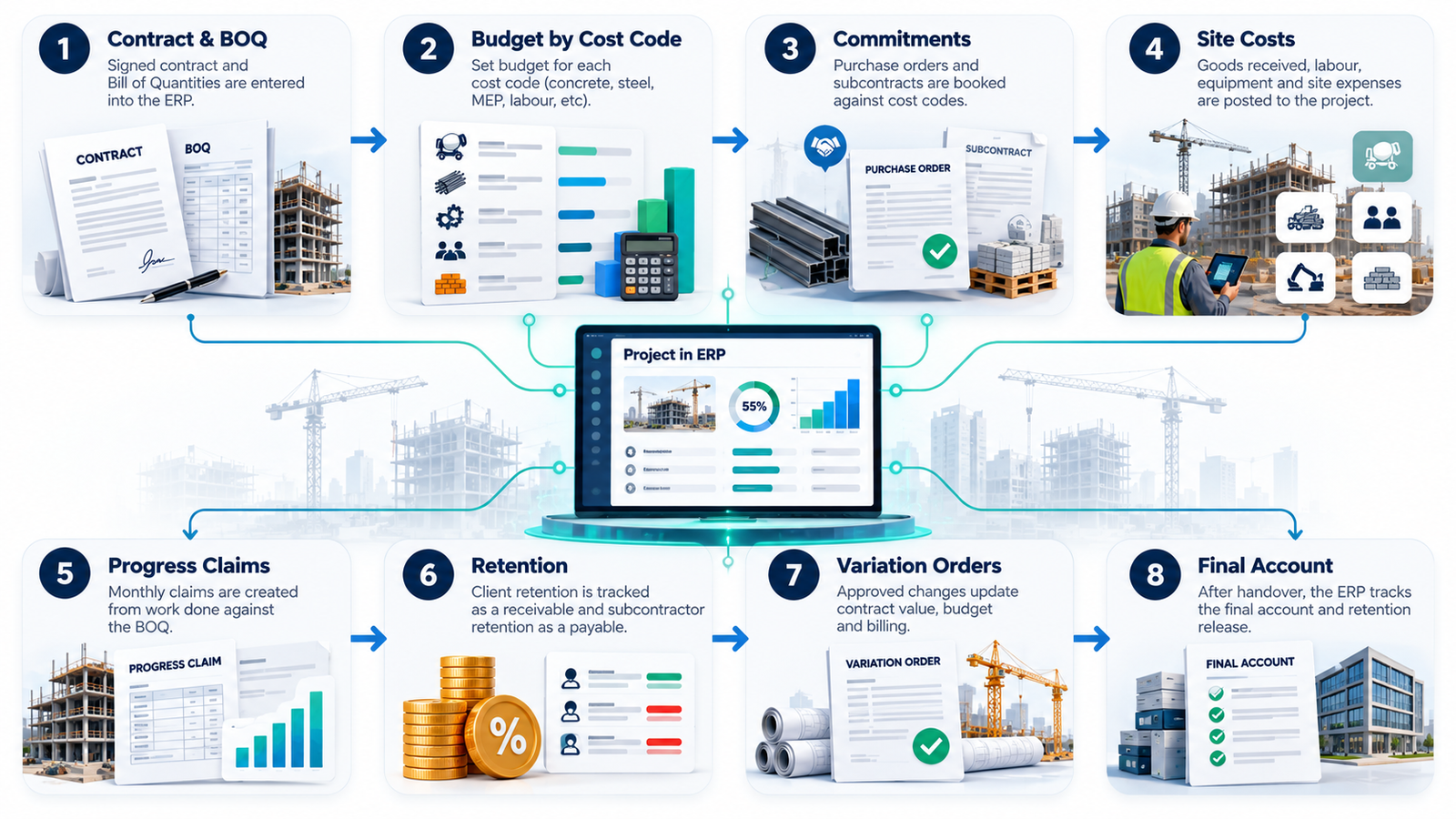
In a construction ERP, one project's money follows a fixed path: contract and BOQ, budget by cost code, commitments, site costs, progress claims, retention, variations, and finally retention release. Each step updates the same project record, so the margin is visible at every stage instead of only at the final account.
Here is that path step by step:
- Contract and BOQ. The signed contract value and Bill of Quantities are entered once. Every BOQ line maps to a cost code.
- Budget by cost code. The estimating team sets a budget for concrete, steel, MEP, labour, equipment and overheads against those cost codes.
- Commitments. Each purchase order and subcontract is booked against a cost code the moment it is approved, not when the invoice arrives. This is your committed cost.
- Site costs. Goods received at site, timesheets, equipment hours and petty cash are posted to the same project.
- Progress claim. The ERP builds the monthly claim from work done against the BOQ, so billing matches progress.
- Retention. The client's retention, often 10% of each certified amount, is tracked as a receivable per project. Retention you hold back from subcontractors is tracked as a payable.
- Variation orders. Approved changes update contract value, budget and billing together, so extra work is never done for free.
- Final account and retention release. After handover and the defects liability period, the ERP shows exactly how much retention is due, from whom, and when.
When this whole chain sits in one system, you stop finding margin problems at the end of the job. You see them the week they start. This is the core of what we set up when delivering ERP for construction companies in the Kingdom.
Project-wise financial reporting: budget vs committed vs actual
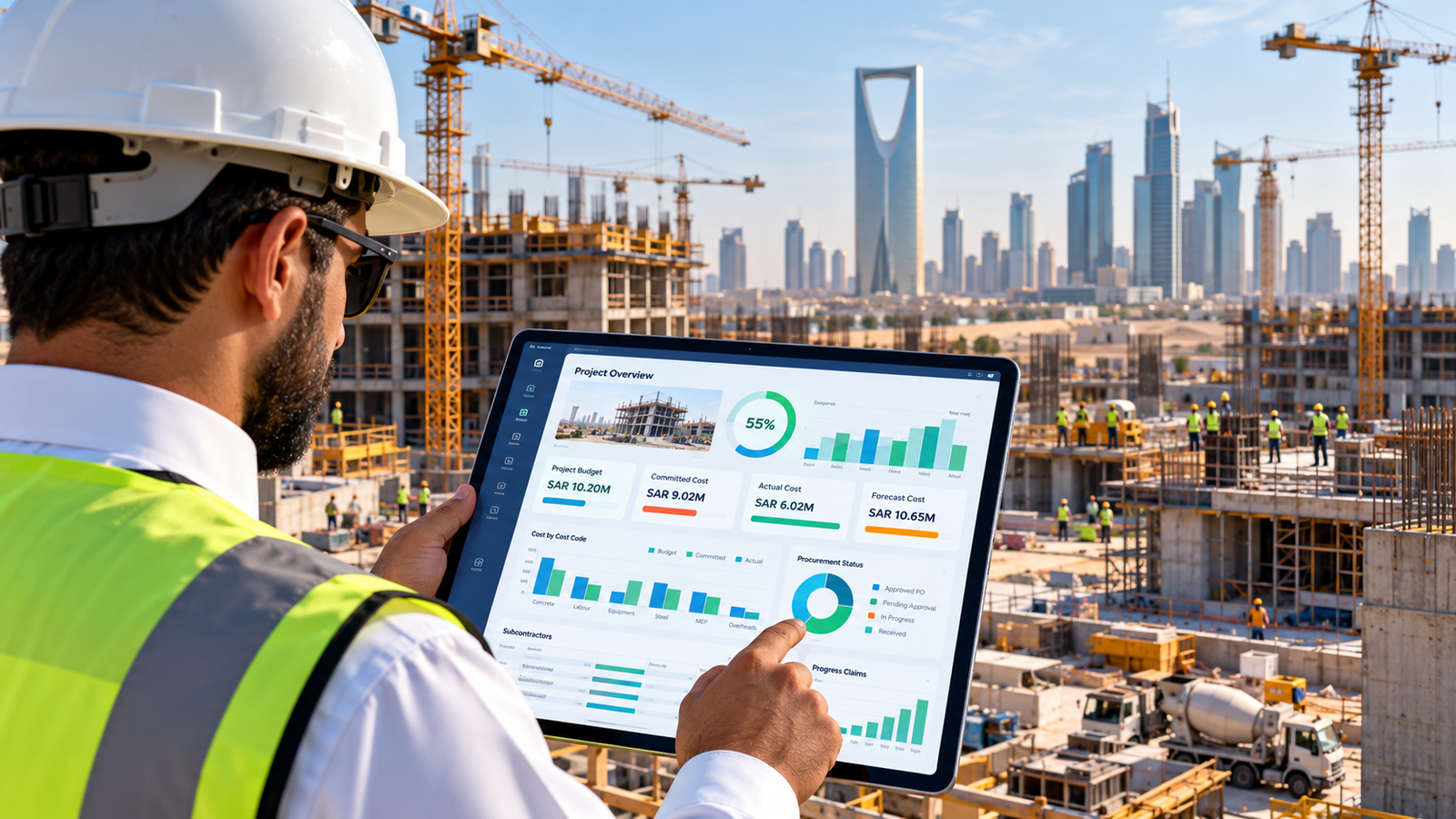
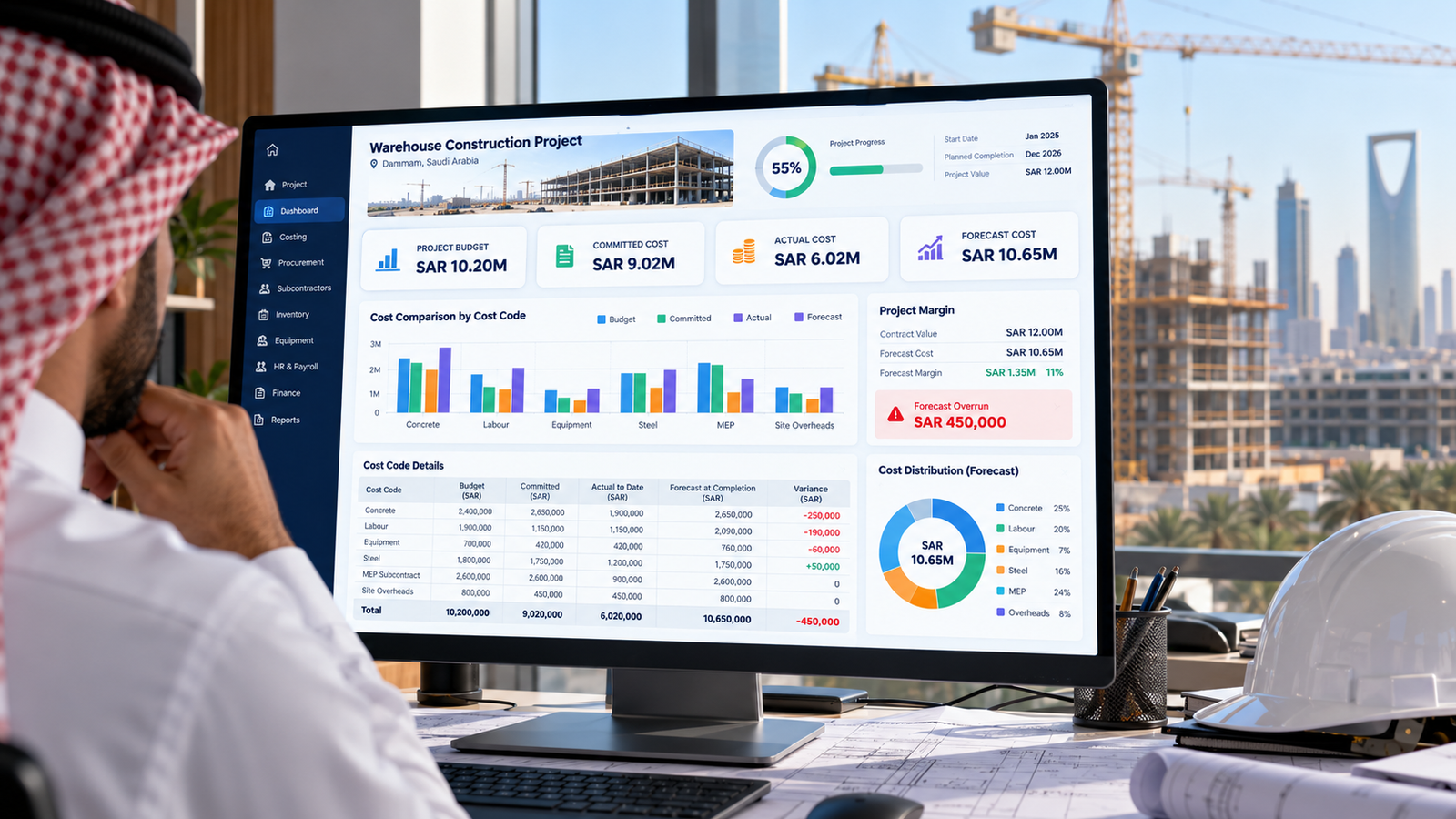
Project-wise financial reporting in an ERP compares four numbers for every cost code: budget, committed cost, actual cost and forecast at completion. Committed cost is the one most contractors miss. It shows money you have already promised through POs and subcontracts, weeks before the invoices land in accounts.
Take an illustrative example. A contractor in Dammam is building a SAR 12,000,000 warehouse. The planned margin is 15%, so the cost budget is SAR 10,200,000. At 55% progress, the project-wise report looks like this:
|
Cost code |
Budget (SAR) |
Committed (SAR) |
Actual to date (SAR) |
Forecast at completion (SAR) |
Variance (SAR) |
|---|---|---|---|---|---|
|
Concrete |
2,400,000 |
2,650,000 |
1,900,000 |
2,650,000 |
-250,000 |
|
Labour |
1,900,000 |
1,150,000 |
1,150,000 |
2,090,000 |
-190,000 |
|
Equipment |
700,000 |
420,000 |
420,000 |
760,000 |
-60,000 |
|
Steel |
1,800,000 |
1,750,000 |
1,200,000 |
1,750,000 |
+50,000 |
|
MEP subcontract |
2,600,000 |
2,600,000 |
900,000 |
2,600,000 |
0 |
|
Site overheads |
800,000 |
450,000 |
450,000 |
800,000 |
0 |
|
Total |
10,200,000 |
9,020,000 |
6,020,000 |
10,650,000 |
-450,000 |
Look only at actual cost (SAR 6.02 million against a SAR 10.2 million budget) and the job seems fine. The committed and forecast columns tell the real story. Concrete is already SAR 250,000 over because a higher-priced supplier PO was approved. Labour productivity is behind. The margin has dropped from 15% to about 11%, and there is still time to act.
This is the report a construction ERP should give your project manager and finance team every week, without anyone building it in Excel.
Must-have modules for contractors in Saudi Arabia
A construction ERP for Saudi contractors needs eight core modules: project costing, progress billing with retention, subcontractor management, procurement, site inventory, equipment, HR and payroll, and finance. Research from KFUPM authors in the Journal of Civil Engineering and Management ranked 13 ERP modules by importance for the Saudi construction industry, which shows how much priorities differ from a standard ERP rollout.
|
Module |
What it controls |
Red flag if it is missing |
|---|---|---|
|
Project costing |
Budget, commitments and actuals per cost code |
Profit is only known after the job closes |
|
Progress billing and retention |
Monthly claims from BOQ progress, retention receivable and payable |
Claims built in Excel, retention tracked on paper |
|
Subcontractor management |
Subcontracts, measured work, back-charges, retention held |
Overpaying subcontractors for work not certified |
|
Procurement |
Purchase requests, RFQs, POs, approvals by cost code |
POs raised without checking the budget |
|
Site inventory |
Main store, site stores, transfers between projects |
Material "lost" between sites |
|
Equipment |
Owned and rented plant, hours, fuel, maintenance |
Equipment cost never charged to projects |
|
HR and payroll |
Labour timesheets by project, Saudi payroll rules |
Labour cost spread evenly instead of by project |
|
Finance |
Ledger, VAT, bank, cash flow by project |
Two systems that never reconcile |
Progress billing and retention tracking
A construction ERP should create each progress claim from measured work against the BOQ and track retention on every certified amount. Saudi construction contracts commonly hold back 10% per payment and release it about one year after handover, as Qoyod's accounting glossary notes. Over a two-year project with 20 monthly claims, that is a lot of small balances to follow by hand.
Your ERP should show, per project: total retention held by the client, the release date, and retention you are holding from each subcontractor. When the defects liability period ends, nobody should have to dig through old claims to work out what you are owed.
Subcontractor management and variation orders
Subcontractor management in an ERP means every subcontract, measured quantity, payment and back-charge sits against the project and cost code. Contractors in Saudi Arabia have historically subcontracted a large share of their work, so weak subcontractor control is one of the fastest ways to lose margin.
Variation orders deserve the same discipline. An approved variation should update the contract value, the budget and the next progress claim together. If your team does extra work on a site instruction and nobody records it, you have just given that work away.
ERP for construction procurement: from request to site receipt
ERP for construction procurement links every purchase to a project and cost code, from the first request to the supplier invoice. The typical flow looks like this:
- Site engineer raises a purchase request against a cost code.
- The system checks remaining budget before approval.
- Purchaser collects quotes and issues a PO.
- Storekeeper records the goods received note (GRN) at site.
- Accounts match the supplier invoice to the PO and GRN before payment.
That three-way match stops paying for material that never reached site. It also gives you real committed cost data for the report shown above.
Site stores, materials and equipment
Most contractors run a main store plus a store at every active site. The ERP should track stock in each, record transfers between projects, and charge material to the project that actually used it. The same goes for equipment: hours, fuel and rental cost should land on the right job, not in general overheads.
Saudi-specific requirements for a contractor ERP
A contractor ERP in Saudi Arabia must handle Arabic and English side by side, government billing cycles through the Etimad platform, and cash-flow tracking under slow client payments. Global construction software often covers the project side well but leaves these local pieces to workarounds.
What to check:
- Arabic and English. Site teams, accountants and clients may each prefer a different language. Claims, POs and reports should print in both.
- Government billing. Contractors on government projects submit invoices through Etimad. Your ERP should produce claim data in the format your team uploads, so nobody retypes figures.
- Cash flow under late payments. Saudi Arabia has no dedicated security-of-payment law, and DLA Piper notes that delayed private-sector payments are common. A project-level view of what is certified, invoiced, received and overdue is not optional.
Construction-specific ERP vs configurable generic ERP
Saudi contractors usually choose between two routes: a construction-specific ERP built for project-based firms, or a configurable generic ERP such as Odoo, Microsoft Dynamics 365 Business Central, SAP Business One or ERPNext, set up for construction workflows. Neither is better in every case. The right fit depends on project size, contract complexity and your budget for setup.
|
Factor |
Construction-specific ERP |
Configurable generic ERP |
|---|---|---|
|
Fit out of the box |
BOQ, WBS, claims and retention ready on day one |
Needs configuration or add-ons for claims and retention |
|
Best for |
Large EPC and infrastructure contractors with complex contracts |
Small and mid-size contractors, or groups with non-construction businesses too |
|
Flexibility |
Strong in construction, weaker for other business lines |
Covers trading, manufacturing or services alongside contracting |
|
Cost profile |
Higher licence cost, specialist consultants |
Wider price range, more local partners |
|
Arabic support |
Varies by vendor, check the local version |
Most major platforms have Saudi localisation |
|
Local support |
Fewer partners in the Kingdom |
Larger partner network across Riyadh, Jeddah and the Eastern Province |
A simple rule of thumb: if your projects run on FIDIC-style contracts with heavy claims, Primavera schedules and multi-level subcontracting, start with construction-specific options. If you are a growing contractor with 5 to 30 active jobs and want one system for the whole company, a well-configured generic ERP is often enough.
For a wider look at the platforms themselves, see our comparison of ERP software options in Saudi Arabia. Budget questions are covered in our guide to ERP cost for construction companies and other Saudi businesses.
How to evaluate a construction ERP: scorecard and 10 questions
To evaluate a construction ERP, score each shortlisted option on project costing, billing and retention, procurement, Saudi compliance, usability on site, and partner support, then ask every vendor the same questions using one of your real projects. A live demo on your own data tells you far more than a sales presentation.
Use this weighted scorecard. Score each option from 1 to 5, multiply by the weight, and compare totals.
|
Criterion |
Weight |
What a score of 5 looks like |
|---|---|---|
|
Project costing and reporting |
25% |
Budget, committed, actual and forecast per cost code, updated daily |
|
Progress billing and retention |
20% |
Claims built from BOQ progress, retention tracked both ways |
|
Procurement and site stores |
15% |
Budget check on every PR, GRN at site, transfers between projects |
|
Saudi compliance and Arabic |
15% |
Saudi localisation, Arabic and English documents |
|
Site usability |
10% |
Engineers can raise requests and record progress from a phone |
|
Implementation partner |
15% |
Local team, construction references, clear post go-live support |
Then ask these 10 questions before you sign:
- Can you show a full project cycle, from BOQ to retention release, in the demo?
- How does the system calculate committed cost?
- How are variation orders linked to budget and billing?
- Can we track retention receivable and payable per project?
- How do site stores and inter-project transfers work?
- Which Saudi construction clients use this setup today?
- Can claims, POs and reports print in both Arabic and English?
- What does data migration from our current system involve?
- Who supports us after go-live, and from which city?
- What is included in the quote, and what will cost extra later?
Our ERP partner checklist goes deeper on that last group of questions. And if you want the general selection process first, read how to choose the right ERP system for Saudi businesses.
Intellitech can help you apply this scorecard to your own projects as part of a project-based ERP implementation, so the shortlist is based on how you actually work.
How Intellitech helps contractors in Saudi Arabia
Intellitech Solutions is an ERP implementation partner based in Al Khobar, working with businesses across the Eastern Province, Riyadh and Jeddah. For contractors, our work starts with how your money actually moves on site, not with a software demo.
A typical engagement covers:
- Discovery. We map your project cycle, from tender and BOQ to final account, and find where cost visibility breaks today.
- Fit and shortlist. We match your workflows against the scorecard above and recommend the right platform for your size.
- Setup. Cost codes, approval rules, progress claim formats, retention tracking and Arabic and English documents.
- Data migration. Open projects, suppliers, subcontractors and balances moved in, checked line by line.
- Training and go-live. Site engineers, storekeepers, purchasers and accountants each learn the part they use.
- Support after go-live. Fixes, new reports and adjustments as your project mix changes.
If margin is leaking between site and office, talk to Intellitech's ERP team about your current setup, or book a free consultation to walk through one of your live projects.
Frequently asked questions
What is the best ERP for construction companies in Saudi Arabia?
There is no single best construction ERP for every Saudi contractor. Large EPC firms often need a construction-specific system, while small and mid-size contractors usually do well with a configured Odoo, Dynamics 365 Business Central, SAP Business One or ERPNext setup. Choose based on project costing, retention handling, Arabic support and local partner strength.
How is a construction ERP different from accounting software?
Accounting software records company-level transactions after they happen. A construction ERP tracks each project's budget, committed cost, actual cost, progress claims and retention as work moves. It links site purchases, subcontracts and billing to cost codes, so contractors can see profit per project while the job is still running.
Can an ERP track retention and progress claims for Saudi projects?
Yes. A good construction ERP builds each progress claim from measured work against the BOQ and tracks retention on every certified amount. It shows retention held by the client, retention you hold from subcontractors, and release dates, so nothing is forgotten when the defects liability period ends.
How does project costing work in a construction ERP?
Project costing splits each project's budget into cost codes such as concrete, steel, labour and equipment. Every PO, subcontract, timesheet and site receipt is posted to a cost code. The ERP then compares budget, committed, actual and forecast cost, so margin problems show up early instead of at the final account.
Does a construction ERP in Saudi Arabia need Arabic support?
Yes. Arabic and English documents matter, because site teams, accountants, clients and government bodies may each work in a different language. Progress claims, purchase orders and project reports should print in both. Check this during the demo using your own documents, not only in the brochure.