Web App vs Website vs Mobile App: What Does Your Business Need?
14 min read
On this page
- The quick answer
- Website vs web app vs mobile app: side-by-side comparison
- When is a website enough?
- When do you need a web app?
- When is a mobile app worth the cost?
- The middle path: progressive web app (PWA) vs native app
- What Saudi businesses must plan for, whichever option they pick
- How much does each option cost in Saudi Arabia?
- A 4-question test to choose the right build
- The phased path most Saudi businesses should follow
- Frequently asked questions
- Not sure which one your business needs?
"We need an app." It is one of the most common first lines in a project brief in Riyadh, Jeddah and Dammam. Sometimes it is true. Often the business actually needs a website, a web app, or both, and a native mobile app would add months and a second budget for very little gain.
The confusion makes sense in Saudi Arabia. Mobile accounts for 99.6% of devices used to go online, according to the CST's Internet Saudi Arabia 2025 report (Okaz). So "our customers are on phones" quickly turns into "we need an App Store app". But being on a phone and needing an installed app are two different things.
This guide gives you a clear answer for each option, a side-by-side table, realistic SAR cost ranges, and the Saudi-specific details most comparison articles skip: Arabic RTL, Nafath login, local payments and PDPL data rules.
The quick answer
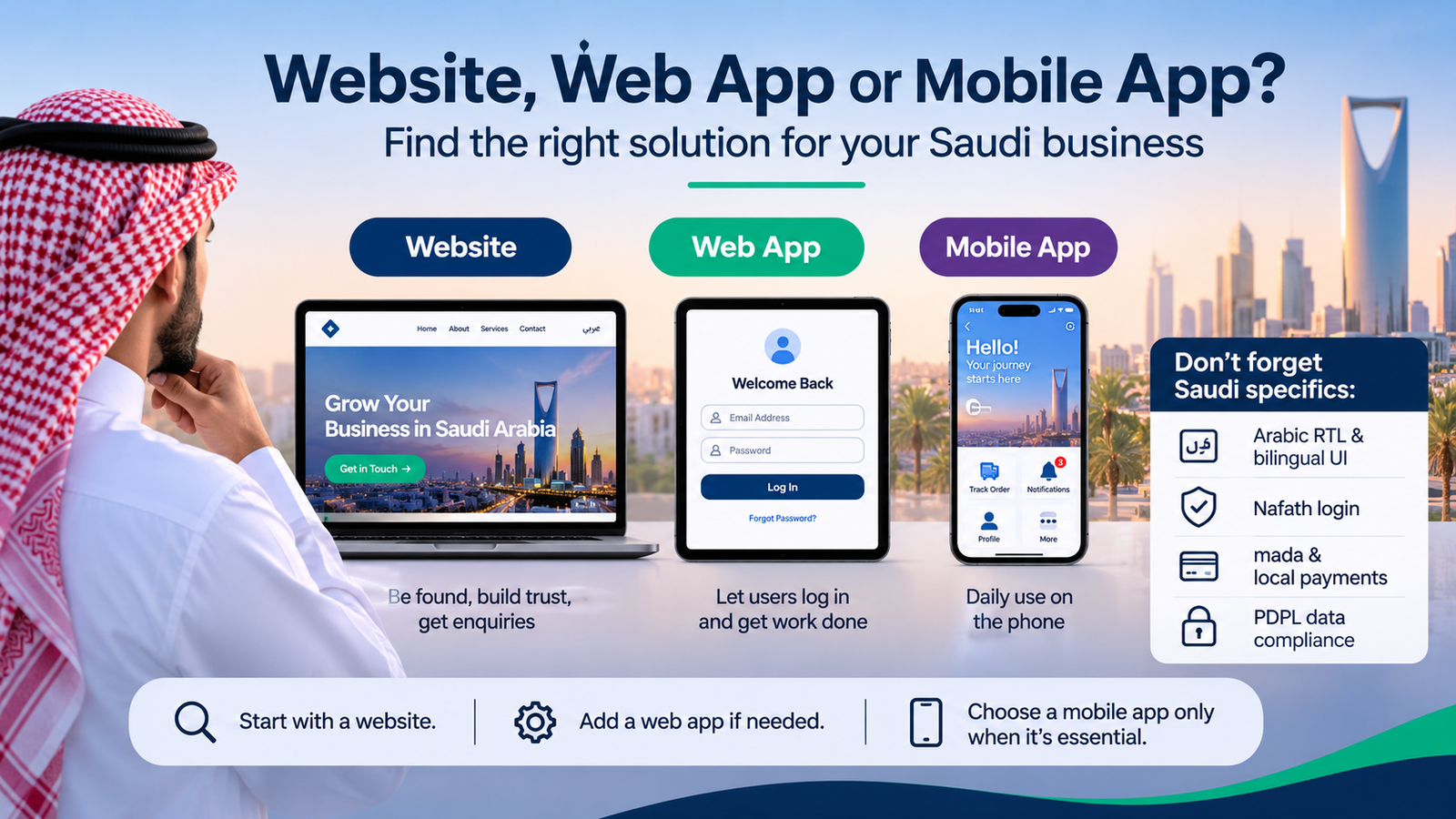
A website informs, a web app gets work done after login, and a mobile app lives on the phone. Choose a website when people need to find and trust you. Choose a web app when customers, staff or partners need to log in and complete tasks. Choose a mobile app only when daily phone use, offline work or device features are central.
- Website: public pages that explain your business, rank on Google and generate enquiries. Example: a company site with services, projects and a contact form.
- Web app: software that runs in the browser where users log in and do things. Examples: a distributor ordering portal, a booking system, a management dashboard.
- Mobile app: software installed from the App Store or Google Play, with full access to camera, GPS, offline storage and push notifications. Examples: a delivery driver app, a banking app, a loyalty app.
Most growing Saudi businesses end up with a website plus a web app. A mobile app comes later, when real usage proves people want it on their home screen.
Website vs web app vs mobile app: side-by-side comparison
The biggest differences are login, device access and how users find you. Websites are found on Google, web apps are used after login in any browser, and mobile apps are found in app stores and installed. Cost and update speed follow from that: one browser build is cheaper and faster to update than separate iOS and Android apps.
|
Factor |
Website |
Web app |
Mobile app (native) |
|---|---|---|---|
|
Main job |
Be found, build trust, get enquiries |
Let users log in and complete tasks |
Daily use on the phone with device features |
|
Login needed |
Usually no |
Yes |
Usually yes |
|
Found on Google |
Yes, fully |
Public pages only |
No, found in app stores |
|
Install needed |
No |
No |
Yes (App Store / Google Play) |
|
Works on |
Any browser |
Any browser: phone, tablet, laptop |
iOS and Android separately (or cross-platform) |
|
Device features (camera, GPS, Bluetooth, offline) |
Minimal |
Partial |
Full |
|
Push notifications |
No |
Yes, if built as a PWA |
Yes |
|
Updates |
Instant |
Instant |
Through store review |
|
Relative build cost |
Lowest |
Medium |
Highest (often a second build on top of the web app) |
|
Typical Saudi example |
Contracting company profile site |
Distributor ordering portal, HR or booking system |
Delivery driver app, loyalty app |
The row that decides most projects is the first one. Describe the job in one verb and you usually have your answer: people browse a website, work in a web app, and carry a mobile app everywhere they go.
When is a website enough?
A website is enough when your main goal is visibility, credibility and leads. If customers mostly need to learn what you do, see proof of past work and contact you, a fast bilingual website does the job. No login, no user accounts, no app store. It is also the only option of the three that fully ranks on Google.
A website fits best when:
- You sell B2B services and most deals start with a call, an RFQ or a WhatsApp message.
- Your buyers search on Google before they shortlist suppliers.
- You update content (projects, certifications, news) more often than you add features.
- You want to capture leads 24/7. An AI chatbot on your website can answer common questions in Arabic and English and pass hot leads to your sales team.
One thing to remember: every business needs a website, even if it later builds a web app or mobile app. The app does not replace your public pages. People still need to find you first.
When do you need a web app?
You need a web app when users must log in and do something: place orders, book slots, approve requests, track shipments or see reports. A web app is real software that runs in the browser, so staff in the office and customers on their phones use the same system, with nothing to install and one codebase to maintain.
Typical web based application examples for Saudi businesses:
- Distributor or B2B ordering portal: wholesalers in Riyadh or Dammam let retailers check stock, reorder and download invoices without calling sales.
- Customer portal: clients track project status, documents and payments.
- Booking and scheduling system: clinics, training centres and service companies take bookings and send reminders.
- Internal operations tools: HR requests, approvals, field reports and management dashboards that replace spreadsheets.
- Portals connected to ERP: if you already run an ERP system in Saudi Arabia, a web portal can push orders straight into it instead of someone retyping them.
The pattern is clear. When the work is a business workflow and people use it on laptops and phones, web based application development gives you one system for every device. That is why most portals, dashboards and SaaS products are web apps.
When is a mobile app worth the cost?
A native mobile app is worth it when the phone itself is the product. That means users open it many times a week, you need reliable offline use, or the core feature depends on the camera, GPS, Bluetooth or background location. If none of those apply, a web app or PWA usually covers the need at a lower cost.
A mobile app fits best when:
- Daily, habitual use: loyalty, food ordering, fitness or banking apps people open several times a week.
- Field work with weak signal: drivers, technicians or inspectors working on sites outside the city who must save data offline.
- Deep device access: scanning, live location tracking, Bluetooth devices or background tasks.
- App store presence matters: consumer brands that want discovery and a home screen icon.
Be honest about the weekly test. If your users will not open it every week, an installed app sits unused and still costs you maintenance every year.
The middle path: progressive web app (PWA) vs native app
A progressive web app is a web app that users can add to their home screen, where it opens in its own window like an app. It can send push notifications, cache data for offline use and show badges, all from one browser codebase. For many Saudi businesses it covers most of what they wanted from "an app" without a second build.
The old argument against PWAs was iPhone support. That changed. Apple added Web Push for Home Screen web apps in iOS and iPadOS 16.4, according to MacRumors, and later iOS versions made home screen web apps open as apps by default. The one catch: on iPhone, users must add the PWA to their home screen before they can receive notifications.
Saudi network quality also helps PWAs. Average monthly mobile data use reached 53 GB per person, about three times the global average, per the Saudi Internet Report covered by Arab News. Fast, cheap data means a well-built web app loads and feels quick for most users in the cities.
Pick a PWA over a native app when:
- Users need reminders or order updates, but not deep hardware access.
- You want one system for staff on laptops and customers on phones.
- You need to ship fixes the same day, without App Store review.
- Budget is limited and you want to prove demand before a native build.
Pick native when offline work is heavy, Bluetooth or background location is required, or app store discovery is part of your marketing plan.
What Saudi businesses must plan for, whichever option they pick
In Saudi Arabia, the choice is not only website vs app. Four local requirements change scope and cost on every option: Arabic RTL design, Nafath identity login, local payment methods, and PDPL personal data rules. Global comparison articles ignore these, but they often decide how big your project really is.
1. Arabic and English, built right-to-left properly. A bilingual product is not a translated one. Menus, tables, forms, charts and PDFs must flip to RTL, Arabic fonts must render cleanly, and numbers, dates and Hijri or Gregorian formats need clear rules. On a website this is mostly content and layout work. On a web app or mobile app, every screen and every generated document (invoices, reports, emails) needs RTL testing on the iPhone and Android devices your users actually carry.
2. Nafath login where identity matters. Government-facing services, HR platforms, real estate, healthcare and finance products increasingly expect users to verify identity through Nafath. That is a web app or mobile app feature, never a website one, and it adds integration and approval time. Ask about it in your first scoping call, not after design.
3. Local payments. Saudi customers expect mada, Apple Pay and often STC Pay at checkout. A website that only collects enquiries skips this. A web app or mobile app that takes payments needs a local payment gateway, refund flows and reconciliation with your accounting or ERP.
4. PDPL and where your data lives. Saudi Arabia's Personal Data Protection Law has been fully enforceable since 14 September 2024, with SDAIA as the regulator (Securiti). The moment users log in, you are storing personal data. That means consent, a clear privacy notice, breach handling and careful choices about cross-border transfers and hosting. SDAIA also opened a public consultation on amendments to the PDPL Implementing Regulations on 6 October 2026 (Akin Gump), so check the latest rules with your legal advisor before launch.
Here is how these requirements stack up by option:
|
Saudi requirement |
Website |
Web app |
Mobile app |
|---|---|---|---|
|
Arabic RTL + bilingual UI |
Needed (pages and forms) |
Needed (every screen, report and PDF) |
Needed (every screen, tested per OS) |
|
Nafath identity login |
Not applicable |
Often needed in regulated sectors |
Often needed in regulated sectors |
|
mada / Apple Pay / STC Pay |
Only for e-commerce |
Needed if you take payments |
Needed if you take payments, plus store payment rules |
|
PDPL personal data controls |
Light (contact forms, cookies) |
Full (accounts, records, access logs) |
Full, plus device permissions |
The takeaway: adding a login multiplies your compliance work. That is one more reason to start with the smallest build that solves the problem, then grow it.
How much does each option cost in Saudi Arabia?
A website is the cheapest of the three, a web app costs more because it has accounts, data and business logic, and a native mobile app usually costs the most because iOS and Android are separate targets with store reviews. Published 2026 Saudi guides put even a basic mobile app at tens of thousands of riyals, with complex apps far higher.
Published Saudi price guides vary a lot, so treat these as ranges, not quotes:
|
Cost item |
What published 2026 Saudi guides report |
Source |
|---|---|---|
|
Basic mobile app |
SAR 25,000 to 60,000 at the low end of the market |
|
|
Basic mobile app (agency rates) |
SAR 110,000 to 225,000 |
|
|
Medium mobile product (payments, bilingual UI, admin panel) |
SAR 225,000 to 450,000 |
|
|
Yearly mobile app maintenance |
15% to 25% of the original build cost |
|
|
Building for one platform only |
Cuts cost by 30% to 40% vs iOS + Android |
Two things push cost up on every option in KSA: bilingual RTL work and integrations (Nafath, payment gateways, your ERP or accounting system). For a full breakdown of what drives price, see our guide to custom software development cost in Saudi Arabia.
The hidden cost is not the build. It is running two or three separate products. A website plus a responsive web app is one stack to host, secure and update. Add native iOS and Android apps and you now maintain three front ends, with store reviews on every release.
A 4-question test to choose the right build
Answer these four questions in order. The first "yes" that changes your scope tells you what to build next.
- Do new customers need to find and trust you? Yes for almost every business. Build or fix your website first.
- Do customers, staff or partners need to log in and complete tasks? If yes, you need a web app on top of your website.
- Will they use it often on their phones, and do you need to notify them? If yes, make the web app a PWA with push notifications.
- Is heavy offline use, Bluetooth, background location or app store discovery essential? Only then plan a native mobile app, ideally reusing the same backend and APIs.
If you stop at question 2, you are in good company. Most Saudi B2B companies, distributors and service firms get the biggest return from a strong website and one focused web app.
The phased path most Saudi businesses should follow
Start with the smallest build that solves today's problem, prove usage, then grow. In practice that means a website first, a web app for the core workflow second, and a mobile app last, only when real user behaviour justifies a second build.
|
Phase |
What you build |
When to move to the next phase |
|---|---|---|
|
1. Website |
Bilingual site, service pages, lead forms, chatbot |
Customers keep asking for order status, documents or self-service |
|
2. Web app (PWA-ready) |
Portal or internal system with login, roles and reports |
Users log in on phones weekly and ask for notifications or offline access |
|
3. Mobile app |
Native or cross-platform app reusing the web app's backend |
Usage data proves daily phone use or device features are essential |
Because the web app's backend and APIs carry the business logic, phase 3 becomes a new front end rather than a full rebuild. That is the cheapest route to an app if you ever need one. If you are comparing partners for this kind of roadmap, our checklist on how to choose a software development company covers the questions to ask, and our roundup of web development companies in Riyadh shows who builds what.
Frequently asked questions
What is the difference between a website and a web app?
A website mainly shares information publicly, while a web app lets logged-in users create, manage or process data inside the browser. A company profile site is a website. A portal where customers place orders and download invoices is a web app.
Is a web app cheaper than a mobile app?
Yes, a web app is usually cheaper than a native mobile app because one browser codebase works on every device. A native app means separate iOS and Android builds, store approvals and yearly maintenance that Saudi price guides put at 15% to 25% of the build cost.
Do I need a mobile app for my business in Saudi Arabia?
Most Saudi businesses do not need a native mobile app at the start, even though almost everyone goes online by phone. A fast bilingual website and a responsive web app reach those same phone users. Build a native app when daily use, offline work or device features are essential.
Can a web app work on mobile phones?
Yes, a well-built web app works in any mobile browser and adapts its layout to small screens. Built as a PWA, it can also sit on the home screen, open full screen and send push notifications on Android and on iPhones running iOS 16.4 or later.
What is a progressive web app (PWA)?
A progressive web app is a web app that users can install to their home screen, with offline caching and push notifications. It behaves much like a mobile app but ships from one codebase, updates instantly and needs no app store approval.
Should I build a website or an app first?
Build the website first, because customers need to find and trust you before they will log in or install anything. Add a web app when users need self-service, and consider a mobile app only after real usage proves people want it on their phones.
Not sure which one your business needs?
Intellitech Solutions helps Saudi businesses pick the smallest build that solves the real problem, then grow it. We scope websites, web apps and PWAs with Arabic RTL, Nafath, local payments and PDPL in mind from day one, so you do not pay to rebuild later.
Tell us what your customers or team need to do, and we will tell you honestly whether that is a website, a web app or an app. Explore our custom web application development services or book a free consultation.