How to Choose a Custom Software Development Company in Saudi Arabia
13 min read
On this page
- The short answer
- 7 checks before you shortlist a custom software development company
- 1. Proof of similar work you can open and test
- 2. A discovery phase before a fixed quote
- 3. A tech stack you can hire for later
- 4. Saudi readiness: Arabic, payments and local integrations
- 5. Data and security: PDPL, hosting and access
- 6. Who you will actually talk to
- 7. Support after launch
- How to compare proposals with a simple scorecard
- A worked example
- Fixed price vs time and materials vs dedicated team
- Why Saudi quotes swing so widely
- Code, IP and account ownership: what to put in the contract
- 12 questions to ask before you sign
- Red flags that should end the conversation
- Local company, offshore team or freelancer?
- Frequently asked questions
- How do I choose a custom software development company in Saudi Arabia?
- What questions should I ask a software development company before hiring?
- Who owns the source code in a custom software project?
- How much does custom software cost in Saudi Arabia?
- Is a freelancer or a software company better for my project?
- How does Saudi PDPL affect choosing a software vendor?
- Talk to Intellitech before you sign
Three quotes land in your inbox for the same customer portal. One says SAR 45,000 and six weeks. Another says SAR 180,000 and five months. The third won't give a number at all until you sit through a paid two-week workshop.
Which one do you pick? At this stage, the price tells you very little. How each company got to its number tells you a lot more.
This guide comes from the team at Intellitech, a custom software development company in Saudi Arabia. It's the checklist we'd give a friend before they sign with anyone, us included. You'll get 7 checks, a scorecard for comparing proposals, the three pricing models explained, 12 questions to ask, and the red flags that should end a conversation.
The short answer
Choose the custom software development company that shows you live work similar to yours, runs a discovery phase before fixing a price, puts code ownership in writing, understands Saudi requirements like PDPL and Arabic RTL, and commits to clear support terms after launch. The cheapest quote is rarely the cheapest project.
Everything below expands on those five points.
7 checks before you shortlist a custom software development company
Run every vendor through these seven checks before you compare prices. Most weak proposals fail one of the first three, which saves you hours of meetings.
1. Proof of similar work you can open and test
Ask for two or three live projects close to yours in type and size, then click through them yourself. Screenshots prove design skill. A working portal you can log into proves the team actually shipped something and kept it running.
"Similar" means the same kind of system, not the same industry. A team that built a booking portal for a clinic can build one for a training centre. Ask to speak to one past client, and ask that client one thing: would you hire them again?
For example, the unified platform we built for a certification company in Al Khobar replaced [client to add: what it replaced and one real result].
2. A discovery phase before a fixed quote
A serious software development company won't fix a price for a custom system after one call. It will suggest a short discovery phase first, to map your workflows, list features, and flag integrations. Then it quotes against a written scope, not a guess.
A good discovery phase should hand you:
- A scope document in plain language
- User flows or clickable wireframes
- A feature list split into "launch" and "later"
- A list of systems the software must connect to
- An estimate with its assumptions written down
This matters even more when the new software has to talk to an ERP system in Saudi Arabia, your accounting tool, or a government platform. Integrations are where loose quotes fall apart.
3. A tech stack you can hire for later
Ask which languages and frameworks they'll use, and why. The right answer is a mainstream, well-documented stack such as Laravel, React, Node.js or .NET, chosen for your project rather than for the vendor's comfort.
The warning sign is a home-grown framework only that vendor understands. If you ever switch partners, nobody else will want to touch it.
4. Saudi readiness: Arabic, payments and local integrations
Ask to see an Arabic screen they've already shipped. Real Arabic support means proper right-to-left layouts, not English pages run through a translator.
Depending on your project, check for:
- Arabic and English interfaces with correct RTL layouts
- Hijri and Gregorian dates side by side
- Local payment methods such as Mada
- Nafath login where users must verify their identity
- ZATCA e-invoicing rules if the system issues tax invoices
5. Data and security: PDPL, hosting and access
Your vendor must handle personal data under Saudi Arabia's Personal Data Protection Law (PDPL), which the Saudi Data and AI Authority (SDAIA) has fully enforced since 14 September 2024. Ask where your data will be hosted, who can access it, and how backups and security testing work.
Transfers of personal data outside the Kingdom follow a separate regulation that SDAIA updated in September 2024, so an offshore team touching live customer data needs a clear legal basis (Clyde & Co summary). Banks, healthcare and government projects usually face stricter National Cybersecurity Authority (NCA) controls on top.
One small test: if a vendor still calls the telecom and IT regulator "CITC", their compliance notes may be dated. It was renamed the Communications, Space and Technology Commission (CST) in 2022. For how hosting and migration choices get made on a real project, see our step-by-step ERP implementation process.
This section is general guidance, not legal advice.
6. Who you will actually talk to
Find out who runs your project day to day, by name. You want one project manager who speaks your language (Arabic, English or both), a demo of working software every one or two weeks, and access to the task board.
If the person selling to you disappears after signing and you only hear from "the team", expect slow answers when something breaks.
7. Support after launch
Software needs care after go-live: bug fixes, security updates, server upkeep and small changes. Ask for these terms in writing before you sign:
- Warranty period for bugs after launch
- Response times by severity (critical, major, minor)
- Monthly maintenance cost and what it covers
- How new features are priced
- Who handles hosting and security patches
How to compare proposals with a simple scorecard
Score each proposal from 1 to 5 on six weighted criteria, multiply each score by its weight, and add them up. It turns a gut feeling into a number you can defend to your partners, and it stops the lowest price from winning by default.
Here are the weights we suggest. Adjust them if, say, compliance matters more in your sector.
|
Criterion |
Weight |
What a 5 looks like |
|---|---|---|
|
Relevant live work |
25% |
2+ shipped systems like yours, plus a client reference you spoke to |
|
Discovery and process |
20% |
Paid discovery, written scope, demos every 1 to 2 weeks |
|
Code and IP ownership |
15% |
IP assigned to you, repo in your account from day one |
|
Saudi readiness |
15% |
Arabic RTL shipped before, PDPL and hosting answers in writing |
|
Support terms |
15% |
Warranty, response times by severity, clear maintenance price |
|
Price clarity |
10% |
Itemised quote, payment tied to milestones, change requests priced upfront |
A worked example
Say three companies quote for the same customer portal. The numbers below are illustrative, not real vendors.
|
Vendor |
Quote |
Live work |
Discovery |
Ownership |
Saudi ready |
Support |
Price clarity |
Weighted score |
|---|---|---|---|---|---|---|---|---|
|
A |
SAR 45,000 |
2 |
1 |
2 |
3 |
2 |
4 |
2.15 |
|
B |
SAR 120,000 |
4 |
4 |
5 |
4 |
4 |
3 |
4.05 |
|
C |
SAR 260,000 |
5 |
3 |
3 |
3 |
5 |
2 |
3.70 |
Vendor A looks cheapest, but it skipped discovery and was vague on ownership. That's the quote most likely to grow once the real requirements show up. Vendor B wins on value even though Vendor C has the bigger portfolio.
One rule overrides the total: any score below 3 on code ownership is a deal-breaker. A great price means nothing if you can't take your own software with you.
[Optional lead magnet: "Download this scorecard as a Google Sheet". Client to confirm.]
Fixed price vs time and materials vs dedicated team
Most software development services in Saudi Arabia are sold under one of three pricing models. Fixed price suits a scope you've already nailed down, time and materials suits a product that will change as you learn, and a dedicated team suits a long roadmap. Each one moves risk to a different side of the table.
|
Model |
How you pay |
Best for |
Your main risk |
Red flag |
|---|---|---|---|---|
|
Fixed price |
One agreed total for an agreed scope, paid by milestone |
Clear scope after a discovery phase |
Every change request costs extra; vendor may cut corners to protect margin |
Fixed price offered with no discovery |
|
Time and materials |
Hourly or daily rates for work actually done |
MVPs and products that will evolve |
Budget drifts without caps or weekly reports |
No weekly timesheets or estimates per task |
|
Dedicated team |
Monthly fee per developer, designer or PM |
Long-term products with an ongoing roadmap |
You must manage priorities yourself |
No replacement policy if a team member leaves |
A common middle path: a small fixed-price discovery, then a fixed price for version one, then time and materials for everything after launch.
Why Saudi quotes swing so widely
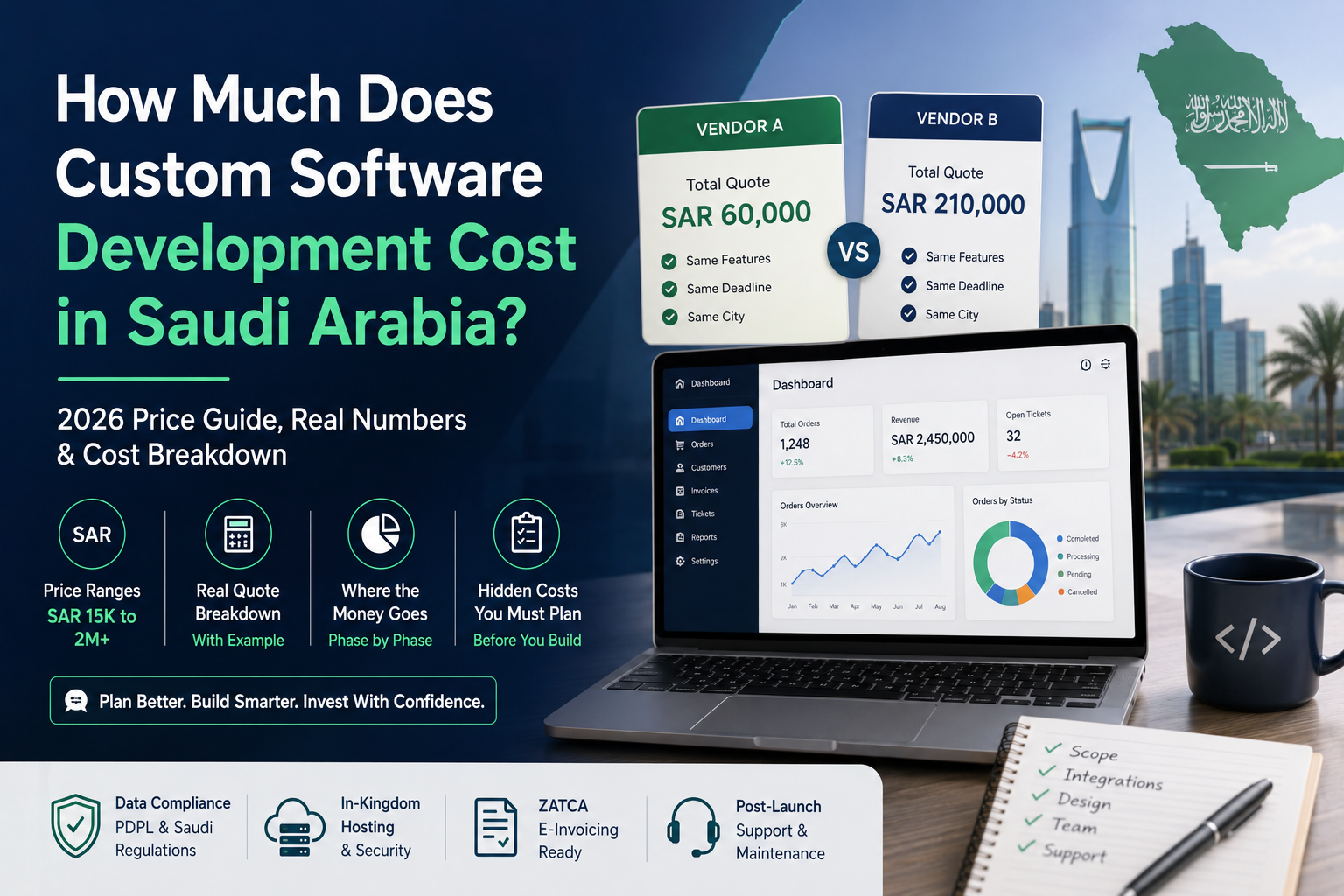
Published price guides from Saudi agencies range from about SAR 15,000 for a simple tool to SAR 250,000 and more for ERP-scale systems, and some quote SAR 1 million plus for enterprise work. That spread isn't random. It comes from:
- Scope and integrations. Each connection to an ERP, payment gateway or government platform adds real work.
- Team location and seniority. A senior local team costs more per hour than a junior offshore one.
- Design depth. Custom UX research and a full design system cost more than adapting a template.
- Compliance and hosting. PDPL work, security testing and in-Kingdom hosting all add cost.
- What's included after launch. Some quotes include a year of support. Others stop at handover.
So compare what each quote covers, not just its total. If you want a number built on a discovery workshop rather than a guess, see how we scope our custom web app development services.
Code, IP and account ownership: what to put in the contract
You only own your software if the contract assigns the intellectual property to you and the code, hosting and domain sit in accounts your company controls. "You'll get the code at the end" is a promise. A repository in your name from day one is proof.
Add these to the contract or the statement of work:
- IP assignment. All code, designs and documents transfer to your company on payment, per milestone or at final payment.
- Repository in your account. The code lives in your company's GitHub, GitLab or Bitbucket organisation from the first commit, with the vendor added as a collaborator.
- Cloud, domain and DNS in your name. Hosting, domain registration, email services and app store accounts are registered to your company, not the developer's.
- Third-party licences. Paid plugins, APIs and libraries are bought under your account, or the contract lists who pays and who owns them.
- Documentation. A setup guide, an architecture overview and API notes, so another team could pick up the work.
- Credentials handover. A written list of every admin login, key and service, handed over at launch.
- Exit clause. If you switch vendors, the old one supports the handover for an agreed period.
A vendor who resists points 1 or 2 is telling you how the relationship will end.
12 questions to ask before you sign
Ask every shortlisted software development agency the same questions, in writing, so you can compare answers side by side. Vague replies are an answer too. If your project includes an ERP, add the checks from our guide to evaluating an ERP implementation partner.
- Which live projects are closest to ours, and can we speak to one of those clients?
- Will you run a discovery phase, and what will we receive at the end of it?
- Who, by name, will manage our project, and who will write the code?
- Is any of the work subcontracted, and where is that team based?
- Which tech stack will you use, and why that one for us?
- How often will we see working software?
- How are change requests estimated and approved?
- What are the payment milestones, and what is delivered at each?
- Will the code sit in our repository from day one, and does the contract assign IP to us?
- Where will our data be hosted, and how do you handle PDPL?
- What does post-launch support include, and what are the response times?
- If we part ways, how do you hand the project over?
Red flags that should end the conversation
Walk away, or at least slow down, if you see any of these:
- A fixed price for a complex system after one short call
- No live work you can open, only screenshots or a slide deck
- A quote far below every other bid, with no explanation
- Refusal to put code and IP ownership in writing
- Deadlines that sound too good, like a full platform in three weeks
- No named project manager, just "our team will handle it"
- Pressure to sign this week to "lock in" a discount
Local company, offshore team or freelancer?
For business-critical software, a local or locally managed company is usually the safest choice, because it understands Saudi requirements and stays reachable after launch. Offshore teams and freelancers can work well, but only for the right kind of project.
|
Option |
Works best for |
Watch out for |
|---|---|---|
|
Saudi-based company |
Core business systems, government integrations, Arabic-first products |
Higher hourly rates; check they don't quietly subcontract everything |
|
Offshore agency |
Well-scoped builds with a strong in-house product owner |
Time zones, PDPL limits on cross-border data, weaker Arabic UX |
|
Hybrid (local PM, offshore developers) |
Balancing cost with local accountability |
Ask exactly who does what and where data sits |
|
Freelancer |
Small, well-defined tasks or prototypes |
Single point of failure if they get busy or disappear |
Whichever route you take, the seven checks above still apply. If you're building a local shortlist, our roundup of top web development companies in Riyadh is a good starting point. [Add this link only once that post is live.]
Frequently asked questions
How do I choose a custom software development company in Saudi Arabia?
Shortlist firms with similar live work, insist on a discovery phase, confirm written code ownership and PDPL readiness, then score proposals side by side. Price should be the last thing you compare, not the first.
What questions should I ask a software development company before hiring?
Ask about similar projects, who will work on your build, how scope changes are priced, who owns the code, and what support covers after launch. Get the answers in writing so you can compare vendors fairly.
Who owns the source code in a custom software project?
You should, but only if the contract assigns the IP to you and the code lives in a repository your company controls from day one. Without both, ownership is a promise rather than a fact.
How much does custom software cost in Saudi Arabia?
Published Saudi price guides range from about SAR 15,000 for a simple tool to SAR 250,000 or more for complex systems, depending on scope, integrations and support. A discovery phase gives you a far more reliable number than any range.
Is a freelancer or a software company better for my project?
A freelancer suits small, well-defined tasks, while a company is safer for business-critical systems that need a team, testing and long-term support. If one person disappears, a company can replace them; a freelancer project simply stops.
How does Saudi PDPL affect choosing a software vendor?
Since 14 September 2024, SDAIA has fully enforced PDPL, so your vendor must handle personal data, hosting and any cross-border transfers under its rules. Ask for their approach in writing before they touch real customer data.
Talk to Intellitech before you sign
Got quotes on the table and not sure how to read them? Send them over. We'll walk you through what each one includes, what it leaves out, and what we'd do differently, even if you end up hiring someone else.
If you'd rather build with us, talk to our web application team about your project, or book a free scoping call [verify contact URL and offer with client]. Every project starts with discovery, and the code is yours from the first commit.