How to Choose a Custom Software Development Company in Saudi Arabia
16 min read

On this page
- How to choose a custom software development company: the short checklist
- Before you contact vendors: know what you're buying
- 8 criteria to judge a software development company
- 1. Live work similar to your project
- 2. They diagnose before they propose
- 3. Who builds it, not just who sells it
- 4. A process you can see
- 5. Built for Saudi users
- 6. Security and data handling
- 7. Ownership and handover terms
- 8. Support after go-live
- A vendor scorecard you can copy
- Who owns the source code?
- What the new Copyright Law changed
- What your contract should say
- The handover kit: what you must own on day one
- Where will your data live?
- Pricing models compared
- 12 questions to ask a software development company
- Software company red flags
- Local company vs offshore agency vs freelancer
- How Intellitech works with Saudi businesses
- Frequently asked questions
- How do I choose a custom software development company in Saudi Arabia?
- Who owns the source code when I hire a software company?
- What are the red flags when hiring a software development company?
- What questions should I ask a software development company before signing?
- Is a fixed-price or time-and-materials contract better?
- Does my software data have to be hosted in Saudi Arabia?
- The bottom line
A trading company in Dammam pays a local agency to build an order portal. A year later it wants new features, asks for the code, and finds out the contract never gave it any. It ends up paying a second company to rebuild the same system from zero.
That story is more common than it should be, and it's almost always avoidable. To choose a custom software development company in Saudi Arabia, judge vendors on four things: live work similar to your project, the people who will actually build it, a contract that assigns the code to you in writing, and real support after launch. The lowest quote is rarely the cheapest option.
At Intellitech, we build business platforms for companies across Al Khobar, Dammam, Riyadh and Jeddah, so we see both sides of this decision. This guide is the checklist we'd want every buyer to use, including on us. If you've already shortlisted vendors and want to see how we work, start with our custom software development company in Saudi Arabia page.
How to choose a custom software development company: the short checklist
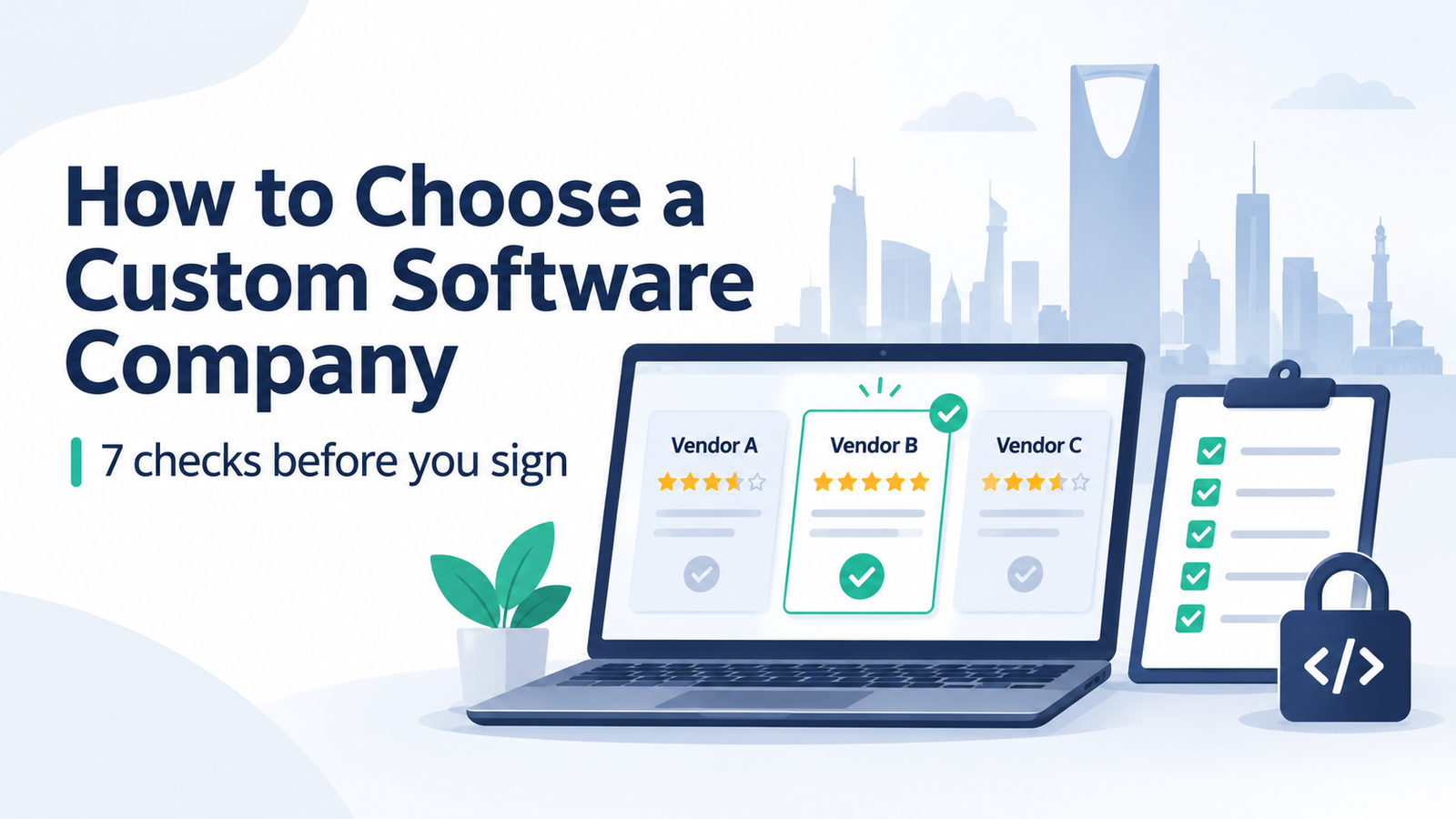
The best way to choose a custom software development company is to compare 3 to 5 firms against the same brief, test the shortlisted one with a small paid discovery phase, and sign only when ownership, handover and support are written into the contract. Here are the 8 steps in order:
- Write a one-page brief. The problem, the users, must-have features, systems it must connect to, budget band and deadline.
- Shortlist 3 to 5 companies. Look for live projects close to yours, not just a long services list.
- Check similar work. Ask to see a working system and to speak to the client behind it.
- Meet the team that will build it. Not only the sales consultant.
- Run a paid discovery phase. Two to four weeks of scoping shows you how they think before you commit the full budget.
- Compare pricing models. Fixed price, time and materials, or a dedicated team each move the risk to a different side.
- Lock ownership and handover in the contract. Written code assignment, a repository in your name, and accounts you control.
- Agree support after go-live. Response times, bug-fix period and how new features are priced.
The rest of this guide explains each step, with a scorecard you can copy and the questions that separate serious companies from the rest.
Before you contact vendors: know what you're buying
A clear one-page brief is the single best tool for comparing software companies, because it makes every vendor quote against the same scope. Without it, one company prices a simple portal and another prices a full platform, and you end up comparing numbers that mean different things.
Your brief doesn't need technical language. It needs answers to six questions:
- What problem are we solving, and how do we handle it today (Excel, WhatsApp, paper, an old system)?
- Who will use it: staff, customers, distributors, or all three?
- Which features are must-haves for version one, and which can wait?
- Which systems must it connect to, such as accounting software, an ERP, a payment gateway or SMS?
- What budget band are we working with?
- When do we need the first usable version?
If you're still unsure whether to build at all, settle that first. Custom software makes sense when your process is a real advantage or no ready-made product fits it. If the job is a common one, an off-the-shelf tool is usually faster and cheaper.
8 criteria to judge a software development company
A good software development company proves it can build what you need, shows you who will build it, and puts ownership, security and support in writing. These eight criteria cover what actually decides whether a project succeeds in Saudi Arabia. Use them in every vendor meeting, then score each company in the table further down.
1. Live work similar to your project
Screenshots and logos prove very little. Ask to see a working system close to yours in size and type, and ask to speak to that client. A company that has built a booking site is not automatically ready for a multi-branch operations platform.
For example, our team built a unified platform for a certification company in Al Khobar, replacing separate manual tools and moving more than 30,000 historic certificate records in staged batches so daily work never stopped. That's the kind of specific, checkable proof you should expect from any vendor.
2. They diagnose before they propose
A serious company asks about your process, users and numbers before it talks about technology. If a vendor sends a price after one short call, it is guessing. Sometimes a good diagnosis even ends with "you don't need custom software": if your real problem is finance, stock and purchasing, an ERP system in Saudi Arabia may fit better than a custom build.
3. Who builds it, not just who sells it
The person in the sales meeting is rarely the person writing your code. Ask for the names and roles of the project manager, lead developer and designer. Ask whether any work is subcontracted, and to whom.
4. A process you can see
You should see working software every one to two weeks, not a big reveal at the end. Ask how they run sprints, how you'll test new features, and where you can track progress and open issues.
5. Built for Saudi users
Check that the team has shipped Arabic right-to-left interfaces tested on real phones, not just translated labels. Depending on your project, ask about Hijri and Gregorian dates, local payment methods such as mada, Apple Pay and STC Pay, and Nafath login for identity verification.
6. Security and data handling
Ask how they protect logins, store passwords, take backups and limit who can access live data. A clear answer here also tells you how they'll handle your obligations under Saudi Arabia's Personal Data Protection Law (PDPL), covered below.
7. Ownership and handover terms
This is where many Saudi buyers lose money. The contract must assign the code to you in writing and give you a repository and accounts in your own name. It gets its own section below because it matters that much.
8. Support after go-live
Every system needs fixes and changes after launch. Ask for a written support agreement covering response times, a free bug-fix period, monthly maintenance cost, and how new features are quoted.
A vendor scorecard you can copy
A weighted scorecard turns vendor meetings into a fair comparison instead of a gut feeling. Score each custom software development company from 1 (weak) to 5 (strong) on every criterion, multiply by the weight, and add up the total out of 500. The weights below reflect what most often decides project success; adjust them to your priorities.
|
Criterion |
Weight |
Vendor A (1-5) |
Vendor B (1-5) |
Vendor C (1-5) |
|---|---|---|---|---|
|
Live work similar to your project |
20% |
|||
|
Named team and who builds it |
15% |
|||
|
Ownership and handover terms |
15% |
|||
|
Visible process and regular demos |
10% |
|||
|
Built for Saudi users (Arabic, payments, dates) |
10% |
|||
|
Security and data handling |
10% |
|||
|
Support after go-live |
10% |
|||
|
Price fit for the scope |
10% |
|||
|
Weighted total (out of 500) |
100% |
Notice that price carries only 10%. A vendor that scores low on ownership or team but wins on price usually costs more over two or three years.
Already holding two or three quotes and not sure how to compare them? Our team can review vendor proposals with you and point out what each one leaves out.
Who owns the source code?
In Saudi Arabia, paying a software company does not automatically make you the owner of the code it writes. Copyright in commissioned work stays with the author unless the contract assigns it to you in writing. If ownership isn't written into your agreement, assume you don't have it, however much you've paid.
Most buyers assume the opposite, and most vendor guides simply say "make sure you own the code" without explaining why it isn't automatic. Here's what you need to know.
What the new Copyright Law changed
Saudi Arabia passed a new Copyright Law in February 2026, in force since August 2026. It now says clearly that work an employee creates as part of the job belongs to the employer. That rule covers your own staff. It does not cover an outside agency or freelancer, so for any vendor you still need a written assignment.
Two more points matter. The developer keeps certain moral rights, such as being credited as author, and these can't be transferred. Penalties for infringement are also much higher now, up to SAR 1 million, or SAR 2 million for repeat breaches. Clean paperwork protects you if a dispute ever comes up.
What your contract should say
Ask your lawyer to check that the agreement covers these five points:
- Assignment of project code. All code, designs and documents made for your project are assigned to your company on payment, in writing.
- Repository in your name from day one. The code lives in a GitHub, GitLab or Bitbucket account your company owns, with the vendor added as a member.
- A list of reused components. Many companies reuse their own tools and open-source libraries. Ask for a list of each one and its licence, so nothing in your system belongs to someone else without permission.
- A licence for the vendor's own tools. Anything the vendor built before your project stays theirs, but you need a permanent licence to keep using it inside your system.
- Escrow or exit terms, if needed. For business-critical systems, agree what happens if the vendor closes or the relationship ends.
This is general guidance, not legal advice. For contracts above a modest value, have a Saudi lawyer review the ownership clauses.
The handover kit: what you must own on day one
Owning the code on paper isn't enough if the vendor still holds every login. Before the project starts, agree that these are created in your company's name, with the vendor given access, not the other way round:
- Code repository (GitHub, GitLab or Bitbucket organisation)
- Cloud or hosting account and billing
- Domain name and DNS settings
- Admin logins for the live system
- Google Play and Apple developer accounts, if there's a mobile app
- API keys for payment gateways, SMS and maps
- Automatic database backups you can download
- Technical documentation and a deployment guide
If a vendor resists any item on this list, treat it as a warning sign.
Where will your data live?
Saudi Arabia's Personal Data Protection Law (PDPL) does not ban hosting customer data outside the Kingdom, but it does set conditions. Transfers abroad are allowed when the law's purposes and safeguards are met, and some sectors, such as government and finance, have their own local hosting rules. Your vendor should explain exactly where your data sits.
You'll often read that PDPL forces every system onto Saudi servers. That's not accurate. The Saudi Data and AI Authority (SDAIA) issued rules on transferring personal data outside the Kingdom in 2024, which permit transfers under set conditions and, in some cases, require a risk assessment first. PDPL also applies to foreign companies that process data of people in Saudi Arabia, so an offshore vendor doesn't escape it.
Ask every vendor these four questions:
- Which country and data centre will the live system and backups be hosted in?
- Does our sector require hosting inside Saudi Arabia?
- Who on your team can access production data, and how is that access logged?
- How do you delete or export a person's data if they ask?
We cover hosting and data decisions in more detail in our step-by-step ERP implementation process, and the same thinking applies to any custom system.
Pricing models compared
Software companies usually price work in one of three ways: a fixed price, time and materials, or a dedicated team. None is always best. Fixed price suits a small, clear scope; time and materials suits projects that will change as you learn; a dedicated team suits long-running products.
|
Model |
Best for |
Who carries the risk |
Watch out for |
|---|---|---|---|
|
Fixed price |
Small, well-defined projects and discovery phases |
Mostly the vendor |
A padded price, or every small change billed as a costly "change request" |
|
Time and materials |
Projects where needs will shift after users try the first version |
Mostly you |
No weekly hours report, or no cap per month |
|
Dedicated team |
Ongoing products with a steady stream of features |
Shared |
Paying for idle time if your backlog isn't ready |
A common, safe path for Saudi buyers is to start with a fixed-price discovery phase, then move to time and materials with a monthly cap once the scope is clear. Whatever the model, ask what the quote excludes. Hosting, third-party licences, SMS fees, app store fees and post-launch support are often left out of the headline number.
When you compare custom software development services, compare scope line by line, not just totals. If you want a quote built that way, see our custom web app development services.
12 questions to ask a software development company
The right questions show how a software development company works, not just what it sells. Ask these 12 in your first or second meeting and write down the answers. Vague replies, or "we'll figure it out later", tell you as much as good ones. If you're also buying an ERP, our guide on evaluating an ERP implementation partner covers the ERP-specific questions.
- Who exactly will work on my project, and can I meet them?
- Is any part of the work subcontracted? To whom?
- Can I see a live system similar to mine and speak to that client?
- Do you have clients in Saudi Arabia I can call?
- Where will the code repository live, and in whose name?
- Which of your own tools or open-source libraries will you reuse, and under which licences?
- What does this quote not include?
- How are change requests estimated and approved?
- How often will I see working software?
- Where will the system and backups be hosted?
- What happens if my lead developer leaves your company?
- What are your support response times after launch, and what does maintenance cost per month?
Software company red flags
The biggest red flags are a quote far below everyone else's, no live work to show, and any hesitation about putting the code in your name. Any one of these is enough to slow down. Two or more together usually mean you should walk away.
- A price far below the others. It usually means a smaller scope, a junior team, or costs that appear later.
- No working examples. Only mockups, logos or "confidential" projects you can never see.
- Refuses a repository in your name. Or says you'll get the code "at the end".
- A vague scope. A one-page quote with a single total and no feature list.
- "We do everything." Web, mobile, AI, blockchain and games, with no clear specialty.
- No named team. You only ever talk to sales.
- Pressure to sign fast. Discounts that expire before you've had time to check references.
Local company vs offshore agency vs freelancer
A local company usually fits Saudi business systems best, an offshore software development agency can cost less when you can manage it closely, and a freelancer suits small, clearly defined tasks. The right choice depends on how complex the system is and how much day-to-day contact your team needs.
|
Factor |
Local Saudi company |
Offshore agency |
Freelancer |
|---|---|---|---|
|
Working days and hours |
Same Sunday to Thursday week |
Time-zone and weekend gaps |
Depends on the person |
|
On-site workshops and training |
Easy |
Rare, extra cost |
Rare |
|
Saudi context (Arabic, payments, local rules) |
Usually strong |
Varies a lot |
Varies a lot |
|
Accountability |
Registered company, contract under Saudi law |
Contract often under foreign law |
One person, one point of failure |
|
Continuity if someone leaves |
Team can cover |
Team can cover |
Project stalls |
|
Typical cost |
Medium to high |
Lower to medium |
Lowest |
If you're leaning toward a local partner and want a starting list, our roundup of top web development companies in Riyadh is a useful place to begin. Score every name on it with the scorecard above, including us.
How Intellitech works with Saudi businesses
Intellitech is a software and automation company based in Al Khobar, working with businesses across the Eastern Province, Riyadh and Jeddah. We start with your process and users, not with technology, then build in short cycles so you see working software early and often.
On the certification platform mentioned above, the client's team built a sales pipeline of SAR 600,000 within a month of going live, because sales, records and follow-ups finally lived in one place. That's the outcome we aim for on every project: a system people actually use.
If you're comparing vendors now, talk to our web application team. Bring your brief, or your competing quotes, and we'll go through them with you.
Frequently asked questions
How do I choose a custom software development company in Saudi Arabia?
Shortlist 3 to 5 companies with live work similar to your project, meet the people who will build it, and run a short paid discovery phase. Sign only when the contract assigns the code to you in writing and defines support after launch.
Who owns the source code when I hire a software company?
In Saudi Arabia, the developer keeps copyright in commissioned software unless the contract assigns it to you in writing. Put the assignment, a code repository in your company's name, and a list of reused libraries and their licences into the contract before work starts.
What are the red flags when hiring a software development company?
The main red flags are a quote far below the others, no live projects you can see, refusal to keep code in your repository, a vague scope with one total price, no named team, and pressure to sign before a proper discovery phase.
What questions should I ask a software development company before signing?
Ask who will build it, which Saudi clients you can call, where the code will live, what the quote excludes, how change requests are priced, where data will be hosted, and what support response times and monthly maintenance cost after launch.
Is a fixed-price or time-and-materials contract better?
A fixed price suits a small, clearly defined scope, while time and materials suits projects that will change as users try them. Many Saudi buyers start with a fixed-price discovery phase, then move to time and materials with a monthly cap.
Does my software data have to be hosted in Saudi Arabia?
Not always. PDPL allows personal data to be transferred outside the Kingdom when its conditions and safeguards are met, but some sectors require local hosting. Ask your vendor exactly where data will be stored and get legal advice for regulated data.
The bottom line
Choosing a custom software development company comes down to three things: proof they've built something like your system, the right people actually doing the work, and a contract that makes the code, accounts and data yours. Get those right and price becomes an easy final step.
Ready to compare options with someone who'll show you their work? Book a free scoping call and we'll review your brief together.