Rule-Based vs AI Chatbot: Which Does Your Business Need?
12 min read
On this page
- What is a rule-based chatbot?
- What is an AI chatbot?
- Rule-based vs AI chatbot: side-by-side comparison
- Where each chatbot breaks with Saudi customers
- 1. Keyword rules break on Arabic, dialect and Arabizi
- 2. WhatsApp limits how big a button menu can be
- 3. An AI chatbot can promise things you never approved
- 4. Your busiest hours are when your team is offline
- When is a simple rule-based chatbot enough?
- When do you need an AI chatbot?
- The 50-chat test: decide with your own data
- The hybrid chatbot: rules where you need control, AI where you need range
- Frequently asked questions
- What is a rule-based chatbot?
- What is the difference between a rule-based chatbot and an AI chatbot?
- Is ChatGPT a rule-based chatbot?
- Which is better, an AI chatbot or a rule-based chatbot?
- Are rule-based chatbots obsolete?
- How long does it take to set up a chatbot?
- Not sure which one fits? Start with your chats
A customer in Riyadh messages your store on WhatsApp at 10:40 pm: "wain talabi?" Your bot replies with a menu: "Press 1 for order status, 2 for returns." She types it again in Arabic. The bot says it didn't understand. She gives up and orders from someone else.
That is the real choice behind rule-based vs AI chatbot. A rule-based chatbot is the right pick when your customers ask a small set of predictable questions and every answer must be exact. An AI chatbot is the right pick when customers type freely, in Arabic, English or both, and the questions vary. Most Saudi businesses end up with a mix of the two.
This guide is part of our series on AI chatbots for business. Below you'll find how each type works, where each one breaks with Saudi customers, a simple test you can run on your own WhatsApp chats, and a hybrid flow you can copy.
What is a rule-based chatbot?
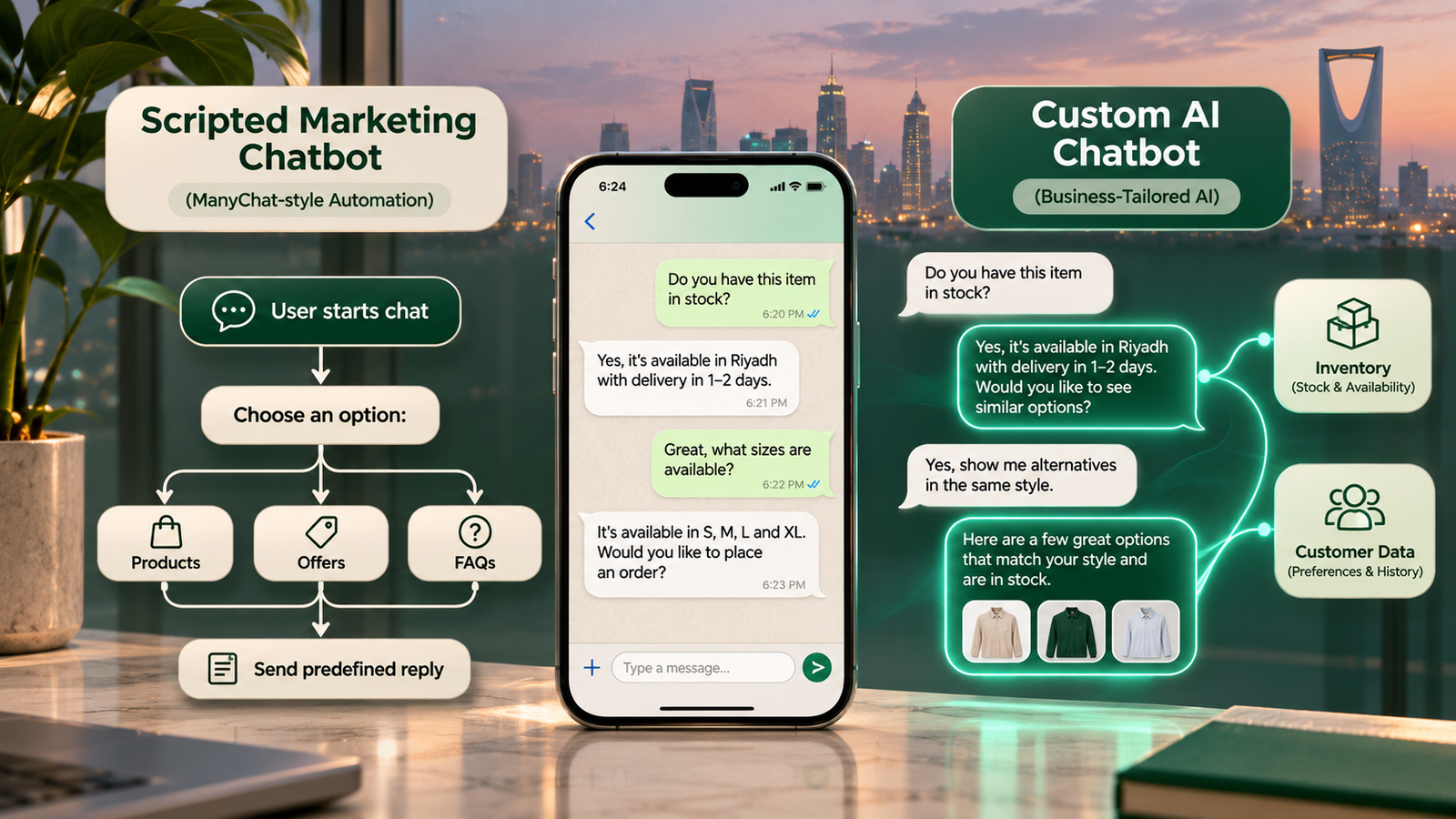
A rule-based chatbot is a bot that answers using fixed rules you write in advance: if the customer taps or types X, the bot replies with Y. It follows a decision tree, so it never says anything you didn't approve, but it also can't handle a question you didn't plan for.
Rule-based bots come in two flavours. Button bots (also called menu bots) show options and the customer taps one. Keyword bots scan the message for trigger words like "price", "location" or "order" and send the matching reply.
Either way, you design a chatbot flow: a map of every question, every branch and every reply. Most builders give you a drag-and-drop canvas where each box is a message and each arrow is a choice. If a path isn't on the map, the conversation hits a dead end.
What is an AI chatbot?
An AI chatbot is a bot that uses a large language model to understand what the customer means, however they phrase it, and writes a reply in real time. A business version answers from your own approved content (FAQs, policies, product data) and can look up live information such as an order status.
You don't map every path. You give the bot knowledge and boundaries, then test it. ChatGPT is the best-known example of the technology, but a business AI chatbot is narrower: it should answer only about your company and hand over to a person when it isn't sure.
Rule-based vs AI chatbot: side-by-side comparison
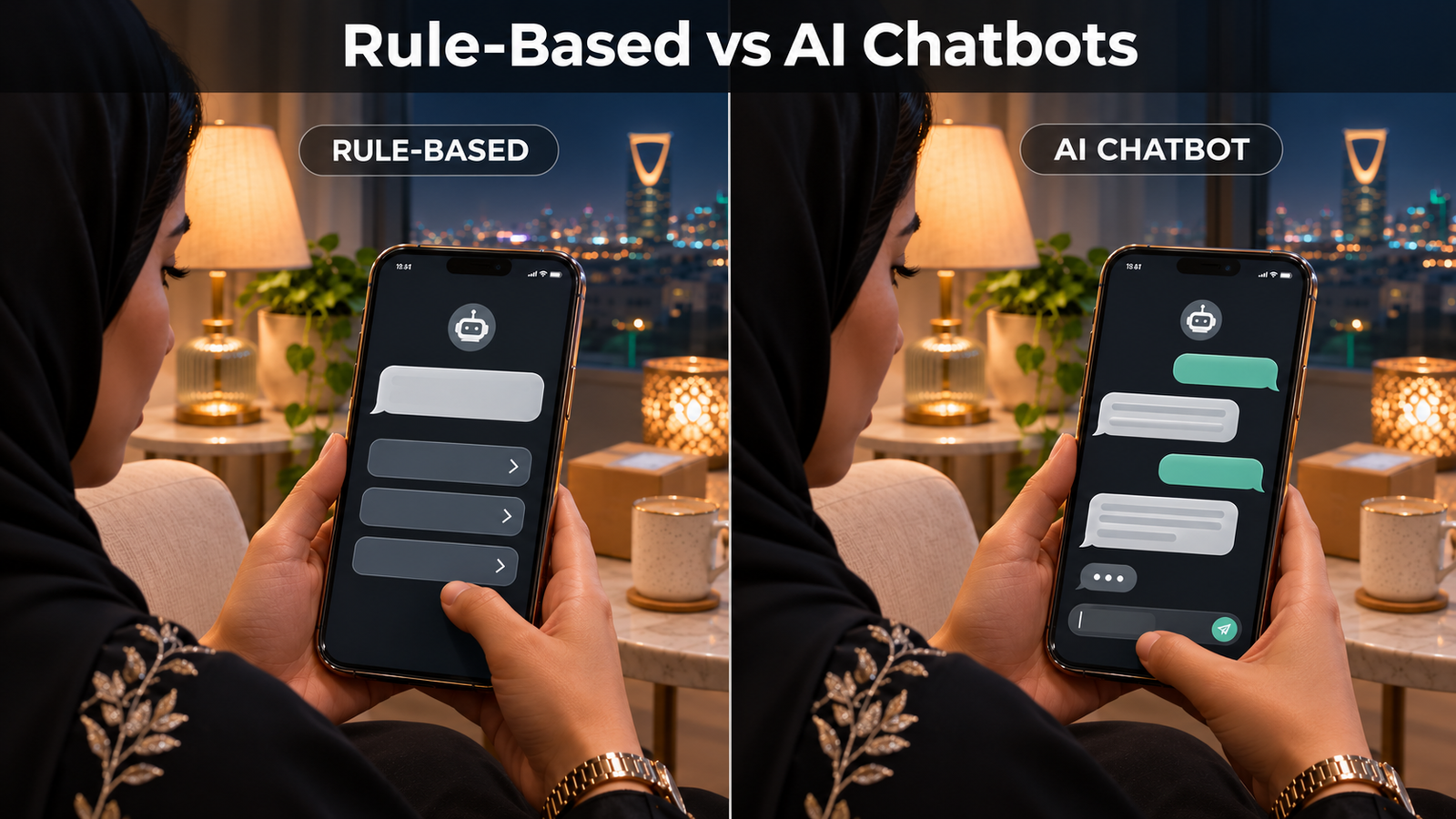
The main difference between a rule-based chatbot and an AI chatbot is how they read a message: a rule-based bot matches buttons or keywords to scripted replies, while an AI chatbot interprets intent from free text. Everything else in this table follows from that.
|
Rule-based chatbot |
AI chatbot |
|
|---|---|---|
|
How it understands |
Buttons, keywords, if-then rules |
Meaning of the whole message |
|
What the customer does |
Taps options or uses expected words |
Types normally, in their own words |
|
Arabic, dialect, Arabizi |
Every spelling needs its own rule |
Handles variations; test with real Saudi messages |
|
Accuracy of answers |
Exactly what you wrote, every time |
Usually right; can be wrong if not grounded and tested |
|
Unexpected question |
Dead end or "I didn't understand" |
Attempts an answer or hands over to a person |
|
Setup |
Fast for a few paths |
Needs content prep, rules and testing |
|
Upkeep |
A new branch for every new case |
Keep the knowledge base current |
|
Cost pattern |
Lower upfront; work grows as branches grow |
Higher setup plus usage costs per conversation |
|
Best for |
Menus, bookings, lead capture, fixed policies |
Varied questions, product advice, mixed-language chats |
Neither is "better" on its own. A rule-based chatbot wins on control. An AI chatbot wins on coverage. The rest of this guide is about which of those your customers need more.
Where each chatbot breaks with Saudi customers
Most comparisons online are written for English-only websites. In Saudi Arabia the conversation happens on WhatsApp, in dialect, often late at night. Those three facts change which bot fails first, and how.
1. Keyword rules break on Arabic, dialect and Arabizi
A keyword-based rule-based chatbot only works if the customer uses a word you predicted. Saudi customers rarely type the same question the same way. "Where is my order" can arrive as:
- وين طلبي؟ (Saudi dialect)
- أين الطلب؟ (formal Arabic)
- "wain talabi" (Arabizi, Arabic in Latin letters)
- "order wain?" (mixed Arabic and English)
- any of the above with a typo
To cover that, a keyword bot needs a rule for every variant, and you'll still miss some. A button bot avoids the problem by not letting people type, which works until a customer has a question that isn't on the menu.
An AI chatbot reads all five as the same request. The catch: language models are often strongest in formal Arabic, so test any AI bot with real messages from your own customers before you trust it.
2. WhatsApp limits how big a button menu can be
On WhatsApp, a reply-button message holds up to 3 buttons with titles of 20 characters or fewer, and a list message holds up to 10 rows in total (CM.com developer docs). That caps every screen of a button bot.
This matters because WhatsApp is where your customers are. The CST Saudi Internet 2025 report puts WhatsApp usage at 92.7%, the highest of any platform in the Kingdom. If your services need more than 10 choices, a pure button flow turns into menus inside menus, and customers drop off with every extra tap. For channel-specific setup, see our guide to a WhatsApp chatbot for business.
3. An AI chatbot can promise things you never approved
In February 2024, a tribunal in British Columbia ordered Air Canada to pay a customer CA$812.02 after its website chatbot wrongly told him he could claim a bereavement discount after booking (CBS News). The airline argued it wasn't responsible for what the bot said. The tribunal disagreed.
The lesson isn't "avoid AI". It's that answers which create a commitment should never be generated freely. Keep these as fixed text or live data from your systems:
- prices, discounts and offers
- refund, return and warranty rules
- delivery dates and order status
- anything legal, medical or financial
This matches the direction of Saudi guidance. SDAIA's AI Ethics Principles (September 2023) and its Generative AI Guidelines (January 2024) both stress reliability, transparency and accountability for AI systems. Telling customers they're chatting with a bot, and giving them a way to reach a person, is a sensible baseline.
4. Your busiest hours are when your team is offline
The same CST report found internet use in Saudi Arabia peaks between 9 pm and 11 pm, and Friday is the busiest day. Either bot type can answer at those hours. The real question is whether your night-time questions are predictable enough for a script, or varied enough that a script will leave people stuck until morning.
When is a simple rule-based chatbot enough?
A simple rule-based chatbot is enough when a handful of question types make up most of your chats, the answers are the same for every customer, and getting an answer slightly wrong would cost you money or trust. In that case, a button bot is cheaper, faster to launch and fully predictable.
Typical fits:
- Clinics and salons: book, reschedule or cancel an appointment.
- Training centres: course list, next start dates, how to register.
- Lead capture: collect name, city, service and budget, then pass to sales.
- Restaurants and cafés: menu, branch locations, opening hours.
- Fixed policies: return windows, warranty terms, payment methods.
When do you need an AI chatbot?
You need an AI chatbot when customers ask the same thing in many different ways, mix Arabic and English, or ask questions you can't list in advance. It also makes sense once your button flow has grown so many branches that nobody on your team wants to maintain it.
Typical fits:
- E-commerce: product questions like "does this come in black and fit a 13-inch laptop?"
- B2B and technical services: detailed questions about specs, scope or compatibility.
- High volume: hundreds of chats a day with a long tail of unique questions.
- Support that needs context: the customer explains a problem across several messages.
If that sounds like your inbox, a customer service chatbot setup built on your own content is usually the next step.
The 50-chat test: decide with your own data
You don't have to guess. Your WhatsApp history already tells you which bot you need. Here is the test we use when scoping a chatbot:
- Export your last 50 customer chats from WhatsApp Business (or 100 if you get a lot of traffic).
- Write down the first real question in each chat, ignoring greetings.
- Group them into types: price, location, order status, booking, product question, complaint and so on.
- Count how many chats your top 10 types cover. Ten is the most a single WhatsApp list can show.
- Mark which answers change per customer (order status, stock, account details) and which are the same for everyone.
How to read the result:
|
What you found |
What to build |
|---|---|
|
Top 10 types cover almost all chats, answers are the same for everyone |
Rule-based chatbot |
|
Top 10 types cover most chats, but some need live data |
Rule-based flow connected to your systems |
|
Many one-off questions, lots of free typing, mixed languages |
AI chatbot with human handoff |
|
A clear core of repeat questions plus a long tail |
Hybrid chatbot (next section) |
This is a rule of thumb, not a formula. But it turns a vague "which is better?" into a decision based on what your customers actually send.
The hybrid chatbot: rules where you need control, AI where you need range
A hybrid chatbot uses fixed rules for the questions where answers must be exact, uses AI for open questions, and hands complex or sensitive cases to a person. For most Saudi businesses on WhatsApp, this is the setup that balances control and coverage.
Here is a hybrid chatbot flow for an online store, ready to adapt:
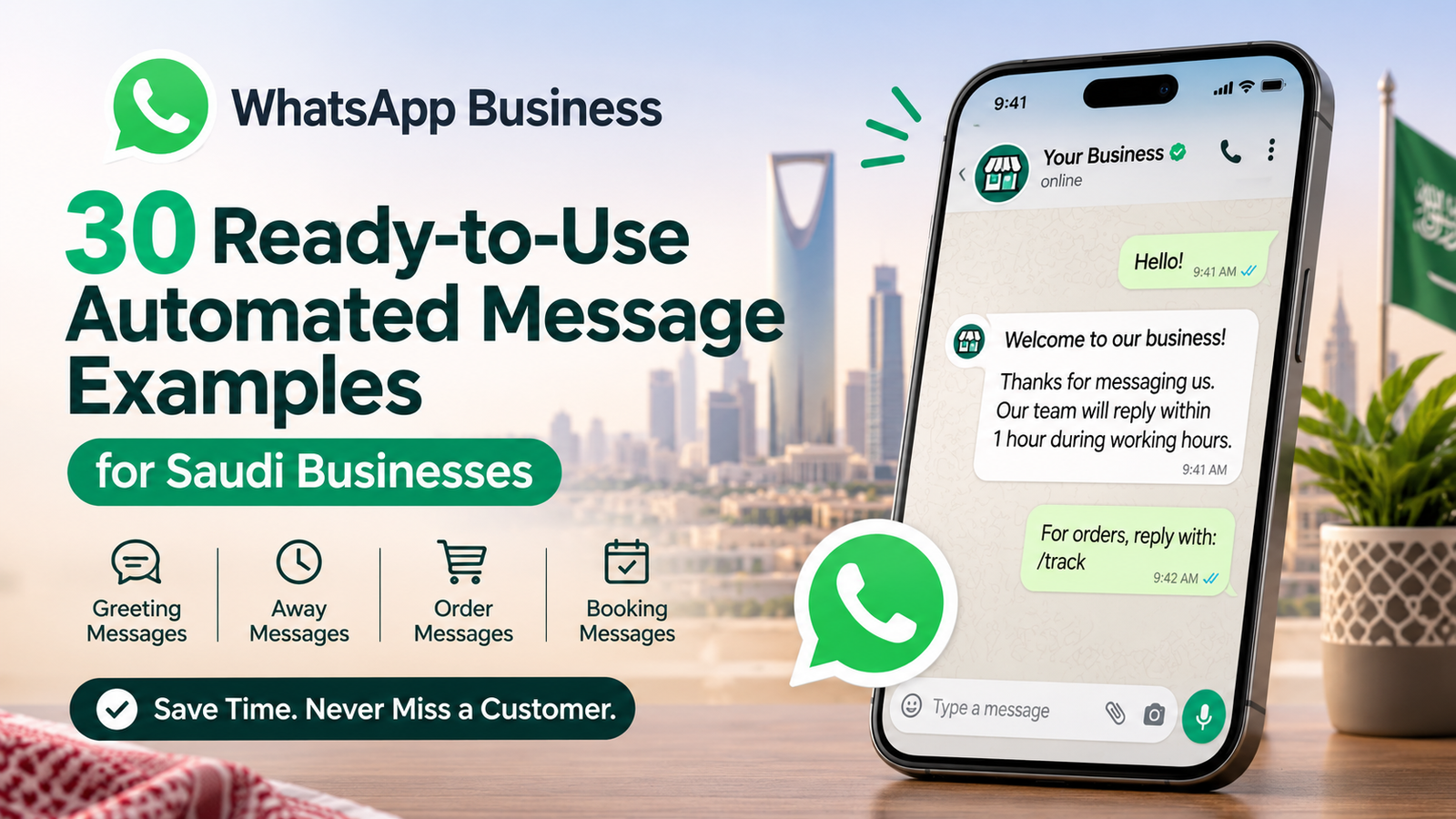
- Greeting with three buttons: Track my order · Returns · Ask a question. Short titles keep you inside WhatsApp's 20-character limit. Pair it with clear greeting and away messages so night-time customers know what to expect.
- Track my order (rules + live data): the bot asks for the order number and pulls the status straight from your store or ERP system. The reply is a fixed template, so it never guesses a delivery date.
- Returns (rules): a list message with return reasons, then your exact policy text and the next step.
- Ask a question (AI): the customer types freely, in Arabic or English. The AI answers only from your approved product and policy content.
- Handoff (human): refunds, complaints, payment issues, or any chat where the AI isn't confident go to your team, with a short summary so the customer doesn't repeat themselves.
Notice what this does. Every answer that carries a promise (order status, return rules) stays in the rule-based part. AI only handles the open questions a script could never cover. And a person is always one step away.
The same pattern works outside retail. A clinic can keep booking on buttons and let AI answer "do you treat X?" A training centre can keep registration on rules and let AI explain which course fits a learner's background.
Frequently asked questions
What is a rule-based chatbot?
A rule-based chatbot is a bot that replies using predefined rules, buttons or keywords set up in advance. It follows a fixed decision tree, so its answers are predictable but it cannot handle questions outside its script.
What is the difference between a rule-based chatbot and an AI chatbot?
A rule-based chatbot matches buttons or keywords to scripted replies, while an AI chatbot understands free-text messages and writes answers in real time. Rule-based bots offer more control; AI chatbots cover more questions.
Is ChatGPT a rule-based chatbot?
No, ChatGPT is not a rule-based chatbot; it is a generative AI chatbot built on a large language model trained on large amounts of text. It writes new replies instead of choosing from a fixed script.
Which is better, an AI chatbot or a rule-based chatbot?
Neither is better in every case: a rule-based chatbot suits predictable questions with exact answers, and an AI chatbot suits varied, free-typed questions. Many businesses get the best results from a hybrid of both.
Are rule-based chatbots obsolete?
No, rule-based chatbots are not obsolete, because bookings, lead capture and fixed policies still work best with predictable scripted answers. They are increasingly used alongside AI rather than replaced by it.
How long does it take to set up a chatbot?
A simple rule-based chatbot with a few paths can go live in hours to days, while an AI chatbot usually takes weeks to prepare content, configure and test. Timelines grow with integrations and languages.
Not sure which one fits? Start with your chats
Run the 50-chat test above. If the answer is clear, you'll know whether a simple button bot will do or whether you need AI. If it comes out somewhere in between, a hybrid setup is usually the answer.
At Intellitech Solutions, we build chatbots around real customer conversations, connect them to the systems that hold your answers, and keep the commitments (prices, policies, order status) on fixed rules. See how we handle AI chatbot development in Saudi Arabia, or talk to our chatbot team and bring your chat export with you.