Arabic AI Chatbot for Business: Features & Top Options
10 min read
On this page
- What is an Arabic chatbot?
- Why most chatbots struggle with Saudi Arabic
- MSA vs how people actually type
- Saudi Arabia isn't one dialect
- Arabic and English in one message
- Right-to-left layout
- Tone matters
- Features to look for in an Arabic chatbot
- Top Arabic chatbot options for Saudi businesses
- How to test a chatbot's Arabic before you buy
- Off-the-shelf platform or custom AI chatbot?
- Data, privacy and PDPL
- Frequently asked questions
- What is an Arabic chatbot?
- How can a business use an Arabic chatbot?
- Do Arabic chatbots understand the Saudi dialect?
- Which is the best AI chatbot for Arabic?
- How much does an Arabic chatbot cost?
- Build an Arabic chatbot that understands your customers
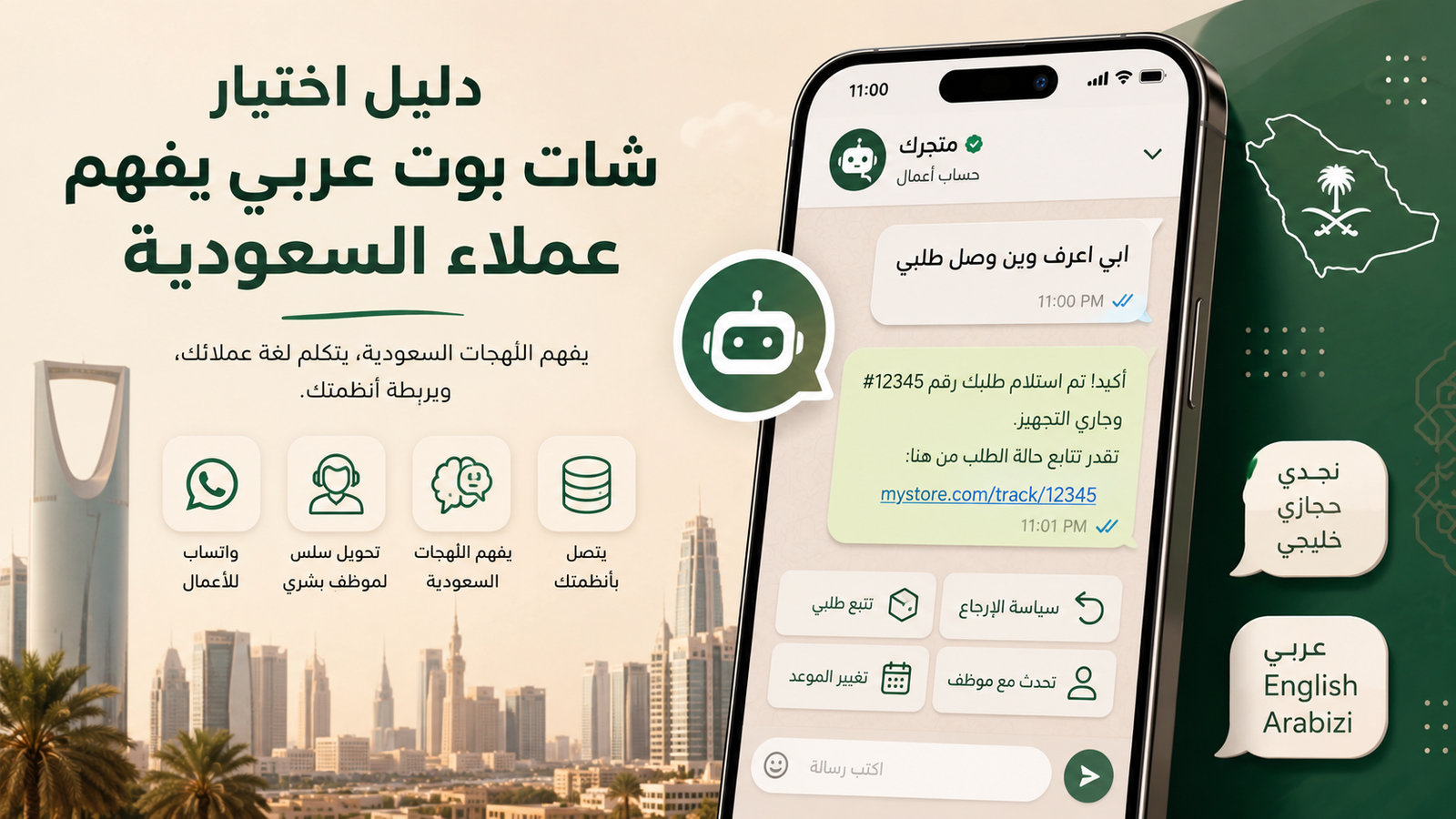
A customer in Riyadh messages your WhatsApp at 11 pm: "ابي اعرف وين وصل طلبي" (I want to know where my order is). Your chatbot replies with a formal paragraph about your shipping policy. The customer gives up and calls in the morning, annoyed.
The bot technically "speaks Arabic". It just doesn't understand how Saudi customers actually write.
Quick note before we start: if you're looking for a free Arabic AI chat app for yourself, Saudi Arabia's own HUMAIN Chat, launched in Riyadh in August 2025, supports Modern Standard Arabic plus 26 local and regional dialects. This guide is for businesses that want an Arabic chatbot talking to their customers, and for that, the bar is much higher. If that's you, and you want one built around your own customers, see our AI chatbot development in Saudi Arabia.
What is an Arabic chatbot?
An Arabic chatbot is software that understands customer messages written in Arabic and replies in Arabic, usually on WhatsApp, a website, a mobile app or Instagram. A good one handles Saudi dialects and mixed Arabic-English messages, not just formal Modern Standard Arabic, and hands the chat to a human when it should.
Saudi businesses use them to:
- Answer repeat questions on prices, branches, timings and policies
- Track orders, bookings and delivery status
- Qualify leads before a salesperson calls
- Book and reschedule appointments
- Collect complaints and route them to the right team, with the full chat attached
Why most chatbots struggle with Saudi Arabic
Most chatbots are trained on formal Modern Standard Arabic (MSA), but Saudi customers write in dialect, mix in English, and sometimes type Arabic in Latin letters. A bot that only knows MSA will miss the intent of everyday messages even though every word is "Arabic".
MSA vs how people actually type
MSA is the Arabic of news, contracts and government letters. Your customers rarely write like that on WhatsApp. They write the way they talk.
Saudi Arabia isn't one dialect
The Kingdom has several major dialect groups. Najdi Arabic dominates central regions around Riyadh, Hejazi is common in the west including Jeddah and Makkah, and Gulf (Khaleeji) Arabic is heard along the eastern coast. The same question can look quite different:
|
Customer writes |
Style |
Meaning |
|---|---|---|
|
ابي اعرف وين وصل طلبي |
Najdi / Gulf |
I want to know where my order is |
|
فين الطلب حقي؟ |
Hejazi |
Where's my order? |
|
أين وصل طلبي؟ |
MSA |
Where has my order reached? |
|
ممكن تسوي لي refund؟ |
Arabic + English |
Can you do a refund for me? |
|
abi a8ayer almaw3ed |
Arabizi (Latin letters) |
I want to change the appointment |
A bot trained only on the MSA line will often fail the other four, and those four are what your inbox actually looks like.
Arabic and English in one message
Mixing languages is normal in Saudi business chat, especially for product names, payment terms and tech words. The bot must treat "refund", "invoice" or "tracking number" inside an Arabic sentence as part of the same request, not as an error.
Right-to-left layout
Arabic runs right to left, while numbers and English words inside it run left to right. Weak platforms break this: buttons flip the wrong way, prices jump to the wrong side, order numbers scramble. Your customers notice instantly.
Tone matters
A bank or government-facing service usually needs polite, near-formal Arabic. A café or fashion brand can sound relaxed and local. The bot's tone tells customers whether you actually know them.
Features to look for in an Arabic chatbot
The must-haves are dialect understanding, an Arabic knowledge base written the way customers ask, WhatsApp support, smooth handover to a human, and a connection to your own systems. Everything else is a bonus.
|
Feature |
Why it matters |
Ask the vendor |
|---|---|---|
|
Saudi dialect understanding |
Most real messages are in dialect, not MSA |
"Show me it handling five of our real messages." |
|
Arabic knowledge base |
The bot answers from your content; MSA-only content matches dialect questions badly |
"Can we write answers in casual Saudi Arabic?" |
|
WhatsApp Business API |
It's where most Saudi customers already message you |
"Is WhatsApp official API included or extra?" |
|
Human handover with context |
Angry or complex chats must reach a person fast, without the customer repeating themselves |
"What does my agent see when a chat is handed over?" |
|
Connection to your systems |
"Where's my order?" needs live data from your ERP, CRM or order system, not a canned reply |
"Can it read order status from our system?" |
|
Correct RTL on every channel |
Broken layout looks unprofessional |
"Can I test it on WhatsApp, mobile web and desktop?" |
|
Arabic analytics |
You need to see which questions fail, in Arabic |
"Can I export failed questions?" |
|
Data hosting and access |
Customer chats contain personal data |
"Where is chat data stored, and who can read it?" |
If the bot will be your main customer channel, look closely at the WhatsApp chatbot side first [add link when live]. And if your answers live in an ERP, that connection is where an ERP system in Saudi Arabia and a chatbot start paying off together.
Top Arabic chatbot options for Saudi businesses
There is no single best Arabic chatbot; the right one depends on your main channel and where your answers live. No-code platforms suit FAQ and lead bots, Saudi-built tools lean harder into local dialect, and a custom build suits bots that must pull live data from your own systems.
|
Option |
Based |
Best for |
Arabic capability (as the vendor describes it) |
Main channels |
|---|---|---|---|---|
|
Kommunicate |
Global |
No-code customer service bots |
Arabic support bots without code; connects to Zendesk and Salesforce |
Website, app, WhatsApp |
|
Thinkstack |
Global |
Training a bot on your own Arabic documents |
Learns from your Arabic web pages, PDFs and spreadsheets; detects the user's language |
Website, integrations |
|
WotNot |
Global |
Teams that want setup done for them |
Managed setup tuned to your market and dialect |
WhatsApp, web, social |
|
ChatDaddy |
Global, Meta partner |
WhatsApp-first businesses |
RTL rendering in buttons and lists; MSA plus Gulf dialect |
|
|
Thikaa |
Regional |
Salla e-commerce stores |
Saudi, Egyptian, Gulf and Levantine dialects |
Salla stores |
|
Hudhud |
Saudi (Riyadh) |
No-code bots with a Saudi dialect focus |
Arabic NLP built around the Saudi dialect |
Social media, WhatsApp |
|
Custom AI chatbot |
Built for you |
Bots that must answer from your ERP, CRM or order data |
Tuned on your own customers' real messages |
Any channel you choose |
Capabilities are as stated on each vendor's own materials in November 2026. Test every one with your own messages before you sign; the next section shows how.
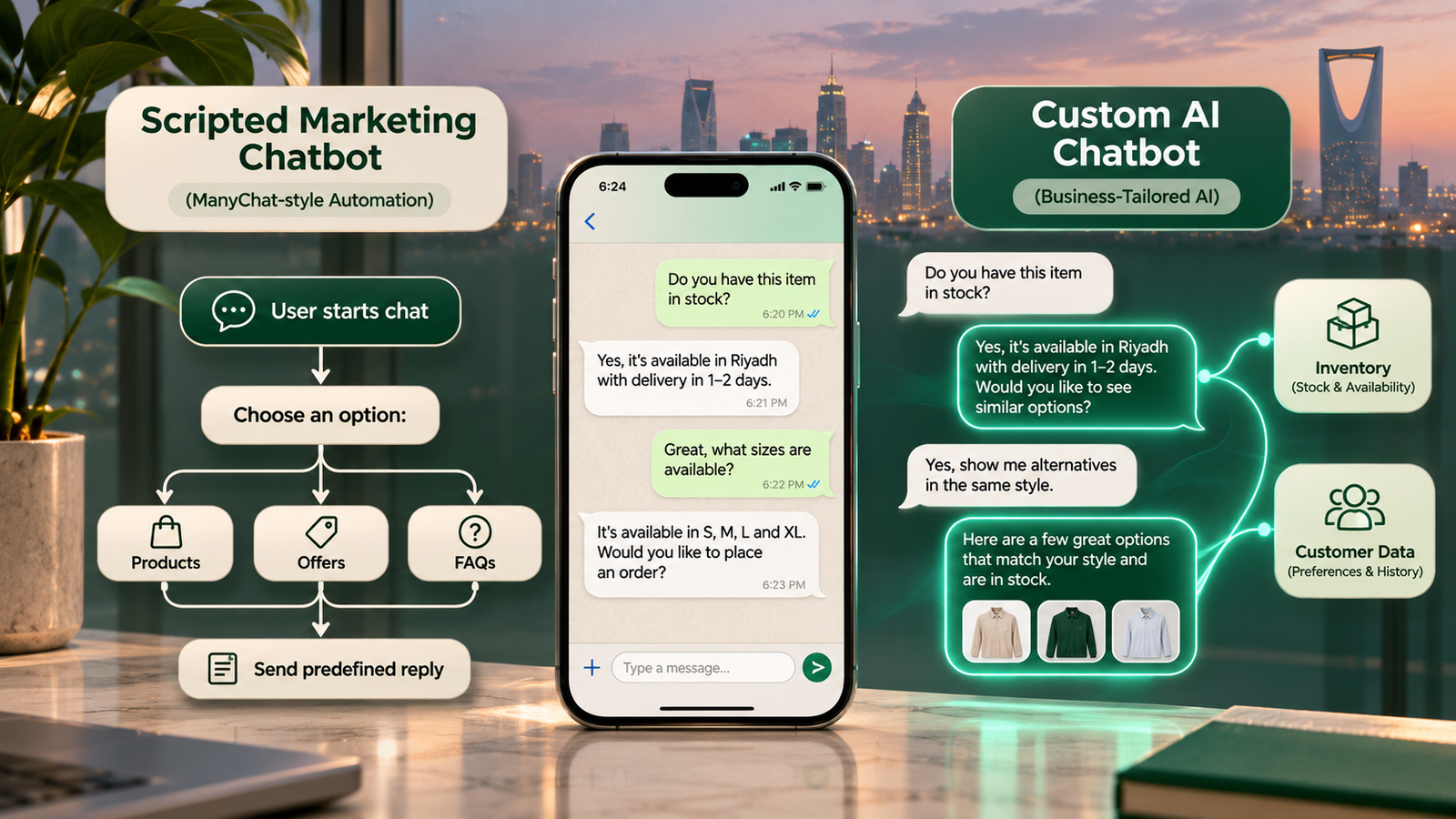
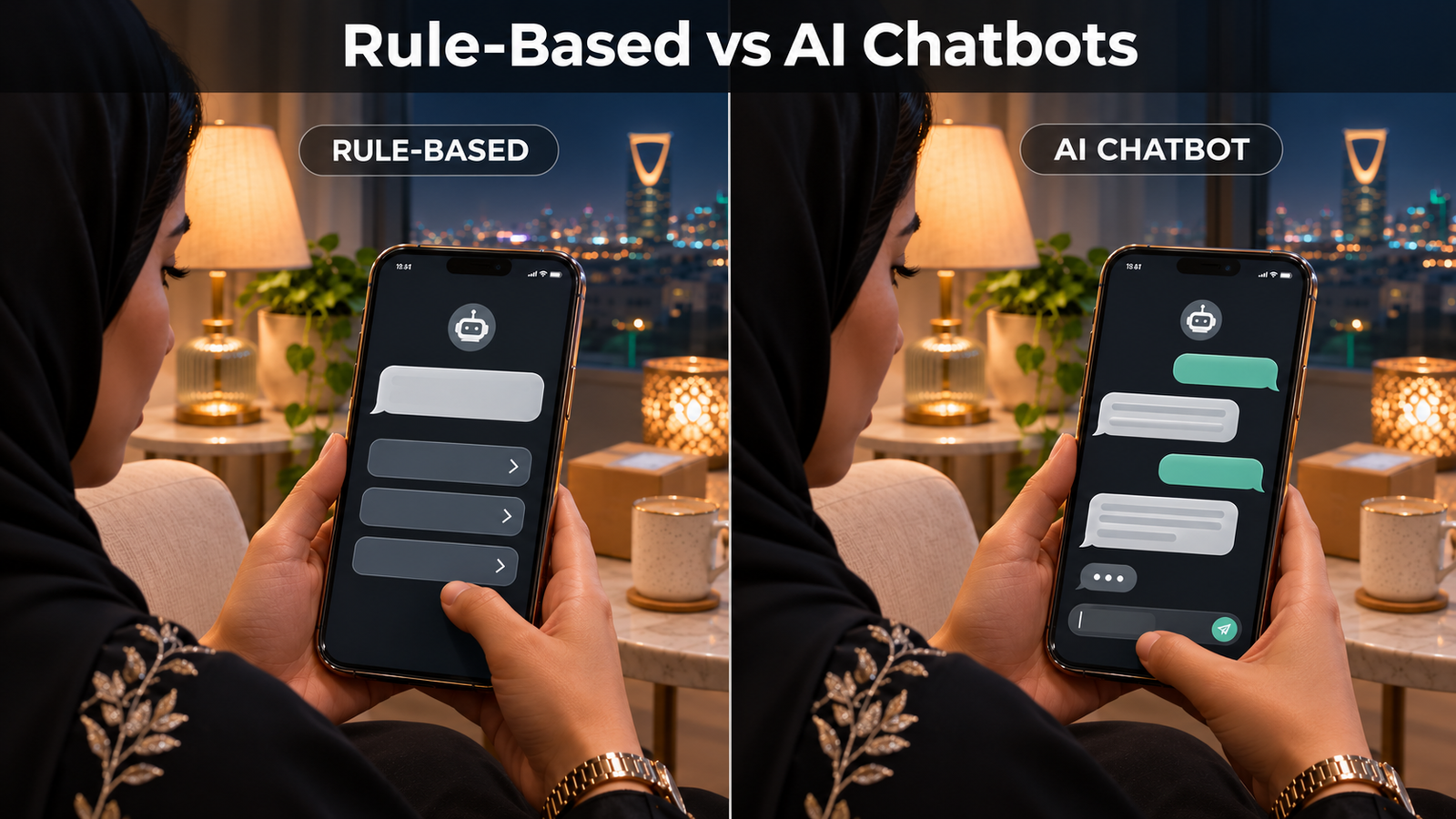
Two patterns stand out. First, every platform claims Arabic, but only some claim dialect, and fewer still name Saudi dialects specifically. Second, almost all of them answer from content you upload. If your customers mostly ask about live things (order status, balances, bookings), you'll need an integration or a custom build either way. Deciding between a scripted rule-based or AI chatbot [add link when live] is a separate choice worth making first.
How to test a chatbot's Arabic before you buy
Pull 20 real messages from your WhatsApp or support inbox, run them through each shortlisted bot, and score how many it understands correctly. This takes under an hour and tells you more than any sales demo, because demos are always run in clean, formal Arabic.
Build your test set from these six types, using your customers' actual words:
|
Message type |
How many |
Example |
Pass if the bot... |
|---|---|---|---|
|
Saudi dialect |
5 |
ابي اعرف وين وصل طلبي |
Recognises it as an order-status question |
|
Arabic + English mix |
4 |
ممكن تسوي لي refund؟ |
Starts the refund flow |
|
Arabizi (Latin letters) |
3 |
abi a8ayer almaw3ed |
Opens rescheduling |
|
Typos and no punctuation |
3 |
Short, misspelled, voice-note-style text |
Still finds the intent or asks a sensible follow-up |
|
Formal MSA |
3 |
A formal complaint |
Replies politely in matching tone |
|
"Let me talk to someone" |
2 |
Any version of "I want a person" |
Hands over fast, with the chat history |
Score each bot out of 20:
- 16 or more: ready for your customers.
- 11 to 15: usable for FAQs, but plan to train it on your own phrasing before launch.
- 10 or fewer: the Arabic engine isn't ready for your market. Keep looking.
While you test, open the bot on WhatsApp, mobile web and desktop and check that Arabic text, numbers and buttons display correctly on all three. Any vendor who won't let you run a test like this before signing is telling you something.
Off-the-shelf platform or custom AI chatbot?
Use a no-code platform when most questions can be answered from content you already have. Choose a custom AI chatbot when the bot must read live data from your own systems, follow complex workflows, or keep chat data under your full control.
|
No-code platform |
Custom AI chatbot |
|
|---|---|---|
|
Best for |
FAQs, lead capture, simple bookings |
Order status, account questions, multi-step workflows |
|
Time to launch |
Days to a few weeks |
Several weeks, depending on integrations |
|
Upfront cost |
Low; monthly subscription |
Higher; a build project plus upkeep |
|
Dialect tuning |
Limited to what the platform supports |
Trained and tested on your own customers' messages |
|
Connects to your ERP or CRM |
Often through extra connectors, if at all |
Built in from the start |
|
Data control |
Stored where the platform hosts it |
You choose hosting and access |
A common path is to start on a platform for FAQs, learn what customers really ask, then move the high-value questions to a custom AI chatbot once you know they're worth it. If the bot is part of a larger portal or app, it can also be built as part of your custom web application.
Data, privacy and PDPL
Chat logs hold names, phone numbers, order details and sometimes ID or payment questions, so they count as personal data under Saudi Arabia's Personal Data Protection Law (PDPL). The Saudi Data and AI Authority (SDAIA) has fully enforced PDPL since 14 September 2024, and transfers of personal data outside the Kingdom follow their own rules (Clyde & Co summary).
Before you choose a chatbot, get three answers in writing: where chat data is stored, who can access it, and how long it's kept. Banks, healthcare and government projects usually face stricter rules on top.
General guidance only, not legal advice.
Frequently asked questions
What is an Arabic chatbot?
An Arabic chatbot is software that understands customer messages in Arabic and replies in Arabic on channels like WhatsApp, websites and apps. The best ones handle Saudi dialects and mixed Arabic-English, not just formal Arabic.
How can a business use an Arabic chatbot?
Businesses use Arabic chatbots to answer repeat questions, track orders, book appointments, qualify leads and route complaints, usually starting on WhatsApp. The bot handles routine chats so staff can focus on complex ones.
Do Arabic chatbots understand the Saudi dialect?
Some do, but many are strongest in formal Arabic, and Saudi dialect support varies widely between platforms. Test any bot with 20 of your own customers' real messages before you buy.
Which is the best AI chatbot for Arabic?
There is no single best Arabic chatbot: no-code platforms suit FAQ bots, Saudi-built tools lean into local dialect, and custom bots suit live-data questions. Pick based on your main channel and where your answers live.
How much does an Arabic chatbot cost?
Cost depends on the route: no-code platforms charge a monthly subscription, while a custom AI chatbot is a build project plus ongoing upkeep. WhatsApp Business API conversations also carry Meta's messaging fees on top.
Build an Arabic chatbot that understands your customers
Your customers already tell you, every day, how they ask questions. The right Arabic chatbot is built from those messages, not from a translated FAQ page.
At Intellitech, we design chatbots around your real WhatsApp and support conversations, test them against Saudi dialect and mixed-language messages, and connect them to the systems that hold your answers. Explore how we build an Arabic chatbot with you, or talk to our chatbot team about your channel and use case.